Weird Studies/Murakami & Borges
29 Mar 2026 - 18 Apr 2026
- The Murakami story Cream
- Ref to Technic and Magic. A labyrynth, because there is a plan that is hidden (from both reader and protagonist)
- The circle whose center is everywhere, whose circumference is everywhere (Nicolas de Cusa), Borges attributes to Hermes Trismegistus.
- Ask Claude
- In "Cream", the young narrator is told by an older man about a circle with a single center and no circumference — which the man frames as a kind of paradox or koan.
- The formulation you're citing — "a sphere whose center is everywhere and whose circumference is nowhere" — has a genuinely tangled attribution history:
- It appears in Nicholas of Cusa (De Docta Ignorantia, 1440)
- But it was also attributed to a lost Hermetic text (Liber XXIV Philosophorum)
- Pascal used a version of it
- Borges — notably in "Pascal's Sphere" — traces this history and notes the attribution to Hermes Trismegistus, while being characteristically precise about the uncertainty of the lineage
- Murakami was deeply influenced by Borges, and the riddle in "Cream" feels very much in that Borgesian mode — a philosophical image that is also somehow emotionally devastating, about how one holds meaning (or the absence of it) in mind.
- Borges story
- Ethan Weed A Labyrinth of Symbols: Exploring 'The Garden of Forking Paths'. A theory of labyrinthine texts (hm how does this relate to hypertext? Is that too literal? )
Borges’ stories have a strange capacity to infiltrate what we call reality, much like the world of Tlön, a labyrinth “devised by men […] destined to be deciphered by men”
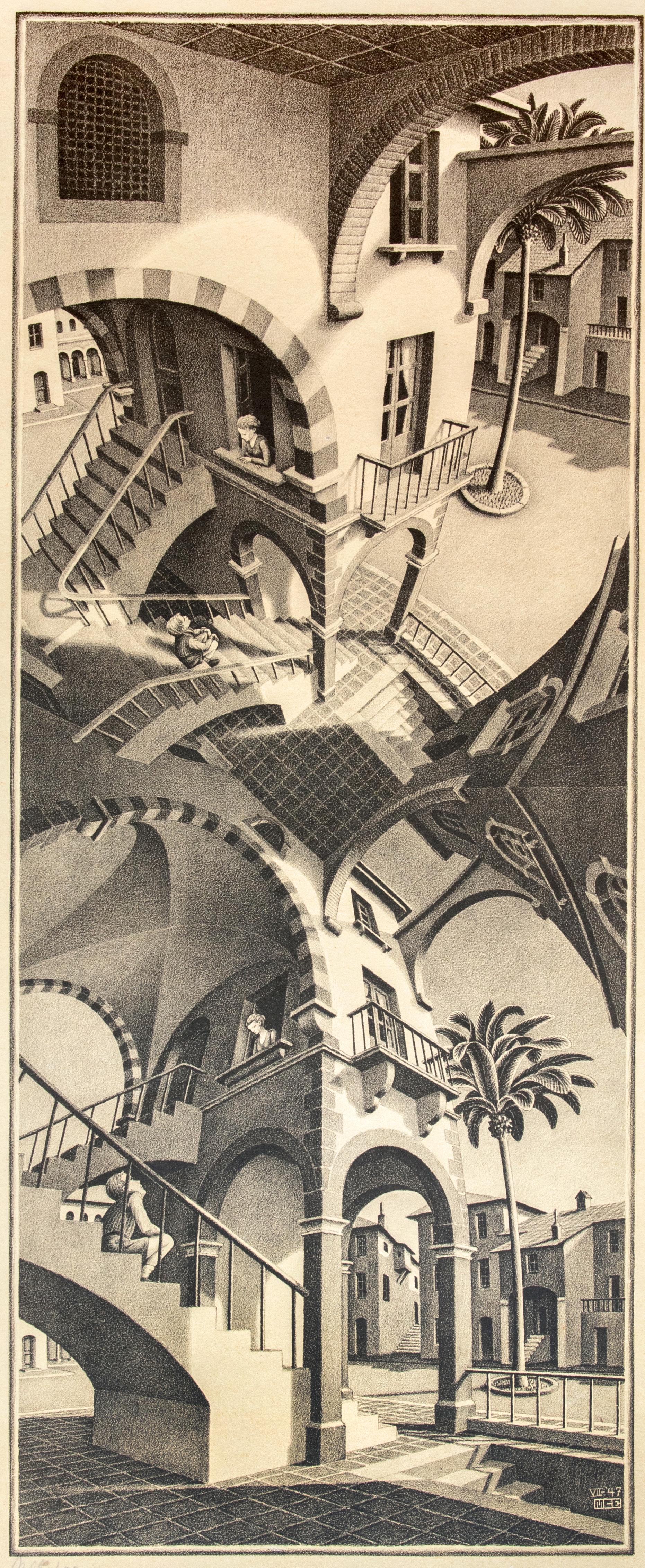
A labyrinthine story does not present a puzzle to be solved, but rather a puzzle to not be solved.
- Borges Circular Ruins also fits this pattern of repitition.
- Wilson, Robert Rawdon. ”Godgames and Labyrinths: The Logic of Entrapment”. Mosaic. 15:4 (1982): 1-22
- End of Twin Peaks, Cooper realizes he is in a labyrinth. Lost Highway even more so.
- The crystalline moments (yes). Things happen only in the present.
- Contingency and necessity. (I hate this trope)
- Leibniz and the best of all possible worlds. Deleuze disagreed.
- What is a world where divination makes sense. Jodo, wouldn't make sense in a deterministic world (?)
I am absolutely opposed to reading hypothetical futures.
- Apr 17th, 2026 actually read the Murukami story, which is very strange in a quiet unsettling way.