About
Search
Page Tree
Incoming links
from Weird Studies/Courses/Twin Peaks
Sesh 1: Zen, or the Art to Catch a Killer (S1E3)
- My texts:
- What is the sound of a silent drape runner?
- Red room evokes more a nightmare version of 50s decor, which at least is usually homey. Red room suggests the opposite of a place.
- Rape, murder, incest, abuse. Nothing else has taken on these topics so directly and effectively.
Sesh 2: Beyond Life and Death (last ep of S2)
- now listening to class. Corbin coined term "imaginal"; imaginal world is in between platonic forms and material reality (?)
- The flashlight in the woods: you can see any part of reality, but never the whole, which is unseeable, unnameable
- Annie's psalm
- Andy is only person who goes into the lodge and emerges unscathed
- JFM confessing to "manicheasm" or moral dualism, but the White Lodge and Black Lodge are "one and the same".
- Laura's moves at the climax were channeling Bob, funny they didn't mention.
- Nadine's drapes and the red room, and the engine oil
- Coopers white-night self, and his shadow side.
- JFM: since there is no spatial extension in the imaginal realm, a monster and its cave or horde are one and the same.
- Notable how Cooper's manner at the end (when he is inhabited by Bob) resembles Mr C from S3. The special horror his laughter at "How's Annie?" – like, expressing concern for another human being is the most ridiculous thing ever.
Sesh 3: Fire Walk With Me
- tv static ≡ s3e8 nuclear stuff
- JFM: Lil means that Deer Meadow is not taking place in our reality
- Cole and coded communication
- Deer Meadow as satanic inversion of Twin Peaks...black lodge has it infested.
- Cable (name of Deer Meadow sherrif) suggests electricity.
- PF: noticed the deadness of the dead body.
- HDS "I've already been places"
- Nathan: Lil – Sumerian wind goddess – uncle theme – Lacanian
- Jacob Mullis – Laura is the one.
- Noir has no heroes.
Sesh 4: Gotta Light?
- PF: Some artworks are just weirndess generators (Valis, Twin Peaks, Parsifal)
- JFM: all the little haunted technologies (electricity, formica table) represent the return of the banished spirits in the modern world. He says, the problem is we aren't modern enough, we haven't realized the consequences of modernity, and I think I agree with him there? We need to see the other side of our own episteme.
- Brakhage obvious influence on atom bomb sequence
- JFM: Twin Peaks is where the real world invades fiction, TP as magical working, a hyperstition or hypersigil.
from Weird Studies/Courses/AI
Week 1
Reading: Emma Stamm, The Digital Image of Thought
- Deleuzian. Different "images of thought" (Plato, Heidegger, Descartes). OK. Thinking of Minsky and SOM as another.
- Plane and image are both background (?) but different:
- > Neither plane nor image present themselves positively in thought. They are distinguished from one another by their effects: whereas the image of thought preestablishes the range of thought’s positive andrecognizable forms, the plane of immanence serves as thought’s container and connective tissue.
According to Arkady Plotnitsky, images of thought realize themselves in scientific processes. His essay “The Image of Thought and the Sciences of the Brain” describes their influence on the disciplines of neuroscience, psychiatry, and psychology (Plotnitsky 2010).
- OK, then goes into the "digital image". My first reaction (before reading the piece) is that this isn't quite right because digital is a technology, not a substrate, and it permits a wide variety of different forms of "thought". It's akin to typography perhaps, or electronics, but even more variable.
- Esthetics of discreteness. This sounded like promising BS to me... Stiegler, Galloway, Tinnell. "to digitize is to atomize and, in so doing, ineradicably alter the subject of digitization". Well all representation does that. This reminds me of the vinyl-vs-cd wars.
- McQuillan on data science.
Locating truth as exterior to the subject, data science and Platonic thought both treat the vagaries of human interpretation as a barrier to their object. Per McQuillan’s argument, data science reinforces the Platonic vision which unites truth with totality, objectivity, and goodness, and discounts the value of the subjective and particular.
- Well yeah that is how science works (not just data science), but it doesn't necessarily mean devaluing the subjective for purposes outside of science. Also seems wrong, data science is not about totality and objectivity except as limit points -- you are always aware of the insufficiency of data to capture all of reality.
- Section . Representativeness and difference in itself
- ??? totally lost here, sorry
The digital mandate to representation seals off all terra incognita.
- No it does not. Wrong. Level of abstraction mistake. Same arguments made against writing or alphabetization.
Because the digital image of thought idealizes representation, it heeds no limit to that which may be reconstructed in digital and mental formats.
- Hm I do not understand what she is saying. Digital thought does indeed "idealize representation", that doesn't make it limitless, on the contrary, the theory of computation puts hard limits on what can be represented.
Its effect on thinking may be likened to the infinite scroll, a web design technique which automates the renewal of content as one navigates across a website or application. The infinite scroll presents figures at an instantaneous pace that preempts the mental production of difference in itself. The thinker always remains within the remit of its offerings, which is to say that they cannot help but acknowledge its endless procession of prefabricated forms. The image’s relative infinity is taken as absolute, as no lines of flight are available to carry the thinker away. Computers “think” or yield information in this manner, as their outputs are indelibly linked (however contingently) with inputs.
- Alright I'm going to call BS on this, at least the last part, that stuff about inputs and outputs is just nonsense. The rest...well, I want to say, infinite scroll is not a property of "the digital", it's a particular UI design used by capitalist enterprises to achieve capitalist ends. .
- Realizing something, that for most people "the digital" means "the internet from 1995 or so". That's what they grew up with, the consumer internet, not the science machines in university laboratories. I'm a relic of an earlier era.
- cites Psychopolitics by BCH really should read that, although sounds like I might hate it for these broad generalizations about "the digital".
- Some stuff on the materiality of computation which, yeah, OK.
- Going to tear into these 2 pgraphs:
These features have made digital information valuable in every conceivable sense. Digital capitalism is at least as dependent on the material world as the economic systems that predates it.
- Yes, but not news
When data are able to move quickly, accumulate without measurable limit, and take on seemingly endless guises, they are ideally equipped to contribute to an economic system which presupposes limitless expansibility.
- The characteristics of the digital are indeed of economic value but I don't know what "presupposes limitless expansibility" means. There's the general problem of capitalism and the digital fits into it quite naturally, I guess.
Their speed and modularity, which accounts for their economic value, is an effect of their immutable structure. In computer systems, this structure functions as a template for information processing. As an image of thought, it delimits mental activities in compliance with the technical requirements of computability.
- OK what the fuck is this saying? Digital data does have structure, although it isn't more or less mutable than anything else. And yes computer systems take advantage of this structure (you could say something even stronger; they create and maintain this structure, that is kind of what they are for). But "as an image of thought, it delimits mental activity" is BS, sorry. Computation may or may not be a good model for thought but it doesn't "delimit" anything (I think, I am not sure what "delimiting" means, but it sounds like "limits").
The relationship between the rigidity of data and the malleability of digital media may appear as a paradox.
- Entirely self-constructed, there is really no mystery about the nature of digital media, no dark secrets or paradoxes.
Yet the conceivable breadth of digital outputs does not exceed that of pen, paper, and other analog means of production. What distinguishes the digital from the analog is not the former’s range of expression, but the extent to which it is taken as a faithful bearer of the real.
- Analog photography had this problem, it was too real and upset art people. Somehow we survived.
Computers are granted the capacity for verisimilitude by the structural inflexibility of the datum.
- Say what?
As a precursor to human thought, the digital image would endow minds with the ability to function as virtually inexhaustible wellsprings of concepts. The currency of these conceptual outputs accords with the degree to which they accurately capture the external world, and their valorization transforms thinking minds into workers par excellence.
- Wait the digital image is a precursor to human thought? What can this mean. The notion that accuracy turns us all into robot slaves seems wrong. I guess what she is against is not computation but objectivist epistemologies? I'm OK with that, but also that computers are guilty of promoting them? Not quite as down with that part.
- From the conclusion:
To characterize machines as “intelligent” is to conceal those aspects of mentality which cannot be translated into economic value. My presentation of the digital image of thought mobilizes Deleuze and Guattari against this campaign of obfuscation.
- Alright, well, that's clear enough at least. But it confuses the materiality of machines with their economic roles. An understandable confusion but one I reject.
The fact that [Turing's] prediction has proven true does not render the figure of the “thinking machine” any less absurd.
- Well OK now we are clear where we stand anyway.
- Cites Data Science as Machinic Neoplatonism | Philosophy which mentions "Karen Barad's idea of agential realism which I guess I should know about.
Reading: Erik Davis
For my part, I can’t imagine why anyone with real power over AI wouldn’t slam on the brakes so that we can try to integrate these extraordinary technologies at something approaching a normal mammal pace
- I liked everything up to this point – this won't happen because capitalism, basically.
With Altman, as with so many in this biz, the computational bias of computer engineering has bloomed into a totalizing psychology. As the CEO put it in a famous tweet, referring to Emily M. Bender’s critique mentioned above: “I am a stochastic parrot, and so r u.” In other words, our brains are just running algorithms, making statistical guesses, and generating predictive processes that compose our reality almost entirely from the inside
- This too I take some issues with. We are algorithms, but better ones than LLMs.
First lecture
The prophetic power of art
- What is art? The means by which people give material form to imaginal reality. Get away from media-specific definitions. "The arts" are where imagination has taken refuge in a disenchanted age. Religion is made of art.
- Art is engaging with the imaginal.
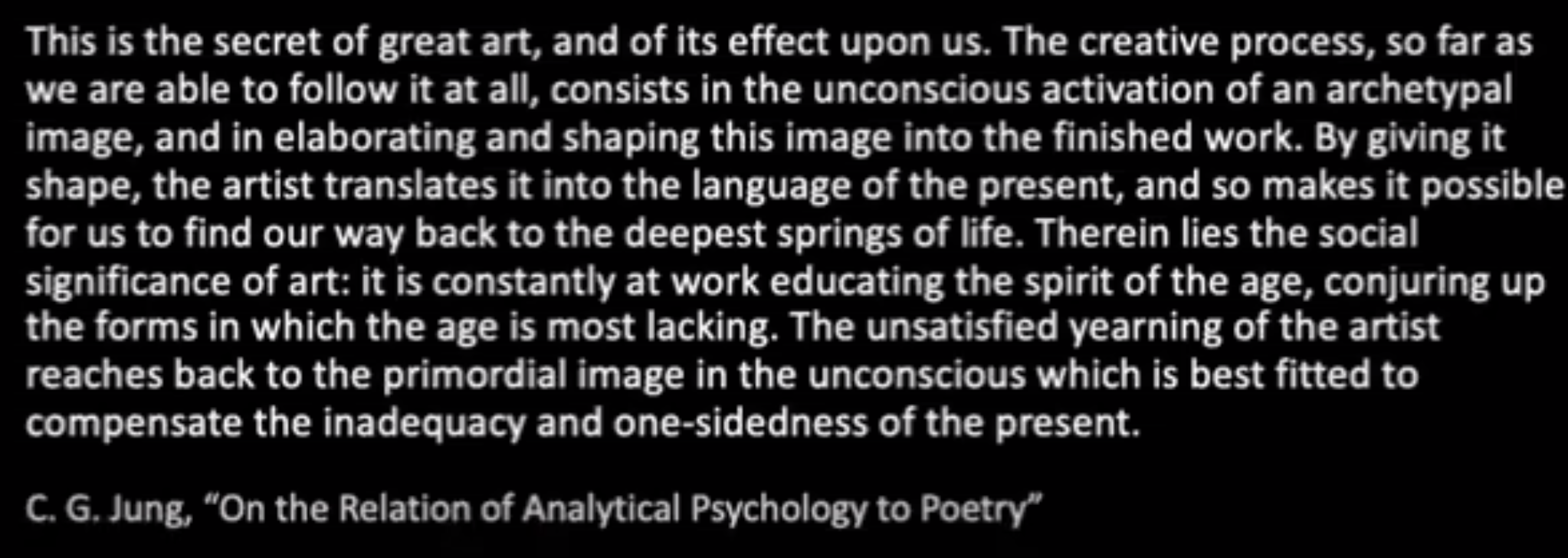
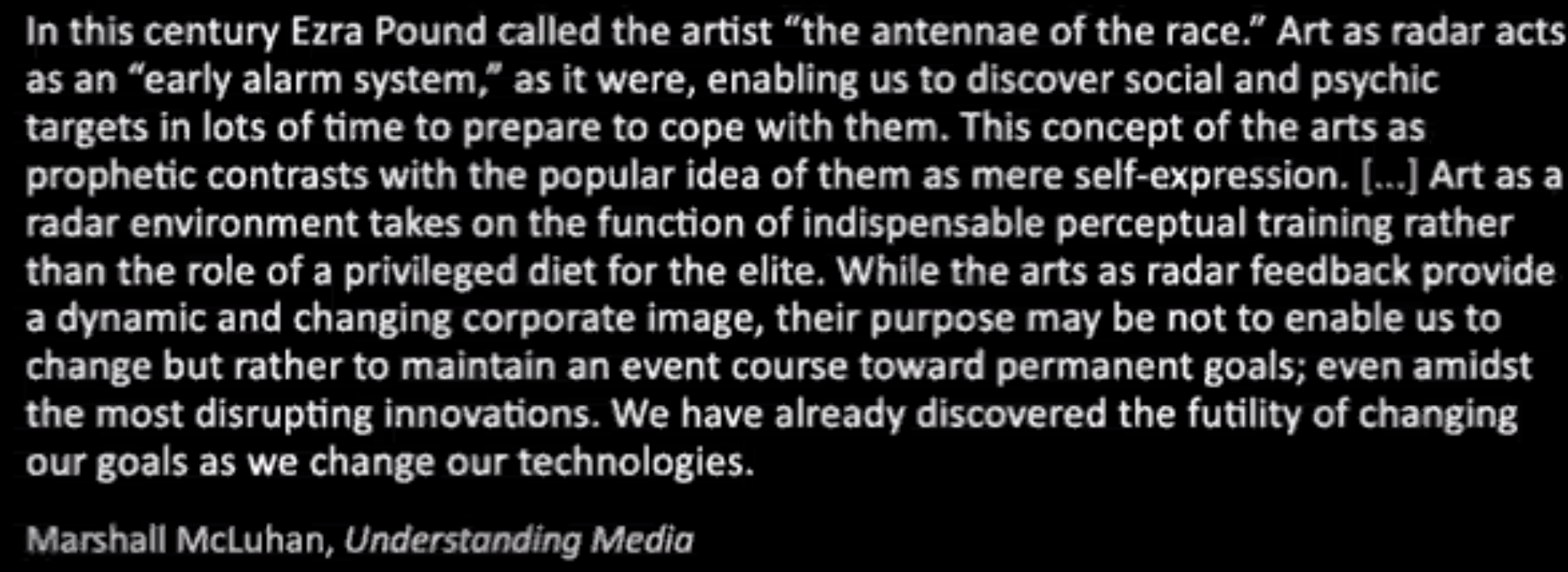
- [not sure I should publish these]
- interesting bit about permanent vs. temp goals. Need to think about that.
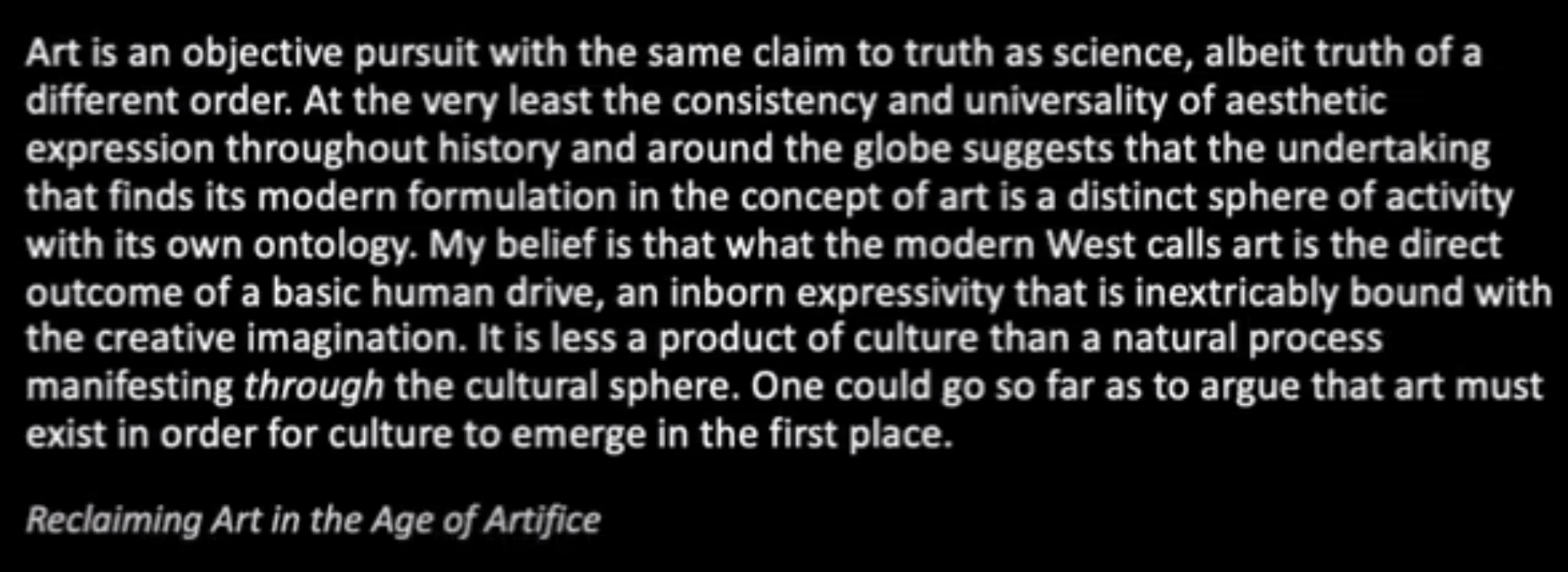
- "Humans didn't invent art, art invented humanity"
- art:
- empirical, (but transcendentially empirical? ).
- compensatory (about stuff which is ignored or repressed, neglected, off the radar)
- and hence political (in the same way the Alps or the Meditteranean)
- adumbrative (prophetic) because attuned to the large forces moving through time.
- Instinctual, precedes culture, as natural to humans as pollen gathering is to bees
- artifice:
- whereas art is a result of plunge into the imaginal, artifact is cultural production which presumes a closed world.
- Google Earth as a great product of artifice. (Eh)
- Maybe a boring mystery or other genre book. Superhero movies, jingles, road signage, propaganda, pornography. Deals in signs, not symbols.
- Signs are symbols with fixed meaning, seen from only one side, sort of dead rather than alive (that's my take, not JFMs)
- "You don't compute a new idea" – question-begging IMO
- What does your phone feed you? Artifice, even if you are watching Ingmar Bergman (why? and what about this class?)
- Heidegger on thought – against "calculative thinking"
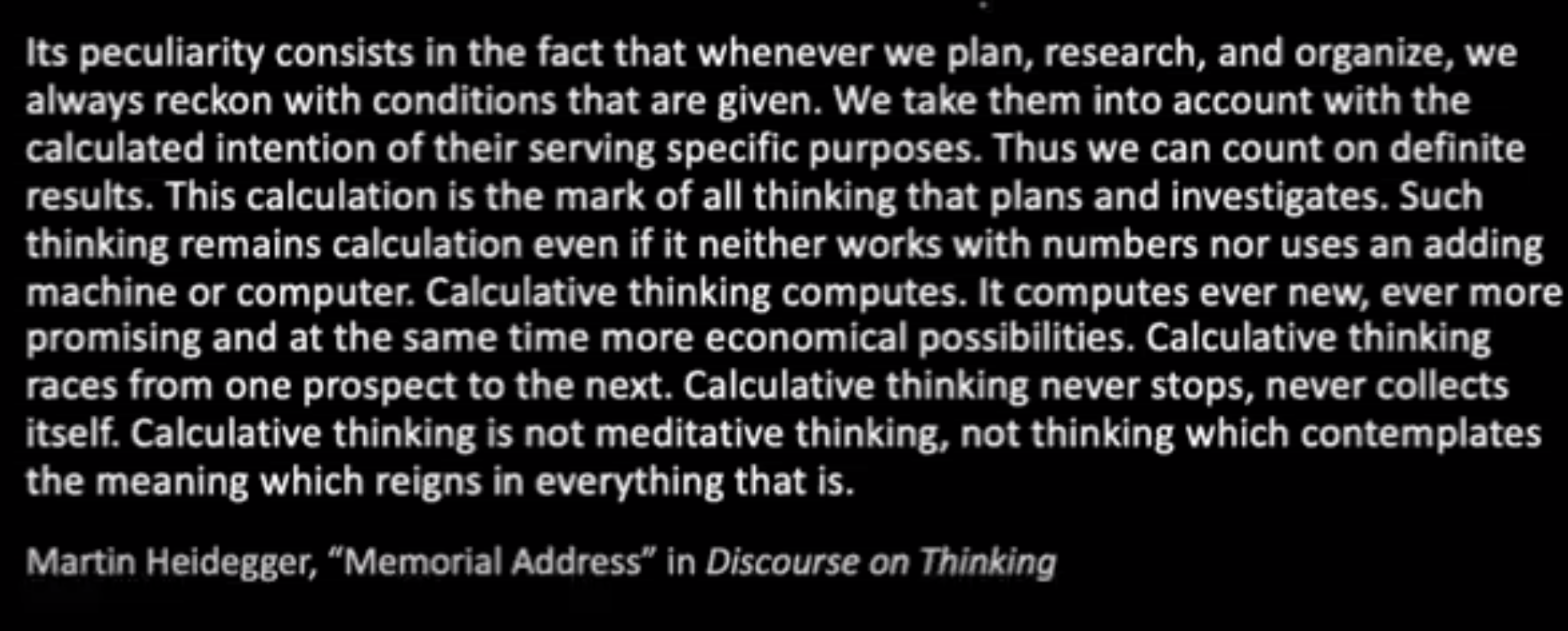
- (must drop a Heideggerian AI ref)
- meditative thinking as a thing, a practice distinct from Zen-style meditation. Glassenheit, openness to mystery.
- Weirding as an attempt to put this kind of thinking into practice. Not to come up with great ideas but attend to things so ideas will manifest.
- MotTT reference. In Temperance chapter, he contrasts rationalism/clarity with other modes of truth. Isolates object from the real (sounds like Stamm paper above)
- AI baked into the very notion of machine
- Macbeth prophecy of "not of woman born" a presagement of AI
- Rudolph Steiner, Lucifer and Ahriman lectures
- 2 different demonic intelligences. Steiner says Lucifer incarnated on earth, in china(?!) leading to gnosticism etc. Lucifer wants "to get us out of matter", spiritualizing, world-denying.
- Ahriman from Zoroastrian principle of evil. In 1919 predicted he would incarnate after the year 2000. We are being groomed for his arrival through technology. Ahriman wants to stop spiritual life and drag us back to quantity or number.
- Mentions Kevin Kelly and the Technium
- Artificial Intelligence may be the oldest force humans have dealt with, but coming now in a new form.
- The inevitablity of AI makes his moral judgement irrelevant, even though it presents an existential threat.
Art, artifice, and thought
Adumbrations of AI
The challenge of generative AI
Questions?
- Art's prophetic power can be explained without supernaturalism, because art guides us in the actual construction of the future.
- No Country for Old Men – definitely art, but I would say its meanings are fucking crystal clear, the characters explain themselves.
- What does your phone feed you? Artifice, even if you are watching Ingmar Bergman (why? and what about this class?)
Week 1 office hours
- LLMs do not implement Cartesian subject/object thinking, or really anything like it. That is not their problem, it’s kind of the opposite, they don’t have enough agency to be actual subject, which is why they freely make stuff up.
- The “inevitability” is a political argument, IMO. I dropped a note on the Nura comments about this, but half of “AI” is just capitalism, especially its inevitability. It’s saying the technium is beyond human control. This may be true but it’s a function of politics, like nuclear weapons, we could control them if we governed ourselves better, but we don’t.
- Margaret Warren presented Don't Sleep There Are Snakes and DataPerf - Adversarial Nibbler
- JFM "pretty on board with Chomsky" – huh
Week 2
Lecture
- The prophetic power of art.
- Discourse surrounding AI
- Doxa and episteme. Doxa is common knowledge, episteme is "of the form", high-falutin stuff that is.
- Deleuze emphasized that episteme are created, not merely discovered. Creating tools, abstract machines (I like)
- 3 AI doxa - all share the property of stopping the conversation. Opinions aim at silence
- Mere mimicry, not intelligence
- Neutral tools
- NRA fallacy. Tools crystallize intentions (I think he's pretty right on this one)t
- tools vs machines (eh)
- Evolutionary destiny
- ED om Techgnosis

- JFM does not accept, he thinks machines are a rift in natural history.
- Guattari – machines are abstract entities, diagrammatic (?). "Machines do not belong to causality" eh,
- A wish is acausal. Machines are an answer to a wish. Supernatural, not natural.
- Imaginal ≡ acausal I don't buy this

- argh
- The plagiarism thing is a red herring (IMO)
- Anti-mechanism. Dismissive of reductionism becasue it implies conscious doesn't exist. Bergson story. He believed cinema was bad because false theory of movement. Intellect should be subordinate to instinct, which better apprehends reality.
- Deleuze wrote book on cinema that disagreed.
- JFM – intelligence without subjectivity can be real.
- AI from the inside (Hm)
- Information is for command inputs (no). information presupposes an outcome (no, actually the opposite)
- Information presupposes fungibility (ok)
- Deleuze: art does not communicate, it has nothing to do with information...
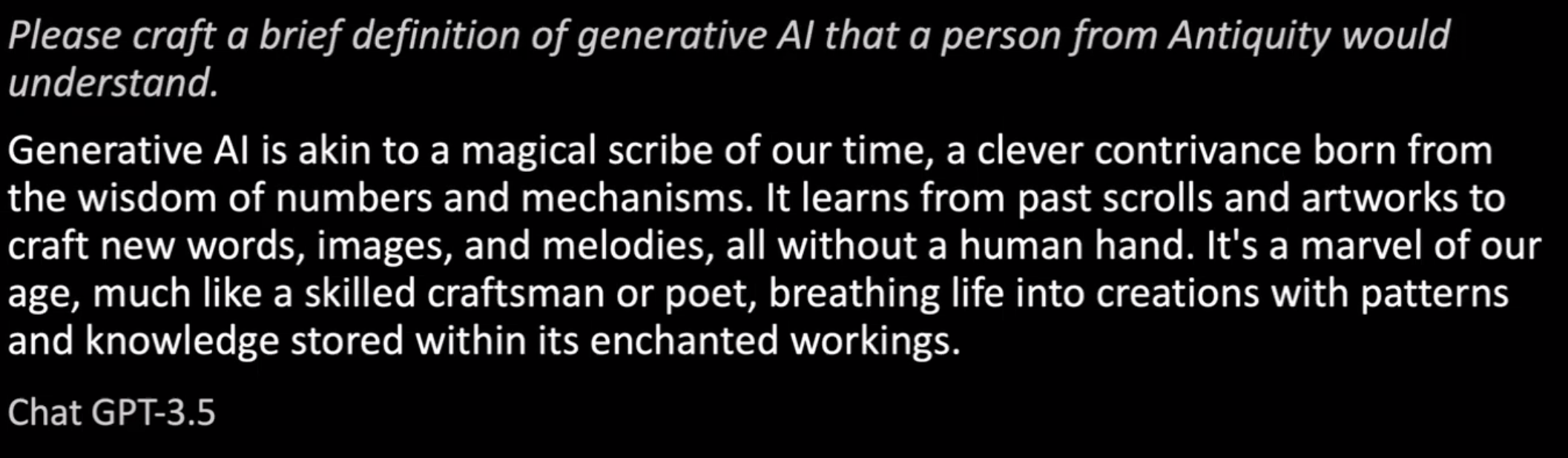
Prepping a comment
- Weizenbaum
- False dichotomies drives me crazy.
- Your meaning of "information" is wrong (or, at the very least, confusing). You said something like information always has a goal, is manipulative. Opposing it, I think, to some more genuine form of communication. Machines exchange information, people do something more, they relate, they are capable of an I-Thou stance. OK, but they don't differ in their manipulativeness. Or are w assuming machine purposes are lower than human purposes?
- My point was not to argue the facts but register that my intuition is different. Information suggests static bits to me, it is less manipulative than human speech which is always loaded down with vast quantities of social purpose.
- Sorry what was the point of this?
Reading: Deleuze, Postscript on Societies of Control
- Who is controlling who?
- Link to The Limits Of Control
- Below the API
Jobs increasingly fall into one of two categories: Either you tell computers what to do for a living or they tell you what to do.
- Sent:
- Undeniable that we have been moving in the direction of more control and finer-grained control. It's not exactly a conspiracy against the individual, more like the necessary mechanization of society as it scales up. Driven by (?) capitalism, modernization, urbanization...Napoleon?
- Computers have been a big part of that, it is more or less what they were invented for and what drives them economically. However: there's always been a strain of computational research that wants to use the technology for more human-centered ends. Douglas Engelbart, the early visions of personal computing, and the free software movement are three examples of this strain, and I only mention them because I'm trying to remind myself what I got into this stuff for.
- AI has its own dream history, not particularly about control in Deleuze's sense, but the current form of AI (LLMs) is peculiarly suited to capitalist centralization and thus control.J
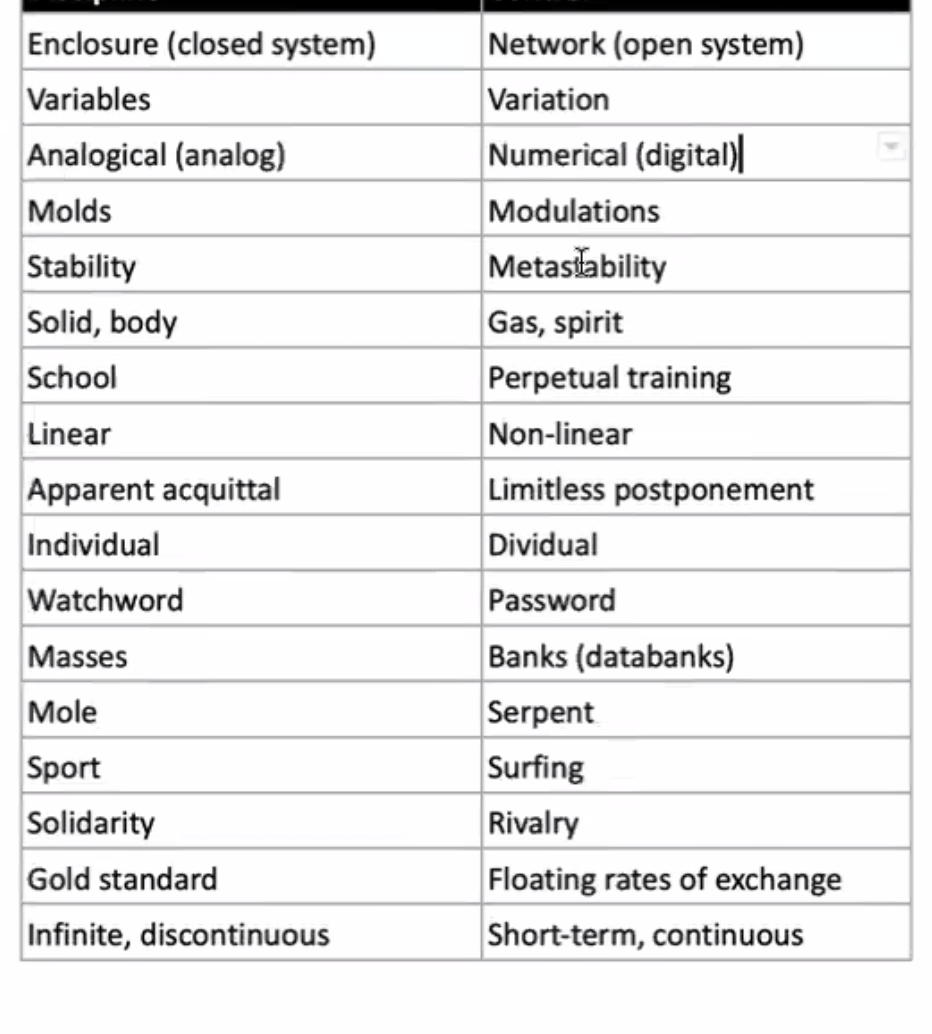
- JFM: makes more sense if you translate "analogical" to "analog" and "numeric" to "digital".
- Discipline vs Control
Week 3
Lecture (async)
- The Technium. Get to the heart of technology (we'll see). Condition of emergence of AI: Technium, Society of Control, Metaphysics of access (aka ethos of suspicion).
- Technium: material and digital infrastructure. That we live our lives in. Arcology trope from SF.
- Have they read The Machine Stops?
- Kelly's notion of technium as superorganism. A single system.
- Around 13:20, JFM twist, he views the technium as a kind of alien imposition, I don't think KK does.
- He takes tool as autonomous... "exodarwinism" that is a good word. (French dude?)
- Society of Control (necessary to get the data for "Ahriman's preserving jars")
- Google Earth and Books as example. (might be worth mentioning internet archive). But those don't really have anything to do with control of individuals.
- Some misunderstanding of cybernetics. A classic steersman is outside the system, but cybernetics puts the control inside and automates it (and that is somehow bad?)
- Quotes JCR Licklider about man embedded in system. Doesn't really grasp the intent I think. Relates it to Deleuze as man imprisoned.
- "man embedded in the technium" – wrong metaphor.
- "the cybernetic ideal of control" – misconceived I think
- from knowledge as power to data as money (fungible power)
- Lick on "supercommunity" – Ahrimanic (Not really)
- Metaphysics of access
- a necessary metaphysical attitude, or ethos, or mood of thinking. Tristan Garcia, "philosophies of access exchange objects for the conditions of their annunciation" (whut)
- OK Garcia is lumped with OOO and speculative realism, I never could figure out what that shit was about.
- I don't need to know that my wife is made up of atoms.
- i guess this is pretty vanilla antireductionism
- naive realism (rejected by all modern philosophers)
- recalls that marvin clip, I think this one
- Nietzschean perspectivialism -reduction to will to power. Similar with Marx. Freud of course. "masters of suspicion" (should google that)
- he is not saying it is right or worng but that it is necessary for emergence of AI (not sure why)
- "turns the human into an object of study" well yeah.
- Technology and the Human
- Angels: pure form, beasts: form and matter
- every angel is its own species (interesting)
- theregfore angelic ≡ digitial (????) beasts are analog a
- angels are not comparable to anything else.
- ah so humans are beast and angel analog and digital
- some confusion here but I can't untangle it
- Ah he says explicitly that tech is different from nature (spiderwebs etc)
- Deleuze technology and thought
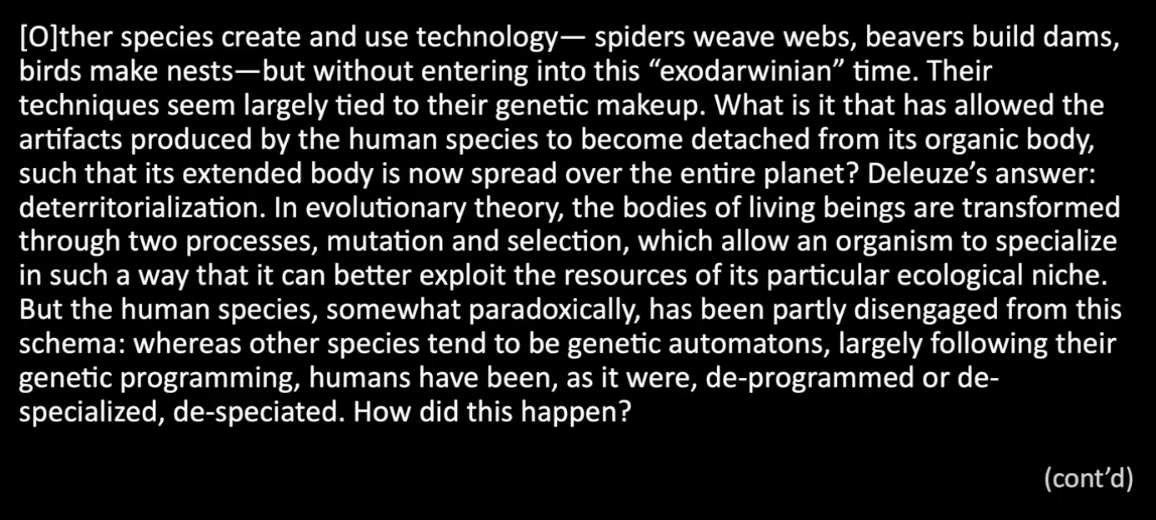
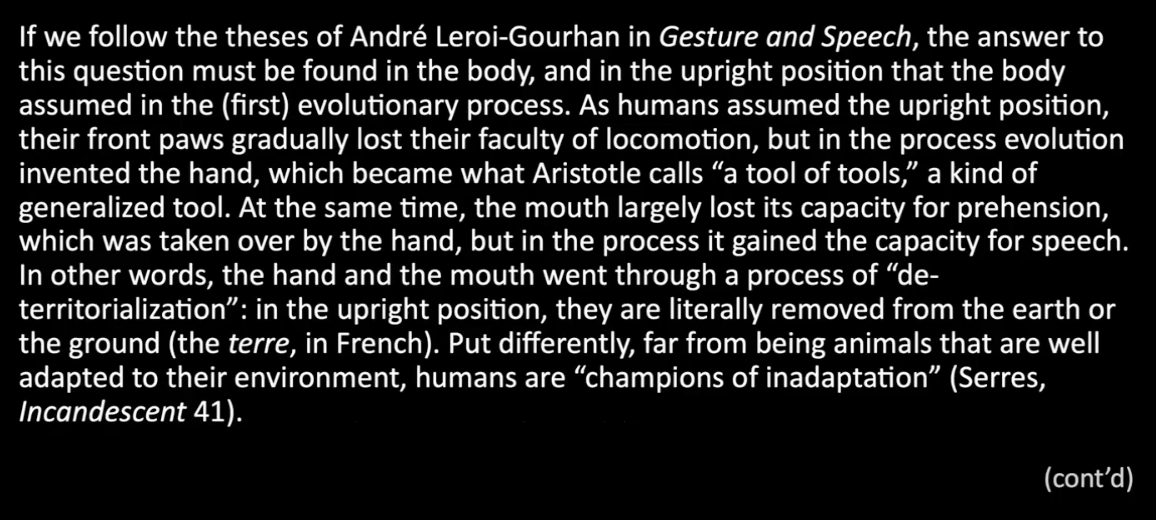
- oh interesting "deterritorialization" as removing from the earth aka ascending to heaven.
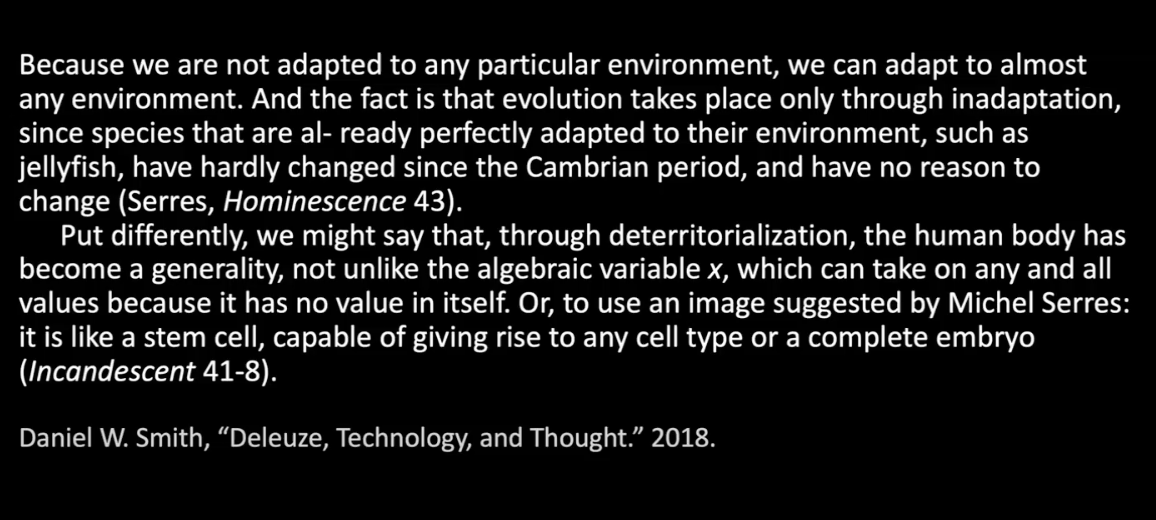
- More anti-reductionism. Eh. Around 00:53
- Hammer different from spiderwebs, require an ontological leap. Showed 2001 manape clip (didn't show the jump cut). Monolith as rift, as acausal something, inexplicable. (I wonder what Minsky thought of that aspect of 2001). Emergence of ought from is (?). OK he likes to emphasize the discontinuity. I must say I don't, but is that just a matter of taste?
- Manticore example. Ah he explictly sneers at the default notion of imagination as in the head, private "an epiphenomenal fog supervening on material reality". I am not sure what the point of this is, this insistence that imaginateion is real. I mean, sure, in some senses, but why is this such a freaking big deal?
- imagination vs imaginal world, the world in which all possible things exist. The imaginal world is digital because things in it are not composed (eh).
- Tools all come from the imaginal world (?). A hammer is both physob and image of something. This is why tools have a telos. Eh.
- He's working towards a partial equating of art and technology, OK.
Thu class (on tape)
- JFM: wants to get away from stale Manicheism. OK.
- Very confused analysis of analog v digital photography. pan vs. echo
- analog is same as mirror (or similar) but not a representation, part of a causal process, on the same ontological plane (OK I think I know what he is trying to do, but it is wrong).
- With digital, more of a rift in representation.
- When superman looks at a 4K hi-def image, he sees something low-res like 80s Donkey Kong.
- what was that a response to?
- JFM is a hardcore Humean! Huh. Not sure what that means. Ought/is distinction implies nihilism, maybe? Story about Hume and the peasant woman.
- Margaret on analog/digital: she equates angel and analog. Digital is impure. JFM explains angel/beast .
- Angel: intelligence, not found in animals. One of its powers is to create counterfactual universes (imagination). JFM is getting into category theory! Blowing his mind.
- Angels are also unique, purely formal. Just a way of thinking – a good model for thinking digitally.
- So we are analog creatures with digital minds, the digital is angelic but not that great?
- Stressed that a and d are both worthy aspects of reality.
- Dyad vs binary. The mole and the snake. Snake represents the digital (from Deleuze?) Mole is enclosed, snake surfs on the earth, the snakes coils are more complex than the burrows of the mole.
- Jeremy (Chomsky) colleague, did work on mathematical linguistics, NOT a programmer. Mentions Minsky (offhand). Works at OceanNet (?). AI as experimental epistemology (after Hofstadter). He agrees with Chomsky, "nature is fundamentally computable". A program is a theory, a thery of mind in the case of AI, so philosophical. Quotes chomsky on humbolt – the infinite use of finite means (?). Some of his explanation of Godel seem cheesy, but I guess ok for the context.
- Echoes some on uniqueness of imagination. I think I disagree with this – dogs and cats can imagine future states of affairs. It's more language that distinguishes humans. Some refs to Leibniz but what do I know about that, nothing.
- Some people take LLMs as refutation of Chomskyian theory. He takes their lack of grammar as evidence they aren't really intelligent. LLMs radically empiricist, not rationalist
- Chomsky becoming something of a Platonist/pythagorean in old age. Their book somehow shows how this leads to the imaginal? Sounds interesting. Albeit vaguely braindamaged.
- Heraclitus was a Chomskyan avant la letter??? Hm. Both believe in a kind of transcendential logic.
- Around 37:00 he is almost a monarchist reactionary. Charles Taylor immanent frame
- JFM Mentions Heideggerian AI Dreyfus paper
- Kants theory of desire (imaginal)
Readings
Chomsky NYTimes piece,
- LLM-skeptical for decent enough reasons. More AI-friendly than you might expect, he even refer's to "the child's operating system".
Unlike humans, for example, who are endowed with a universal grammar that limits the languages we can learn to those with a certain kind of almost mathematical elegance, these programs learn humanly possible and humanly impossible languages with equal facility.
- There's a paper: Priorless Recurrent Networks Learn Curiously | Semantic Scholar
While scientists certainly seek theories that have a high degree of empirical corroboration, as the philosopher Karl Popper noted, “we do not seek highly probable theories but explanations; that is to say, powerful and highly improbable theories.”
- Interesting
True intelligence is also capable of moral thinking.
- I suppose. What's so special about moral thinking? LLMs problem is that they don't think at all.
- The example of the AI explaining how it has no personal perspective is kind of weird and creepy.
Note, for all the seemingly sophisticated thought and language, the moral indifference born of unintelligence. Here, ChatGPT exhibits something like the banality of evil: plagiarism and apathy and obviation.
- interesting. Was Eichmann not intelligent? I mean, he may have been a moral idiot, but he seemed to function OK (for some definitions of OK) without a well-developed moral sense. But OK, there is some connection between intelligence and morality, and the idea of an amoral intelligence divorced or independent from morality (as in paperclip maximizer ) has something wrong with it.
- Summary: I guess I mostly agree with this article but don't think it makes a great case against ML. Gary Marcus or Chapman go deeper.
excerpt from the 25th hour
Of the laws governing the mechanical slaves, I will menIon only three: automaIsm, uniformity, and anonymity
We are learning the laws and the jargon of our slaves, so that we can give them orders. And so, gradually and impercepIbly, we are renouncing our human qualiIes and our own laws.
- Personal reactions: well, you know, "machines" aren't like anything, except as how humans design them. This kind of story is very trite, actually – from Terminator to the Berkeley Rationalists, everyone is terrified of a revolt of the machines.
Week 4
Lecture
- Art and technology both about making the imaginal real. Are they the same? (No).
- Review of "imaginal" – the imagination is not subjective, put perceptive, we observe a real imaginal world, which includes all possible worlds. The possible is part of the real. Real and unreal possibilities are different (manticore vs square circle).
- The past subsists in the present (but it is imaginal as soon as it is past). The future "insists" upon the present (?). Deleuze and Guttari in What is Philosophy use "chaos"
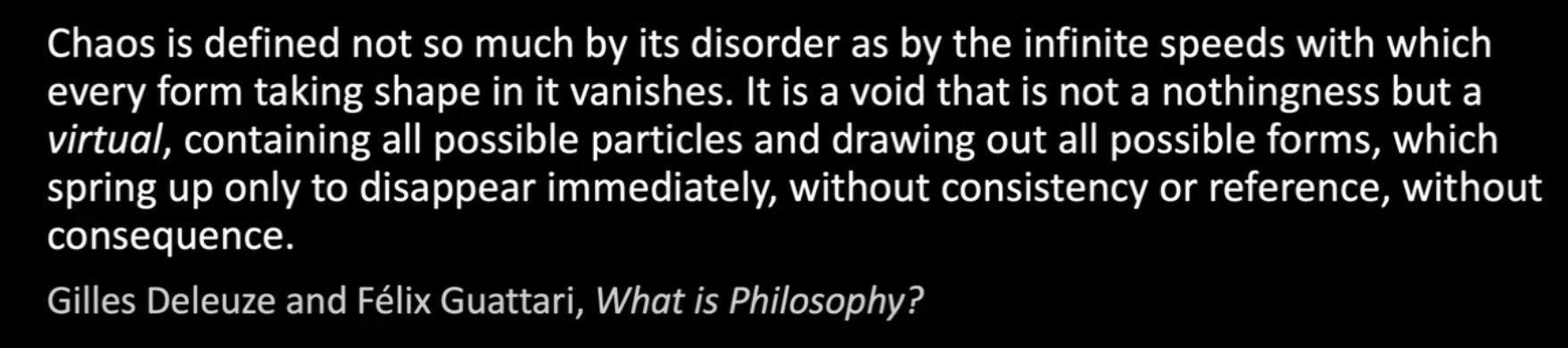
- digital/analog material vs imaginal cheese. Argh this seems braindamaged to me.
- Anti-Magrrite pipe.
- Hylomorphism (everything is a combo of form and matter). The form of cheese has to predate actual cheese (eh). Bjork Modern Things. Bergson, matter and memory, the ? image...oh this stuff seems so dumb.
- I totally tuned out when he started going on about tools and 2001. He seems to be desperately trying to prove something obvious or trivial. Tools have a telos (OK agree with that at least). A tool is physob and image (But what isn't?).
- Technology seeks the abolition of all causality (WTF). And minimizes body and maximilzes image (I guess true of media tech). The parts of the imaginal machine generate causality (WTF).
What is a machine
- "a systematic assembly of parts, each with a function that interact in predetermined ways to achieve a desired outcome" – OK, not too bad.
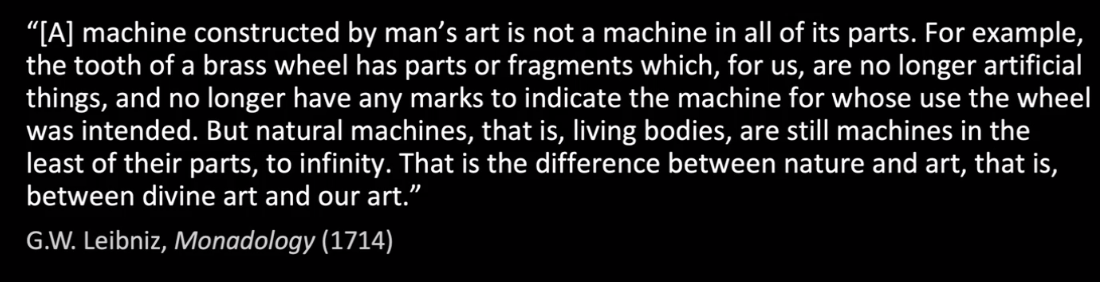
- This sounds wrong and stupid.
Leibniz felt that the moderns had erred in ascribing this godless model to life itself. He set out to restore the uniqueness of life by positing that infinity was its defining feature. For Leibniz, even in their smallest parts organisms were machines – and therefore were machines ad infinitum, akin to onions that could never be completely peeled. Leibniz
- Hm, Leibniz apparently invented the Chinese Room Argument (also dumb) Leibniz's Mill Argument Against Mechanical Materialism Revisited. I forget sometimes that stupid arguments about materialism have been going round and round for hundreds of years.
- "There are no fascists because we are in a society of control" – JFM , paraphrasing, I couldn't disagree more...
- Macbeth course was about time, this is about space (???)
- JFM: You can't start doing philosophy without. aconcept of time
- "teenagers smoking a joint style philosophy" – no shit
- "time is the present slipping into the imaginal" – hm. In a way he's right – we can't directly experience the past, we can only deduce it and/or imagine it.
- He's making an argument about the reality of the future that is close to my anti-freel-will stuff.
- What if the material is the infinitely imaginal...
- Stuff on doves made me think of
- Resisting this stuff...maybe I'll stop.
Reading
- Wargo on Giger. I liked this, up until
If there is an origin trauma in Giger’s work, I suggest it is really the trauma of origins in the ancient Gnostic sense: of spirits who find themselves born, painfully, even hopelessly, into the world of matter, with all of matter’s pains, frustrations, and limitations.
- But maybe I am a cozy traitor, counseling spirit to not feel so hostile toward matter, treat it as home rather than oppressive jail.
- OK this is just wrong
While the “fall of spirit into matter” seems like a purely theological or mythic narrative, it has an uncanny reflection in what has become the accepted, fully materialistic account of the origins of complex life forms on Earth. The theory, first proposed by the Russian botanist Konstantin Mereschkowsky in 1926 and then supported by the discoveries of biologist Lynn Margulis (below) in the early 1970s, is now entrenched in biology textbooks: Over two billion years ago, changes in Earth’s environment such as an increasingly oxygen-rich atmosphere led bacteria to adapt in new ways, including by merging and coopting each other, sharing their genes and unique bacterial talents. Through a process called endosymbiosis, independent creatures engulfed each other and “grew together”—most often, perhaps, pointlessly and painfully, but every now and then forming mutually beneficial and stable unions that shaped subsequent life. This was the origin of the first complex, nucleated cells or eukaryotes.
Margulis’s story about our merging bacterial ancestors is inspiring and cool … as long as you hold it at a 2-billion-year arm’s reach. Can you imagine the horror of being forced to live out your life immobilized inside another organism?
- Sorry, that is a stupid projection of human concerns onto single cell organisms.
- Talk of jouissance, I realize I have no theory for this. Seems bogus, but also useful? Like mental energy, or willfull play.
I am inclined to take Lacan’s jouissance as essentially the same thing—as spirit or consciousness, the thing that separates us from inert matter.
- Nut graf:
Giger’s world shows us this dark threat of cyborg endosymbiosis: not to be simply augmented by machines (or even simply replaced by them) but to be parasitized and engulfed by them in a kind of numbed ecstasy that somehow masks the violence being done.
Donna Haraway suggested that even to hope for such a choice could be a mirage, because we have always been cyborgs: Language, culture, tools, all act on and in the body so thoroughly we could never unplug from them.
- Yeah
- Recalls Blake
For Bacon and Newton, sheath'd in dismal steel, their terrors hang Like iron scourges over Albion: reasonings like vast serpents Infold around my limbs, bruising my minute articulations.
- Really recalls Swarm
Office hours Thu
- Maya Ward doesn't like Giger.
- JFM is platonist, or leibnizian or David Lewis (Plurality of Worlds). Forms precede instances.
- I got in my comment about Giger ≡ capitalism and what about human creativity?
- Some stuff on holism and final causes.
- Jeremy brings up Latour (but not sure which thing).
Office hours Sun (async)
- JFM claims Leibniz invented computing and he got the idea for binary from the I Ching, which is interesting... Leibniz: Explanation of Binary Arithmetic (1703)
- Tomberg: calculative vs meditative thinking. "with the drop" or "with the flood", or L/R dichotomy sort of. Brings God and omniscience into it, unnecessarily. Argh.
Week 5
Office Hours
- Playing cards and platypi. Reductionism.
- Some weird critque of reductions that it doesn't know when to stop? "you can take something apart forever" – eh no.
- Understanding the Eye doesn't require going all the way into quantum physics. Agree but so.
- That's what the imaginal is, the power of things to exist onm its own as a whole.
- And this "trnascends its existence as part of a causal system"
- "the power of cheese"
- ontological primitives. Used to be atoms.
- every whole is a miracle because acausal – ok, well, that is fucking dumb
- reality is two parts, a causal part and things as simply existing as they are.
- Rota on Husserl. Facticity and function. Fundierung as a bridge between the material and the imaginal (I would say they don't need a bridge, they are never apart). JFoster: framing out a facticity and making a symbol, anything can mean anything (sounds braindmagaged). NOT a mere affordance. Take x and make it AS something else. He is against pragmatism, sigh. This is the essence of real intelligence, the ability to see possibilities.
- Humans have more flex than animals. This is deterritorialization. We can invent/change roles/functions.
- JFoster: both platonist and empiricist. "you can be a total realist about the imaginal". He mentions multiworld physics theories, trying to be materialists about the imaginal. JFM: David Lewis, Pluarality of Worlds.
- JFM: anything that matters has to be real. Agree completely, but then he goes on about manticores and against a cognitivist version of imagination, a mere secretion of the brain. "Matter itself is simply a particular organization of imaginal reality". But why is that an argument for animal imagination? Argh. One of his cats is human. "A realist position with regard to the imaginal".
- JFM: wasps have imaginal knowledge of caterpillar anatomy (kind of wrong and undercuts earlier arguments about human exceptionalism).J
- JFM: against dualism and we are already immersed in it (I agree but h seems inconsistent to me?)
- JFM on divination and the I Ching, thinking with the flood. Similar to art. Jungian unconscious (not oppositional as it is in Freud). "In you is an infinite mind". "When you think artistically you are thinking with the entire universe". But not mystical, purely natural??? The conscious mind is a drop within the ocean of the infinite. D&G go into chaos, make friends with it, in order. toextract new principal. tointegrate into culture (hm).
- ChatGPT has. a trillion drops but not access to the infinite (not sure why, but he's still anti-AI here).
- Technology as junk in Star Wars and our lives.
- Art about recovering interiority (contrast with BCH on Zen)
Office Hours 2
- Once a tool comes into (material) existence...
- intelligence needs to be present in nature...film camets imshinsl, noy found in nature...
- pure image of film,
- LEibniz machine in all parts – frangly dont get it. God's infinite machine vs human finite machines. That's how animism works??
- LLMs overwhelming us like in King of Elfland's Daughter story.A
- JFM: Art fell off the spiritual path with Dada, by erasing line between life and art. Bad idea!
- Shannon Taggert, Patrick Harpur, neoplatonism and emanationism. JFM, trying to give uncoded philosophy (? purely out of the immanent, no ref to Kabbalah etc). JFM acknowledges he is rediscovering their stuff.
- Somebody brought up Abebe Birhane and "atemporality". Smooth places (airports, D&G like, JFM does not). Birhane wants humane technology, ack of human dignity...respecting the human and irreducible singularity.R
- Role vs function in Ulam Fundierung writing
- WS AI Course Continued
Proclamations
- I've had to miss all the live sessions this week because I am too busy serving the machines, but thought I would share this review of Kevin Kelly's What Technology Wants (the source of the term technium) I wrote some time ago. Not sure I would agree with it all today, and the issues I'm thinking about are somewhat different from the course topic, but thought it might be of interest. https://omniorthogonal.blogspot.com/2010/12/power-so-great-it-can-only-be-used-for.html
- I'll have to take another look at the book, but my impression is that JFM's take is quite different. Kelly's purpose is to describe a grand unified process of the emergence of everything, including biological life, human life, and technology, which are just different phases of the universe complexifying itself. JFM in contrast seems to be emphasizing the discontinuities between technology and nature. Technology is something of an alien imposition on humanity, something that comes from outside through a rift and wraps us in its systems. Especially digital technology. (Apologies if I am oversimplifying or just getting it wrong).
- They share, I think, a kind of view of "technology" as an agent or inexorable force. From within or without, it is coming for us, or already here and we live within it. That is perfectly valid, but it rubs me the wrong way for reasons I get into at the end of that review. Technology is not an alien imposition, it is a human creation. It's not something that was done to humanity but that humanity did to itself, and is still in the process of doing. If we can't control it, it is not the fault of technology, which for now has no agency of its own, but the fault of irresponsible human creators and control systems.
- Mostly when people assign agency to technology, it makes more sense to me if I substitute in capitalism. Unlike technology, it is clear and obvious how capitalism has agency, how it insinuates itself into human desire. Technology often is used as a tool of capitalism, but it is just a tool and can, we hope, be put to other ends.
- Unsent to thread from Avi
- I admit to having my own difficulties with the ethos of suspicion. I suppose I've been marinating too long in materialist cognitive science, but I have a tough time grasping how there could even be an alternative. "Direct realism" is not a theory, any theory (from Marx, Freud, Darwin, Nietzsche or J. Random Scientist) has to explain something in terms of underlying forces or dynamics or it isn't a theory.
- That is, it is not a scientific or intellectual theory. It's a perfectly fine theory for getting around in ordinary life, and indeed we use it all the time, we are obligated to. Our experience is made up of what appears to be direct perception, because the mechanisms underlying perception are not normally visible to consciousness.n
- Sorry, getting into science-asshole territory here, but the honest question is, what are the alternatives to an ethos of suspicion?
Statements
Mechanism: not all that bad
- A lot of this course, and WS discourse in general, seems based around a basic assumption that there is a hard separation between computation, mechanism, information, and algorithms on one hand, and human intelligence and consciousness on the other. People have a very powerful intuition that whatever they are, they are more than mere machines, and if they were mechanical it would be absolutely terrible.
- This is not just a WS opinion of course, it's pretty commonplace, almost everyone except technogeeks finds the idea to be some mixture of absurd, repellent, or alarming. Now that real AI seems, if not quite here yet, at least plausible down the road, people with that hard barrier in their ontology are challenged and confused. Some basic fixed assumptions do not seem so fixed any more. Sacred concepts like personhood are in the process of transformation, by forces that are barely understood even by the technical people pushing them forward, and reeking suspiciously of capital and control.
- There's a vast literature in philosophy of mind around these issues, and I don't feel too much like recapitulating those arguments here.
- Weird naturalism
- Computation is not quite the same thing as capitalism or control society
- Although of course very tightly coupled
- Possibility of liberatory technology
- Humans aren't "intelligent" either (in the supernatural sense). They are smart machines
from Weird Studies/Courses/Bergson redux
- A one-day special by JFM on Bergson last book, Two Sources of Morality and Religion. On the Mutations platform, so not officially WS, but who cares. Henri Bergson - Mysticism, Technology, and a Philosophy for the Future — Mutations
- Noticed on the mutations platform a lot of talk about building a new relationship with time, which made me thing, but Long Now already doing that. And me, outside both of them.
Part 1
- Late work, takes time for granted. More about future than past. Book is extremely timely given current events. Bergson's optimism. Unique, important, alternative.
- "Humanity groans, crushed between the weight of its own..." A machine for making gods.
- Space is not time. Time is immeasurable. Can't get to duree through science because that is precisely the use of the intellect... however there is the possibility of a science of time, if science serves intuition rather than reason.
- Time and free will.
- Radical realism. Our perceptions are the world. Anti-Kant. We have direct access. We have direct intuitive access
- He keeps fudging the body
- Mind and matter resulved through time
- Creative Evolution. Evolution vs, Evolution is creative (ok, but not very radical). Anthill vs human socieities (instict vs )
- Fascists appropriated Bergson (elan vital), Bergson fell into nationalism, he regretted it.
- Bergson's method. Finding a fissure, a "bad composite" and disentangling them. Splittting time from space and following their logic. Free will as a badly posed problem (with him there)
- 2 sources of morality and religion. Disentangle them. Open/closed moraliuty static/dynamic religion. Mechanics and mysticism. Not saying mechanics bad (so different from heidegger etc). Technology is religious and on the side of dynamism (more or less).
- Closed morality. Start with fact of life (good). The fact takes the form of obligation (this sunds very Critchley). Forbidden fruit earliest memory (very Freudian actually).
- Drive to servitude and mastery. Similar to wolves and apes.
- Closed societies. When they collide, war.
- Pathologization of rival political parties. They don't have the same interests.
- open morality needs special persons? Needs emotion vs intellect? (not so sure about that)
- closed morality (justice) is matthematical (justice, quantified). Open morality flips it, there is something beyond...brothers karamzov (omelas).
- Jung, archetype is intstincts image of itself (? might be misremembeing)
- the agents of dynamic religion are the same – saints, etc. dynamic religion does not rely on fabulation although involved with it (?). Walter Benjamin, fairy tales vs myths. Myths shot through with necessiuty, fairy tales have radical freedom, arbitrariness. No code, one must attend to situation. Static religions provide security, dynamic serenetiy (acceptance). Gospel of Adam: you will be freed from the authority of death. Via immortality or just being ok.
- Open morality ≡ mysticism (For some reason. Buddha etc tuned into earliest sources of all life). 2 forms of mysticism – inaction, extinguishing, apophatic, withdrawal. Another type, "mysticism of action" transformative of the world.
- not(e) Buddhism has an active side, indicated by the term upaya, skillful means.
- christs replacement of law with faith and "all one in christ"). Bergson surprised to find himself with Chtistianity.
Part 2
- Conclusion, mechanics and mysticism. He doesn't (surprisingly) oppose them. He was seen as anti-science, but –
- No: science on side of open, of dynamic. But incomplete. Art has it, and philosophy needs to be more art-like. (OK 100% with him). Art is a fundamental mode of knowing. Open is associated with the creative, always good for Bergson (100%)
- Last chapter Bergon's political treatise. (OK should read). The kind of world he wants to create. He has sense of emergent collapse (before his time). He makes predictions (1932 before nuclear fission)
- Technology extends body (OK). Life working through the human. (He's sort of going KK here). Origins of private property in tech (think this isn't quite right and runs into Marx, but...)
- Marx believed in collective ownereship but also in the reality of the collective.
- Planetary bodies (this is so SB).
- Middle ages ascetiism vs modern materialism.
- Not a Hegelian but thinks just like one? Need to return to ascetiism (so hippie)
- in touch with the impetus of life (creative etc)
- Bergson's affirmitive philosophy (he had no negations (is that right?))
- love: drive towards. unity (ok here I am having doubts)
- life wants to evolve, matter resists (just wrong)
- building tools is a mystical practice (or should be) and lead to open culture
- Citew David Noble Religion of Technology
from Weird Studies/Courses/Weirding
- I went through Weirding, an online course presented by the Weird Studies hosts. Disorganized notes below
Session 1 Trash Stratum
In this class, we consider how we might encounter the divine (in whatever guise) as it manifests in exotica music, professional wrestling, avant-garde Happenings, and other cultural forms. And we will consider the all-important pro-wrestling principle of kayfabe: maintaining and protecting the Inside of a divine encounter from a hostile and uncomprehending Outside.
- Material:
- Maria Montez paper, exotica paper
- Notes
- There are 80 people here! Can't be too interactive, which is probably fine
- Similar ideas?: bulldada, Omniorthogonal: Mr. Burns, Emperor Norton
- VALIS: initiatory artworks, like Parsifal
- false dichotomy between personal and universal interpretations...oh well.
- trash stratum as escape, and a version of magical hermeneutics? (Aristotle 4 causes + fifth cause, diviners cause)
- Dick offering third position: value from human and non-human beings
- He's trashing camp and The Room (despite never having seen it) – charity is required. He rants against those who put themselves above the artwork, you must get down on your knees before it...doesn't like the "so bad its good" pose. OK – I don't care that much... asymmetrical consciousness ...
- Passionate identification vs. ironic detachment
- Artworks are people too (and should be approached with I-Thou)
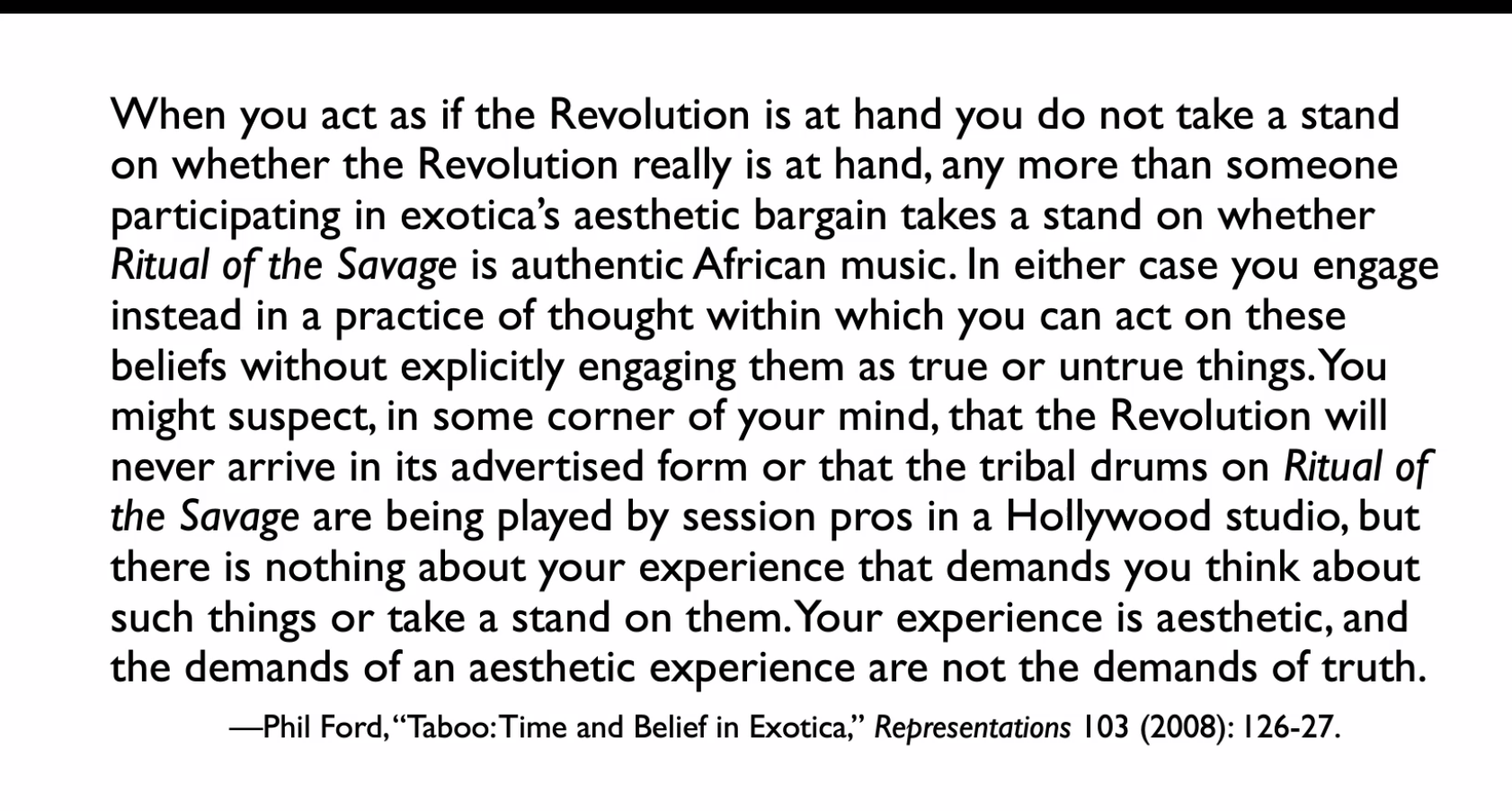
- The nature of pro-wrestling: blur the line between fiction and nonfiction.
- Kayfabe – the great arcanum of all magic. Commitment, you weave your story into the world. Works (staged) vs Shoots ("real")
- Andy Kaufmann! (Laurie Anderson stooged for him, didn't know that)
- Uh oh Edge.org (Eric Weinstein on Kayfabe)
- The mystery is ontological not epistemological.
- Ramsey Dukes How to see Faeries
- Roger-pol ? Astonish Yourself – Magic as empirical science
- If magic is kayfabe – the ability to maintain a fiction to the point it becomes real – I understand why Emperor Norton is so revered by the Discordians Emperor Norton | Discordian Wiki | Fandom
- Awakening is an accident, and mediation makes you accident prone. – Baker-Roshi
- Office Hours
- Simondon on technology
- Artists are good diviners, they see a future for objects...
- Charnel grounds and filth
- Machen and evil (Have not read him)
- JFM: Deleuze: all that returns is noble, so no real evil (eh I want to argue)
- PF: Arousing of the bodhi-mind, non-discrimination. does not mean "don't like anything more than anything else" – don't address under-the-abyss problems with above-the-abyss techniques.
- Crowley's life as kayfabe (Or David Bowie self-creation project)
- dada as erasing line between life and art (?) Trump as ultimate
- Crowley acceptance of his fate
- Musil ? Decadents – were they leaning into the dark to affirm the light...
- Logos appears. when you fuck around and find out. John Cage answer to why there is suffering: to thicken the plot...Henry: I have transgressed, now I am back...blah.
- Emanations...the New...Life ... OK I can vibe with this but I can't (yet) talk about it.
- Acausal or hyperchaotic thing (seems to be a reference to some early convos that I haven't heard)...
- Failures of divination (But its all that for a skeptic like me).
- JFM: spirituality as learning about those parts of yourself (or reality) that you reject...A defence of traditional religion – empirical systems for exploring the imaginal world.
- Daniel at 6:20 or so...should review.
- Was going to raise the issue of the homeless – human trash – but not sure it was going to fly. Might be too real, and I have no business making people feel guilty.
- I didn't bring this up in the discussion because it is not fun or spiritually fulfilling, but the juxtaposition of trash stratum with morality made me think of a glaring social problem where I live (San Francisco) – the homeless, essentially people who society has relegated to the trash stratum.
- Jesus, I assume, would be at home with these dregs of society, but the good bourgie citizenry (myself very much included) avert our eyes. We can't look at these people, there need is too great, we have to ignore them most of the time.
- OK somebody else did
- Thanks for posting this. I was thinking along similar lines during the office hours, but I'm leery of getting too political or moralizing in these discussions. We have created a class of people who are basically garbage (in the eyes of society) and because we can't deal with this fact honestly, they pile up in the streets (esp in San Francisco), a constant reminder of social failure. Jesus, I assume, would be at home with these human dregs, but the good bourgeoise citizenry (myself very much included) avert our eyes.
- Want to draw a line between trash stratum and repression, seem obviously related.
Session 2 The Zone
- see Weird Studies/Stalker and Weird Studies/JFM on Zones
- Reading the "Daimonic Reality" paper and barfing a bit
The Otherworld is always imagined as beginning at the edge of our known world....Scientism recognizes no Otherworld, but, as I intimated in my 'little history of daimons', daimonic reality has a way of subverting it. Thus scientism constructs its own literal versions of a transcendent and and immanent Otherworld. The former appears in the weird models of the universe articulated by astronomers and cosmologists; the latter appears in the speculations of nuclear physicists.
- Man does that sound confused. It goes on, revealing a stunning ignorance of what science is about. It's like Tao of Physics but even stupider, electrons are like fairies! or UFOs!
The subtaomic Otherworld has its own elegance and a certain stark beauty, as the physicists are keen on emphasizing; but iut is grey and meaningless compared to the world William Blake saw in a grain of sand.
- Well buddy, you are the person who decided that physics is a version of your Otherworld (an inferior one I guess). I don't really see them as being the same thing or in competition for my soul.
- 3rd reading
the Zone is usually a singular, often unmoving place of anomalous materiality. Importantly distinct from magical phenomena themselves, “[t]he zone is the region, spatial or temporal or both in which the phenomena may occur;” it is an “‘order’ that is outside order.”
- Refs: Notes on the Zone Concept (i) – Centre For Experimental Ontology (link in pdf is wrong)
Indeed, it is my contention that Zones are instances where the noumenal mixes with the phenomenal; where the Outside intrudes on the Inside. The beaches of Kant’s Island of Reason are littered with constantly evolving and changing tide pools.
- Detour into Kant.
systematization and standardization of the human experience in the understandable world of the phenomenal is our treasured Inside...Furthermore, this set of rules that organize our experience of space and time “consistently and predictably” produce a homogeneity, a sameness that determines what Amy Ireland calls our “anthropomorphic regime.” Such a regime, she goes on, creates a sense of normalcy and harmony amongst us insofar as everything is “ordered, familiar, comfortable, and homely.”
- Wow cites Steve Harrison and Paul Dourish , “Re-Place-in Space: The Role of Place and Space in Collaborative Systems,” in Proceedings of the 1996 ACM Conference on Computer Supported Cooperative Work
- The Talk
- "comprehensively unsystematic" (reading from a text, eh)
- Can a time period (he sixties) be a zone?
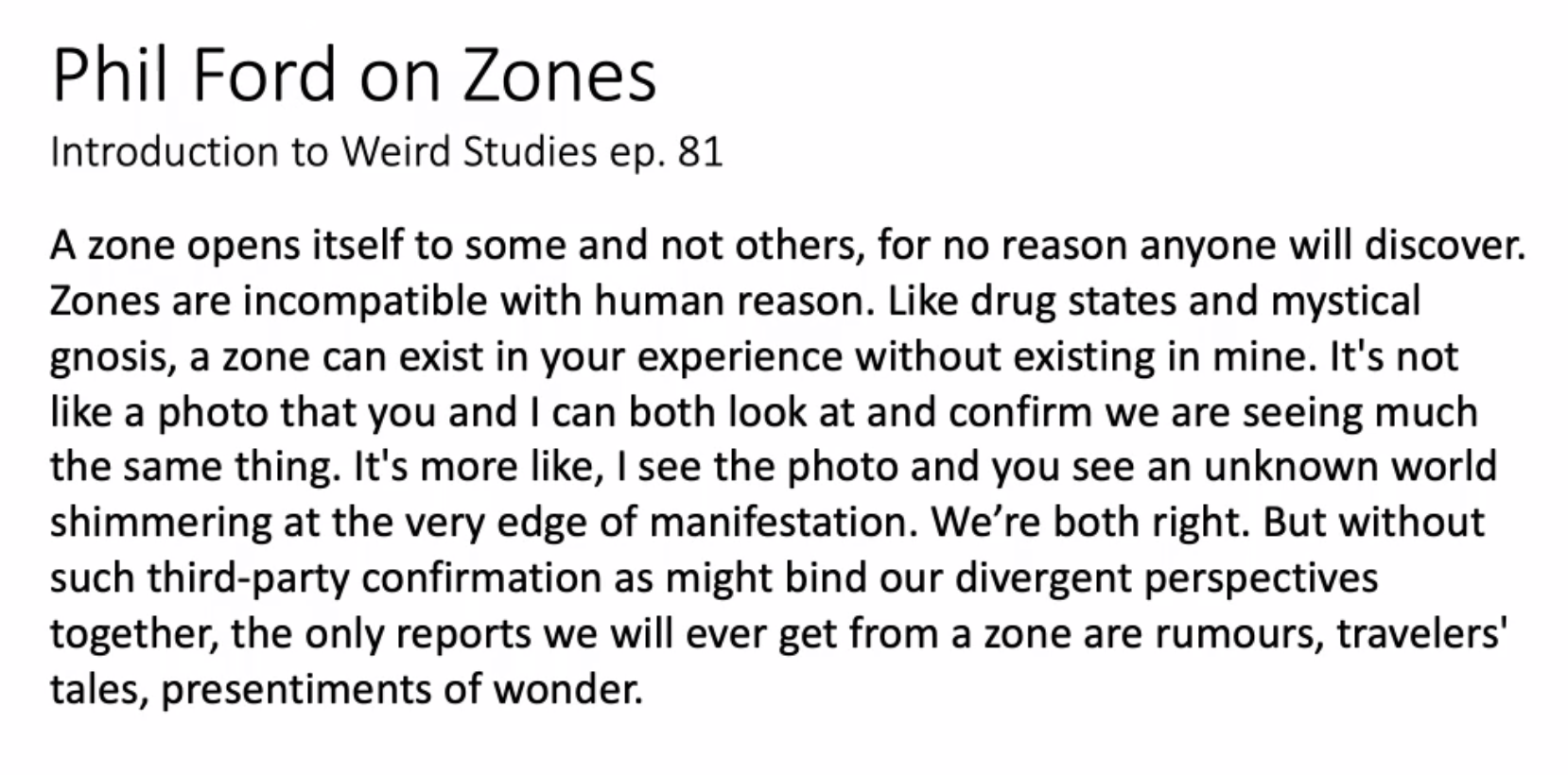
- JFM OTOH wants to consider Zones as an objective thing, independent of human subjectivity.
- Twilight Zone! Yes!
- Blake double vision. Superior to single vision. Yeah I suppose. Imaginal things are objectively real, as indpendent as the thistle at least (eh).
- Coleridge: subjective imagination vs primary imagination (latter is as real as the physical world). Sufi mundum ? More reality when you see the thistle an old man. Eh.
- Zones as hauntings. Where the weird manifests into reality.
- de Chirico another good example
- a zone where imaginal beings pitch their tent in our world (or vv). Charles Taylor disenchantment.
- Line that people keep experiencing daimons whether or not they have been banished...yeah I suppose. "minded entities that are on a level with the human yet not human".
- 44% of American believe in ghosts...argh this is way too paranormal-religious for my taste.
- liminality an example of bait-and-switch...
- he seems to be making a case for the objectivity of the imaginal...this seems misguided to me.
- cite of Mark Fisher Weird and Eerie. Eeriness, the feeling of being watched by something alien...or being such a watcher. F2F with the nonhuman.
- Ep 59 on Walking addressed how to find zones. Exercise: go for a walk, with no destination or podcasts. look for a "cursor", a tug in a particular direction.
- He hates "intersubjective" because it implies an objective (?) Art exists independently of humans (I still think this wrongheaded).
- To me, something seems wrongheaded about the assertion than daimons etc are objectively real. Let's grant that they are real in some sense – they generate real experiences, if nothing else – but they aren't real like a physical object is real, or we wouldn't think of them as interesting – they'd be normal, not paranormal. So what is their reality like? It's not objective or subjective, but some third type of being.
- Wow PF picked up on this and read it, I'm kvelling
- Followup (unsent). Subjective and objective assume a certain cosmology (or constitution, in Latour terms). Zones and daimons fuck up the boundary, I don't think it's right to think of them on either side (purely real and objective or purely subjective)
- Try again: I think this boils down to a (false) dualism, that something is either objective (eg, natural, physical, has its own existence apart from observers, measurable with scientific instruments) or subjective (all in the head, culturally constructed, basically made up and thus could easily be made differently in someone else's head).
Session 3 Art that looks back
- Cool, two podcast eps I haven't listened to yet Weird Studies/Duchamp and Weird Studies/Talking the Walk
- Buber, should link my I and Thou Ribbonfarm essay. Or do I, how about listening to their take first? They are talking about finding thous in the inanimate, my essay is about how it's tough even with the animate.
- No mention of Sloterdijk/Rilke ??? (comes up later)
- Notes on Wastiau Two Congolese Masterpieces
- Looking at art as "Tabwa" rather than the product of individuals is rather parallel to feeling that "all asians look alike" – somewhat defensible due to cognitive limits, but also obnoxious and colonialist. Good to be remembered that there were individual minds at work here.
- Notes on Lecture – The Artwork Looks Back
- Komar and Melamid, Healing Power of Art (not)
- He's denouncing his youthful cynicism (I guess I agree but I don't care about academia, trendy or otherwise)
- quote from Jodorowsky, Psychomagic
- Assigning agency to art (from Duchamp episode, "this music loves me")
- He is not sure what he meant – that's good, honest
- Elkins, people who cry at paintings
- Mumbo Jumbo, mutafica repatriazing stolen art works
- Uchiyama, Just Bow
- PF says I and Thou is full of Zen shit
- Don't put such tight conditions on personhood
- It is the borderlessnes of being that comes through an encounter with art.
- Burning Man art kind of solves the museum problem ...
- Nathan showed that Alex Grey book on art.
- Robert Irwin: Seeing is Forgetting the Name of the Thing One Sees
- Office Hours
- JFM: his movies were more real before they were made (when he was "wrestling with the angel")
- The book they are working on has its own telos
- talk of magic and I feel weird and inadequate
- David J does gemerative synth music and finds a thou in it. Modular synth guy, which is the cool thing.
- Art (the physical thing) is a third think in between artist and The Spiritual Thing – art is the actual relation.
Session 4 The Dreaming
- Reading Borges piece on dreams – actually pretty vanilla for Borges, but OK
- The idea that there is a single dreamer. See I Am You
- Also made me think of Chuang Tzu story about the dreaming butterfly.
- Lecture
- last week – artwork as imaginal being
- before that - zone as habitat for imaginal being, trash stratum
- "imaginal" – nonhuman intelligence
- He is against dreams as trash (GC theory).
- psychoanalysis
- Dumpert quote – are people really that anti-imagination or anti-dream? I mean that was satirized in Hard Times but most people today give at least lip service to the importance of imagination.
- "our attitude today" is that imagiantion and dream are epiphenom of the "real" world and not real in themselves.
- "objective dream" – he means the dream as it is, before interpretation (not clear that means anything. Cats exist whether you perceive them or not, dreams – well, no).
- Dreams present themselves as encounters (agree with that), thus anything we encounter is not us.
- dream ego and waking ego aren't the same.
- the fragmented nature of dream recollections is evidence for the reality of a larger world that they are glimpses of
- we recognize dreamlikeness in some films (He didn't mention any, but Lynch and Tarkovsky come to mind)
- Hillman, dream world is underworld (death and the past)
- Why How What Who Where When
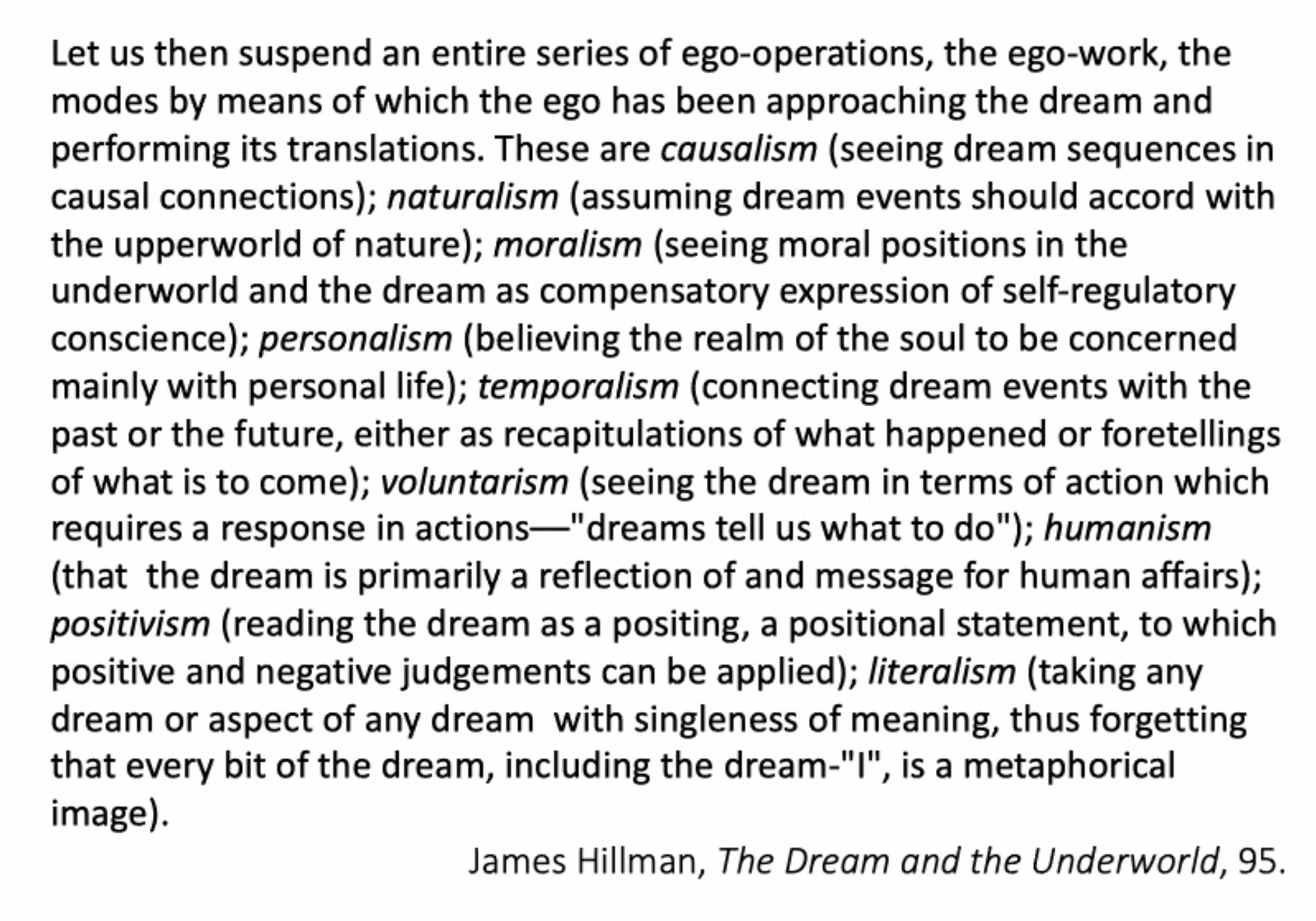
- Dream is how immaterial beings clothe themselves in material garb...i like that...
- Bergson dream theory (1901 or so)l He believed that memory was total (wrong).
- 6pm explicit about how imaginal is real
- Hm the problem is that listening to other people's dreams is boring.
- western philosophy as sufferiing from skepticism to the point of insanity.
- PF snarking on computational models of mind, pretty fairly actually.
Section 5 Diviner's Time
- Sources: Weird Studies/Diviner's Time and Weird Studies/I Ching
- The lecture
- He's going to talk about Wagner's Ring Cycle – it is structured by Diviner's Time. The Slit in Nothingness
- Mahler's ambivalence about Wagner – two truths that must remain in dissonance (man vs. music)
- The Ring as cosmic McGuffin
- Alex Ross book
- Moving between keys implies agency and being; the single E-flat chord in the opening is before being, above the abyss.
- Ref to Laws of Form, nice. How do people know that book?
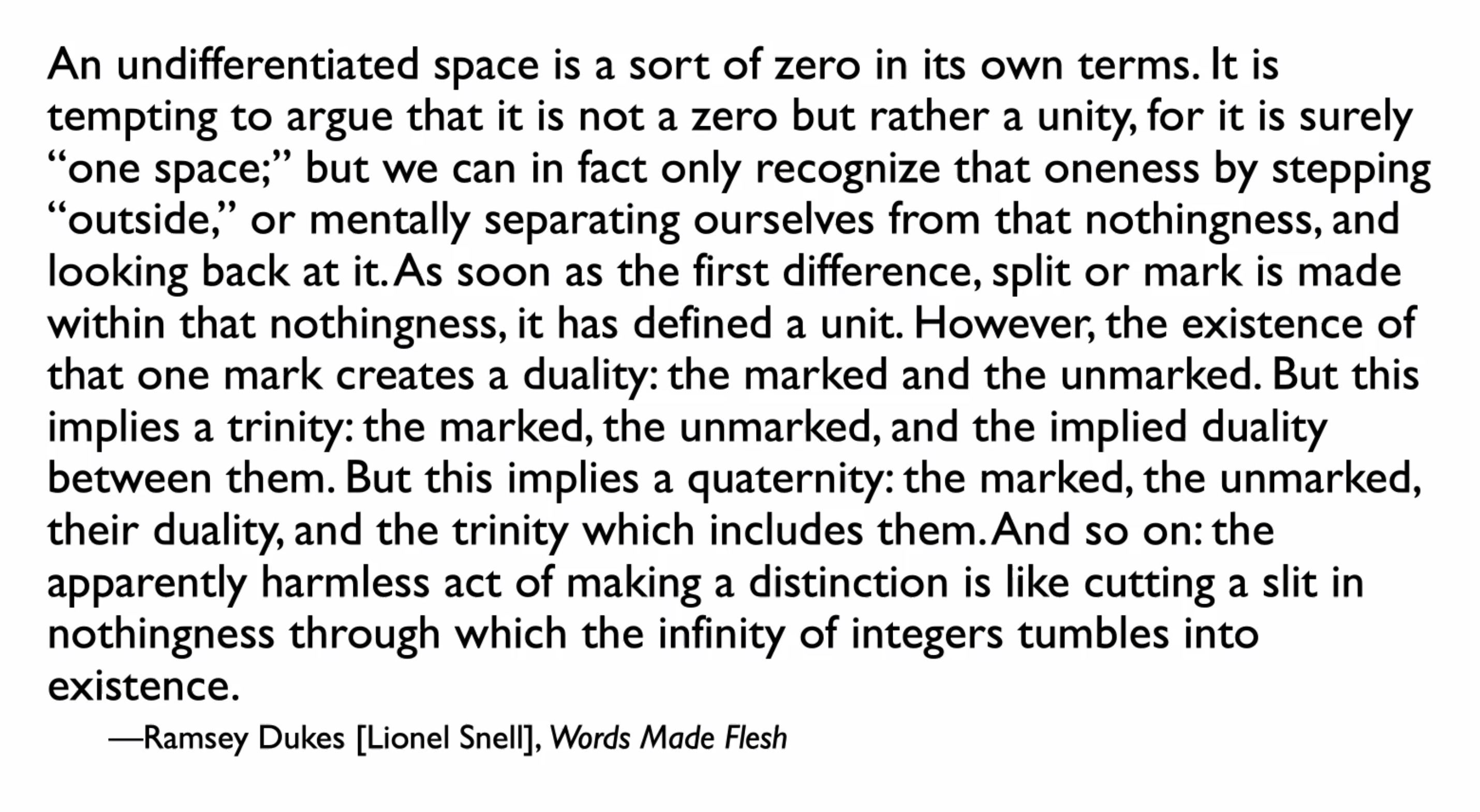
- Wagner palled around with Bakunin? Learn something new ...
- Wagner's encounter with Schopenhauer (and hence Buddhism) – "all things go their different ways / you can alter nothing"
- JFM: Leitmotif as Platonic form, Ulysses as making the mundane transcendent.
- P Craig Russel did a version of the Ring...highly recommended
- Office hours
- Ring Cycle Tarot!
- Diviner's time has a feel, moments befall in a certain type of way, a certain flavor of eventfulness...
- a certain formalized mechanism – the feel of time – time that has aspect of mind but is not just me....divinbation as a black light for seeing this higher temporality
- Jaci: Science, JFM: Origin of Species is a Wagnerian book.
- Jacob Foster science vs scientism – yeah ok maybe.
- Wagner elucidates divinatory in all art, some modern stuff occludes that.
- JFM mentioning his art theory (artifice short-circuits interpretation, hides the real mystery)
- counter-initiatory texts, things that steer you away from initiation.
- CIA anti-real-art conspiracy. OK. Capitalis God and Work a Religion (Jaci)
- Nathan: Paradise Lost all-day performance
- Magical realism as ghettoizing magic
- Faraday building theory from Chladni lines??? Things that are permissible to study vs those that are not.
- Freud evolving towards telepathy (?)
- PF: ref Platonic Mysticisn (SUNY press) Hannegraf?
- JFM: Adam Becker, What is Real? (Questioning Copenhagen interp)
- Time that is minded, that has the univese looking back, that the intelligence of the u is back at us.
Section 6 Real Magic
- Episodes
- Reading: BoA intro
- Ritual ≡ play, Homo Ludens
- "Jaded moderns scoff at ritual" – that annoys me for some reason. I know of nobody who scoffs at ritual (people scoff at beliefs)
- Reconstructionism, sort of
Through the fabulations of fantasy, we test the Real, sounding its depths and learning, again and again, that there is more to this universe than any dogmatic con- strual would allow.
- "imaginal" coined by Henry Corbin "mystics since time immemorial have been visiting places that are immaterial, yet totally real." – guess this is the crux of his belief. Coleridge, Jung ... "were united by a conviction that at least some of the images we see in visions, dreams, and fabulations are Things in the horror-genre sense of the term. That is, they are beings in a world of beings. Our world is not limited to matter as com- monly understood."
- Insisting that the imaginal is important – OK
- Insisting that it is real – iffy. I mean sure it is real on some sense, but to try to equate it with material reality is to miss the point.
- Alright, maybe I shouldn't be fighting with this. I just never really got that much into fantasy roleplaying and thus am not that into magic. I resist it. Not even sure why...am I trying to overcome my resistance? Do I aspire (in the Callardian sense) to belief?
Unfortunately, getting any of it to work will require one thing that no book can give you, ... This is the seriousness that is integral to real imaginal play. In magic, you play for keeps or don’t play at all.
- Yeah I have problems there.
- Lecture
- Radical otherness of dreams (from earlier). From Diviner's Time: "the aleatory nature of intelligibility as such" (no idea)
- chance, contingency, and magick in the context of the real (?)
- When modern people say luck we don't know what we are talking about (speak for youreslf jack).
- Bruno's ten types of magic, each with its own causality. Modernism (materialism, immanent frame) denies the reality of these.
- JFM: magic should eschew causality, not a "fifth cause" as in Ramey. But then modernism rejects it? (could not follow this at all).
- Sorry I am confused, is the point that magic is acausal or that it works by forms of causality that modernity rejects?
- Goals for magic theory: no occult forces, no turning-world-into-illusion (somehow retrocausality implies that?). Allowing naive realism to operate.
- Propositional vs Compositional Tree as effect of non-tree vs form of tree. (Process is very non-tree, non-Platonic) (not sure why "compositional" is the right name )
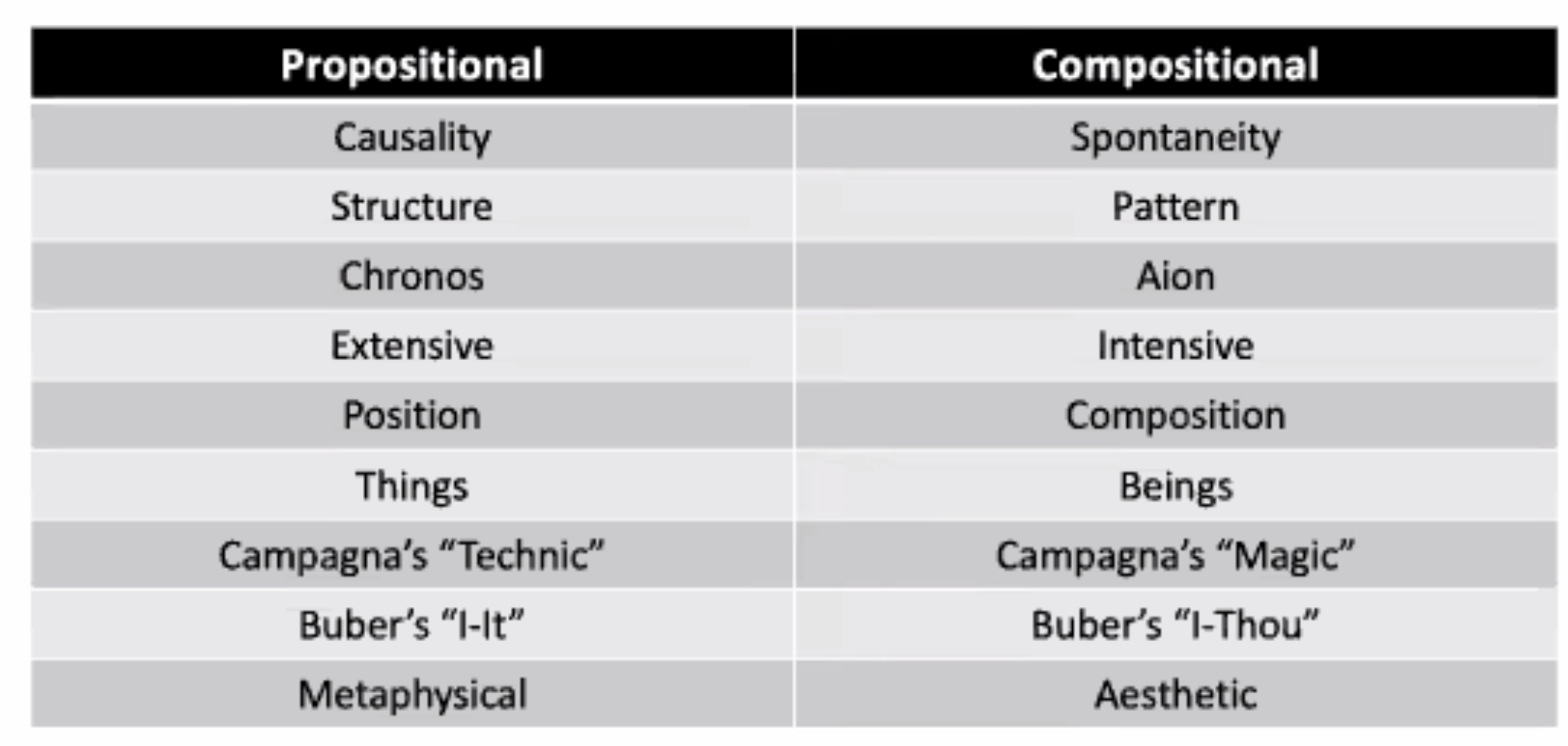
- "Intensive" means things exist as beings (?). Transcends the purely mechanical...
- P and C are complementary, not exclusive (OK). "it is a tree before any causal blah" ... ugh. brute entities, transcending causal forces. We do this with human beings. (ugh).
- trees in dreams do not require sunlight or are made of atoms. Well duh.
- a dream like a person cannot be reduced (says who? oh well here's where we part company).
- trying to move dream logic into real world (I guess this is how you get magic?)
- real world causality real but not necessary (that is, contingent).
- you believe in at least one brute entity (that acts non-causally). Bernardo Kastrup
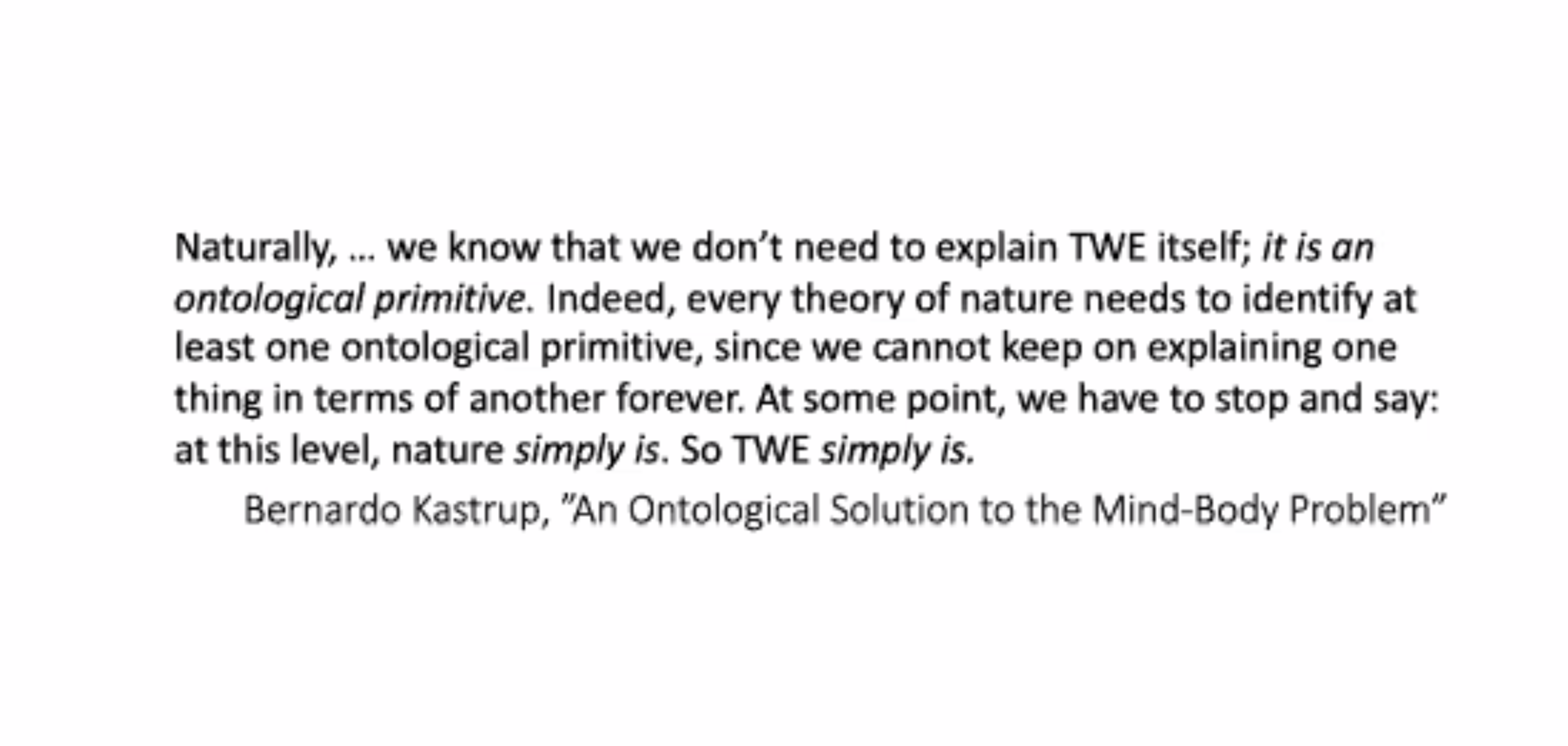
- Makes me want to be antifoundationalism (ist)
- Doesn't your belief in the human mean that they transcend the causal (no).
- The argument that you can imagine anything seems really weak. All this fighting against causality seems misplaced to me.
- No law of physics is really a law (Hume). Stupid as hell.
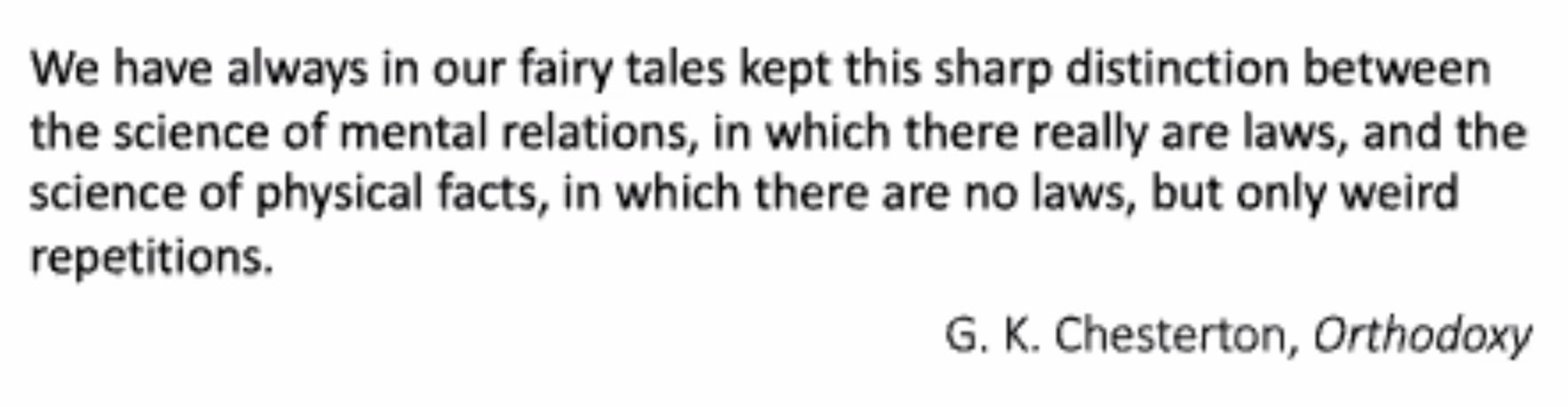
- Semantics of Clocks vibe.
- Seems like occasionalism which is another really moronic idea (or, more likely, one I don't understand)
- The imaginal is real, what we call reality is the "actual". But the process of how things move from imaginal to actual is not causal, so magic has no causality? Or something? Seems very fucking confused.
- The question of good and evil goes to the bottom of reality (hm).
- Causation is the meter and rhyme of the world (Sets a pattern but it gets violated).
- The world is a story before it is a clockwork mechanism (Nope!)
- He's with Dun Scotus and scholastics (?)
- Eric Wargo time loops as pure propositional block-universe theory of magic, completely different from this.
- My question: Is this antifoundationalism? The idea that there isn’t really a single base layer to reality.
- Answer: yes (other than esthetics maybe). (But believes in causality and science)v
- How is covid intelligence an argument for dream-logic?
- Office Hours
- Watching video for OH1
- PF: trying to defend magic as a worldview. Refs back to table from talk (proposition/compositional).
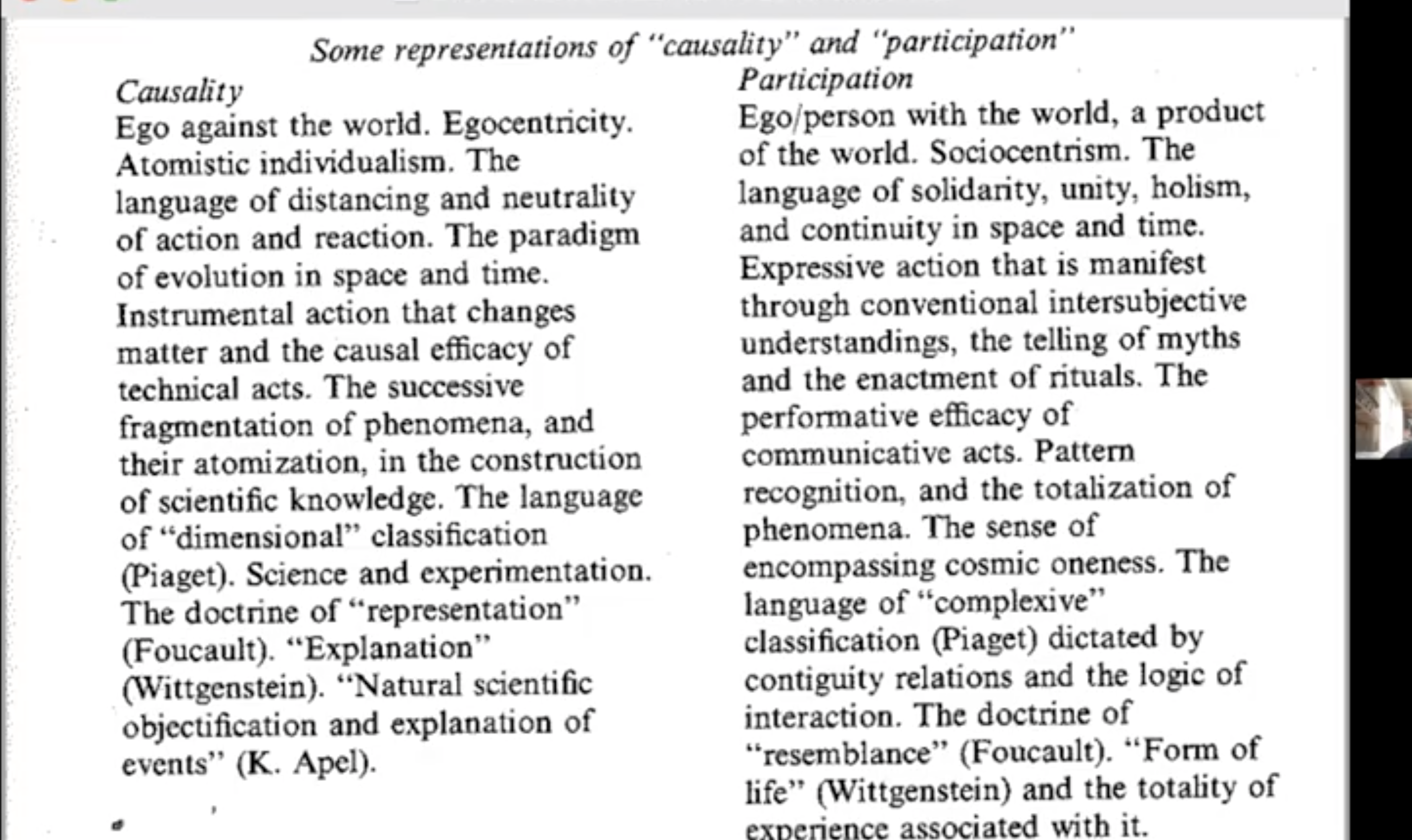
- From Lévy-Bruhl whose thing is participation I gather (have zero familiarity). Huh according to Lucien Lévy-Bruhl - Wikipedia an influence on both Jung and Piaget.
- Kripal humanist 2-step (? heard that wrong)
- JFM: we experience this magical universe all the time, it's not reserved for peaks (like enlightenment). "causation doesn't have the final word on the real". It's everyday mind.
- Hm. Not sure what I think of that. I mean, props to everyday mind but it doesn't have a metaphysics...no damn it. Hm. He's putting me (and science and modernism) in the position of the asshole enclosing the commons of experience, expropriating everybody. Hm.
- JFM: the problem is that we are not modern enough (ok, that is really good, he is not reactionary, he wants to go forward, or show that the magical is already within the modern)
- Nothing is outside of participation – but some things (rationalism) tries to be.
From JF Martel : Magic, Science, Religion and the Scope of Rationality 14:47:36 From Dylan Burns : The psychologist Nathan Schwartz Salant used an image of a [[Klein bottle]] (3D version of moebius strip) to describe the therapeutic encounter. Both parties are in the bottle and in participation, and both are outside it, reflecting on it.- From David J : Sure. I haven't read Crowley personally but I really enjoyed this podcast that focused entirely on The Book of The Law and the phrase "Do as Thou Wilt" . 003 Do What Thou Wilt - WORP FM | Acast There is a pretty good summary on the page
- David J thinking about ethics and causality – or what is anything for. How does magic inform "what to do"? JFM: "what matters" is important, better than materialist. imaginal outlook fuses "what is" and "what do i do". Magic as a form of pragmatism (He doesn't say that, that's an mt insight).
- Plato: the good lies beyond Being (or beings). It simply is, but you can't even say that it is, it is a kind of groundlessnes that orients all beings (and becomes god in christianity). Good has to lie outside or beyond being.
- Think I disagree, or at least, this sort of thinking is the root cause of a lot of shit.
- What the sun is in the phys universe, the good is in the intellectual universe.
- Duns Scotus univocity of being (opens the modern) – all things exist on the same plane before the nonbeing that is the good.
- Camus and the existentialists nail the primacy of ethics. Nietzsche too. MEtaphysics is unnecessary to this world (with him there).
- Nathan: de Broglie, pilot-wave theory, causality
- both top-down and bottum-up feedback
- graham harman overmining and undermining (sounds like useful terminology)
- Jaci: a physical 3rd level Natural Selection for Least Action (ok should read this)
- evolution exists because of entropy
- entropy meets tzimtzum and emanationism
- transcendence – entropy – nirvana – all things desire nothingness...
- general reaction – doing this stuff without mathematics is pointless.
- time only exists because of this search for equilibrium (that sounds suggestive at least)
- entropy as increaseof creative freedom (??)
- Joel Grus: from advertising to magic
- circumspection – a good thing
- JFM on causality which I still don't quite grasp. Ethics and causality linked.
- However causal the mechanism was, there was an acausal decision...nah. He believes in freedom and contingency, and that ALL PHYSICAL PROCESES have this axiological nature? (Axiology about ethics and esthetics; distinct from metaphysics which is about causality).
- Karolinska (?) Aristotle's Poetics rather than metaphysics. Efficacay of magic and power
- Lewis Mumford and the machinic
- JFM: bad to assume the mechanisms of nature are all of nature
- modernity pushes mechanism so far it bumps up against the acausal (in a prim culture, it would be magical-causal).
- Random notes
- Dec 2nd, 2022
- I found this week's material frustrating, and I'm not completely sure why. In general, when I listen to the podcast I often find myself in disagreement with things, sometimes quite strongly – but I always appreciate the clarity of the philosophical views expressed and explored there. Even when I disagree, the ideas and reasoning and motivations are clear enough, and I find it refreshing and clarifying to figure out for myself these points of disagreement, what they imply for my own ideas and values. To the extent possible, I feel like I am trying to broaden my own mind and that I am learning things. Nothing is better than that!
- So why is this particular stuff so fucking irritating? It lacks that clarity, and it lacks a certain modesty. It is going from the honest inquisitiveness of the podcast to an attempt to lay down a kind of formalized worldview.
- Maybe it boils down to Blake's "Everything possible to be believed is an image of truth".
Week 7 Practice
- Note
- Phil, that was a remarkable piece of writing, thank you for "assigning" it. Could really feel the presence
- Quibbles: classism, holism. Don't quite trust "wholeness", something too static about it. But not the way she presents it.
- Talk: I Really Should Be Practicing
- MC Richards + Occupy(?!). Sloterdijk ref, ok.
- The practicing person is one whose life is oriented to the repitition of an activity with a view to its perpetuation. (or flourishing)
- The Invisibles

- Fenellosa. MIT Piano Drop. Process. Philosophical texts as wormcasts of the real activity.
- Practicing as a way of being (rather than a particular activity).
- Sound, experience, Timothy Leary
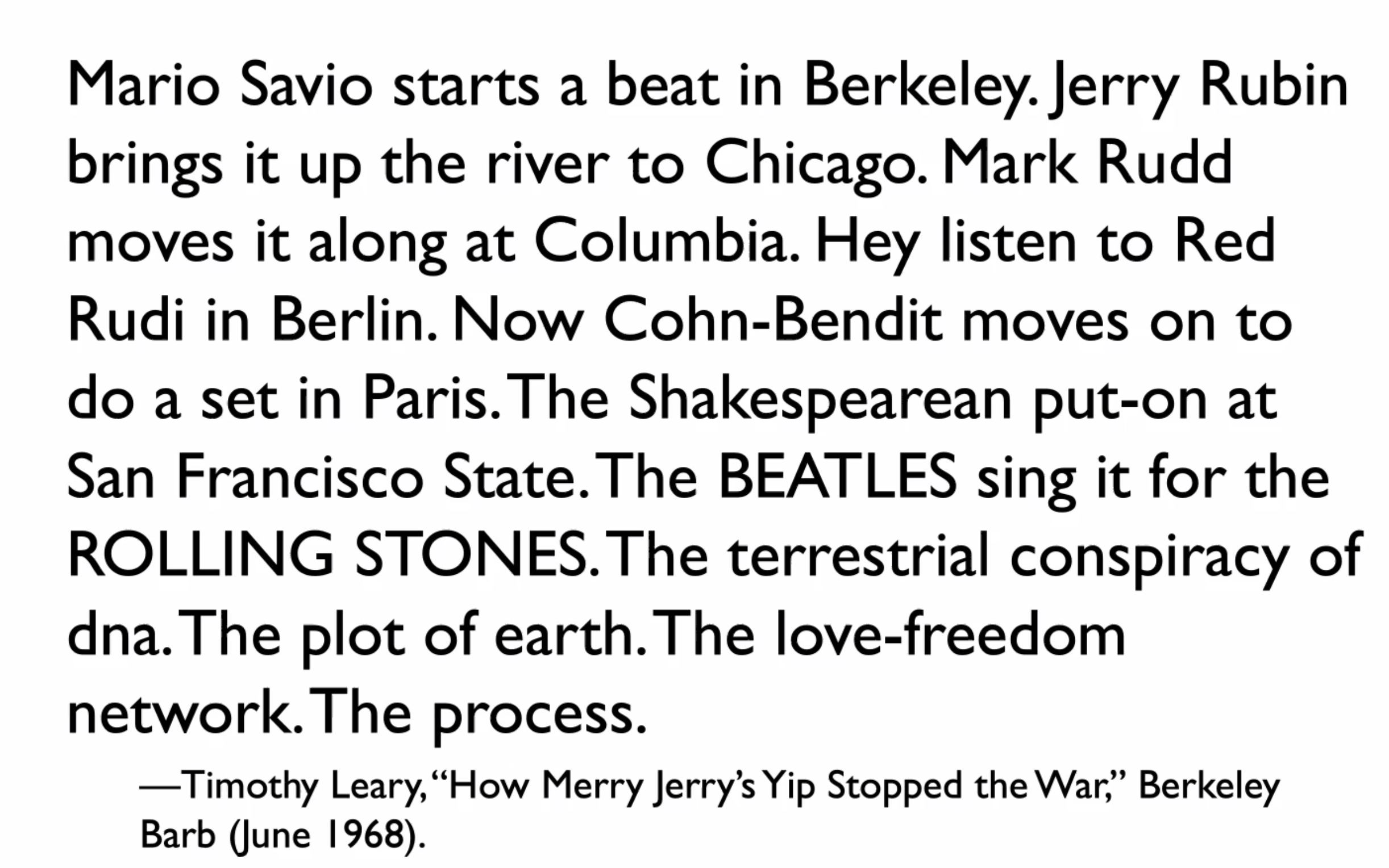
- Agency in Battle of Algiers – accomplished through sound. Levy-Bruhl participation.
- 0:45 what does he say about materialism?
- Rushkoff Occupy Reality clip
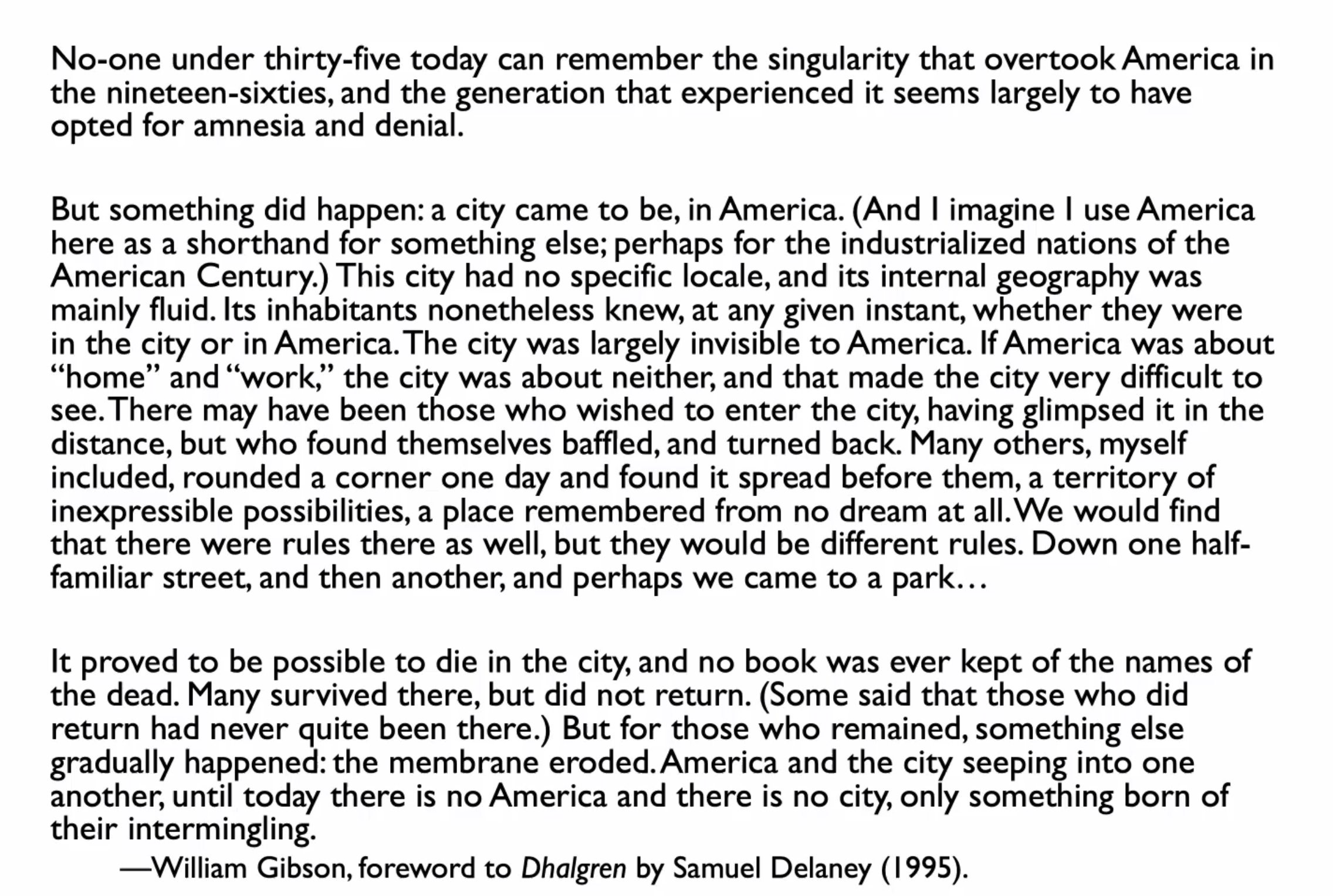
- Brouwer ref! A two-ity. Parachronic time
- Mathematical languages shape our understanding of time in physics | Nature Physics (from Jacob Foster)
- Chesterton Orthodoxy Eternal Revolution (!)
- This was quite good! And touched on a bunch of my own touchpoints.
- Office hours
- habit and canalization (good and bad)
- Finite and Infinite Games comes up (from JFM)
- Winnicott, Playing and Reality (from Joel Grus)
- Hollow Knight video game
- Stravinsky quote about limits (also Fripp and Henry Miller)
- Alex Henderson (NC) anarchism
- Orwell quote from politics and english language: the inflated style of harold lasky...pf dubious about "the political"
- JFM: Distributivism, catholic social teaching..
- Dylan Burns: Climate Psychology Alliance
- Hopecore and hopepunk
- Adam Curtis Hypernormalization
- Karolina Lebek: teaching a course on utopia
- Notes for me:
- Occupy is such an unusual semi-political term
- Office Hours 2 (listening only)
- Christmas dishes
- Animal play as practice. PF: make-believe as a favorite topic. Kayfabe. Occupy had elements of it.
- Kate Altheiser, animal musicality (a student of his)
- Nathan, capitalism is a wave like elctromagnatism.
- JFM: you can't reduce waves to motion of molecules (is he a Latour irreductions guy?)
- Practice and canalization (again). This is good. Very important to make good choices about what you repeat. They should talk about resistance to practice though.
- William Irwin Thompson essay (unnamed)
- Zen and freedom. Looks like the negation of freedom but to the person sitting, that is freedom. And within the very limited freedom of classical music. Within these frames, the goal is perfect freedom...being what you are, the freedom of being (JFM: that is what real magic lecture was all about). Honestly I don't quite get. Sure, being is great, discipline may be totally wonderful, but how is it freedom?
- Yeah skip that and stick to the topic
- Discipline is great but in what sense is it freedom? I don't quite get that. Maybe it's because I don't quite believe in freedom.
- Ah, but I am trying...I am selectiong versions of myself that believe...as have my illustriouos ancestors...
- Not that I want to open up that tedious philosophical debate – I believe in practical freedom vs metaphysical freedom. (hm that is a good phrase)
- Freedom to choose a master, it sounds like. Freedom to follow a discipline.
- PF: Practice is always breaking and reforming
- JFM on Mulder had to realize he was on a non-rational quest..o.y vey
- Monk Watering a dead tree (as analogy for practice). Or piano or dissertation. Long stretches of aridity.
- Practice vs performance (my stupid hypertext is blurring the lines, may be the problem).
- St John of the cross (dryness)
- Habits of weirding (habits of self-creation, soul-creation, creating a destiny or telos. Not picked out of a menu).
- Suggests both Aspiration and Inventive Minds
- James on Habit in Principles of Psychology
- could the young but realize how they will soon become ambulatory bundles of habit....oh my that is good.
- Oh Ainslie too
Week 8 Hyperstition
If Weird Studies has an overarching theme, it may be the hunch that the fundamental principle of reality is neither inert matter nor pristine mind, but pure event—that is to say, drama, story, poesy, act. There is perhaps no better way into this thought space than with the philosopher Nick Land’s *hyperstition, *the notion that certain subjective imaginings can, in time, become objective realities.
- Seems like a weak notion of hyperstition to me, which has nothing to do with subjective and objective. It's not subjectivities becoming objective, it's real powers calling themselves into being out of nothingness.
- But that's just one phrase, I think in general he gets it as least as well as I do, probably better.
We will argue that by embracing hyperstition, one can make life a transformative process on the cosmic scale, a sacrament that leaves nothing unaltered, not even the remotest star.
- or maybe not, I think Nick Land would barf up his amphetamines at this nicey-nice shit.
- Nick Land reading! Alright, cool.
- Read these, its a weird take-off on Burroughs.
- Lecture
- Weirding as a practice (or set)
- Long viewing, cursor, (I haven't really done these properly I'm sorry to say)
- Weirding as Negative capability
- More like pluralism than skepticism – universe overdetermined (meaning, can be explained in multiple ways).
- Weird philosophy is subjunctive, about how things could be (I have to say I'm not down with this really). Maybe, but not undecided. "supervenes on a deeper yes". Yes to absolute possibility. A knowing of radical mystery.
- Large Sum example, boring. How can we define a world where this is possible. Second spear (Azande) – this stuff is all nonsense, at least as argument. Acausal events, they have no fucking clue.
- Magician extracting possibilities from the field of the possible and makes it real. "reaching into the imaginal".
- Well how do you do that: "Advanced Magic for Beginners"

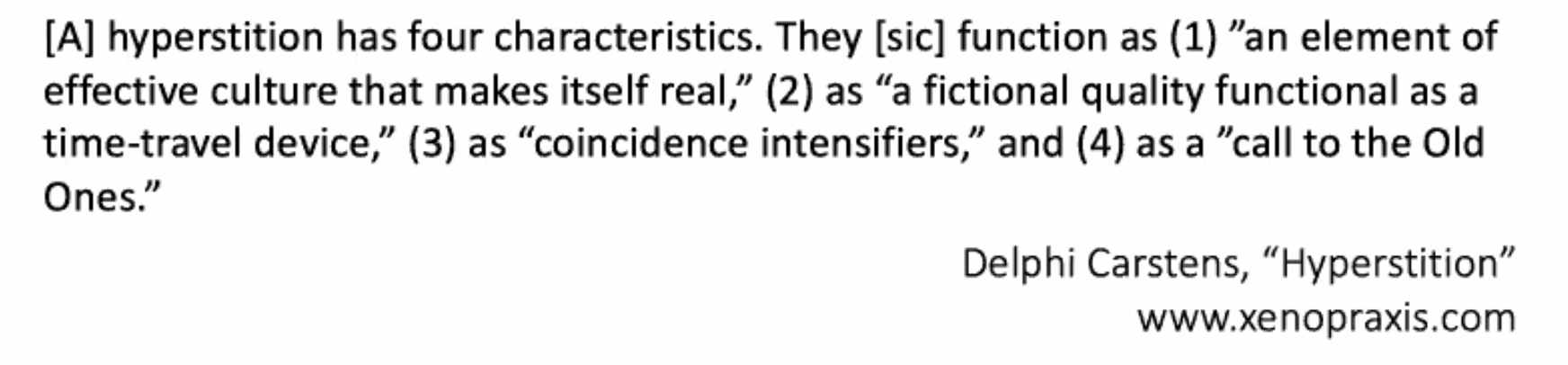
- What are the old ones? "the non-human real"...are they literally entities?
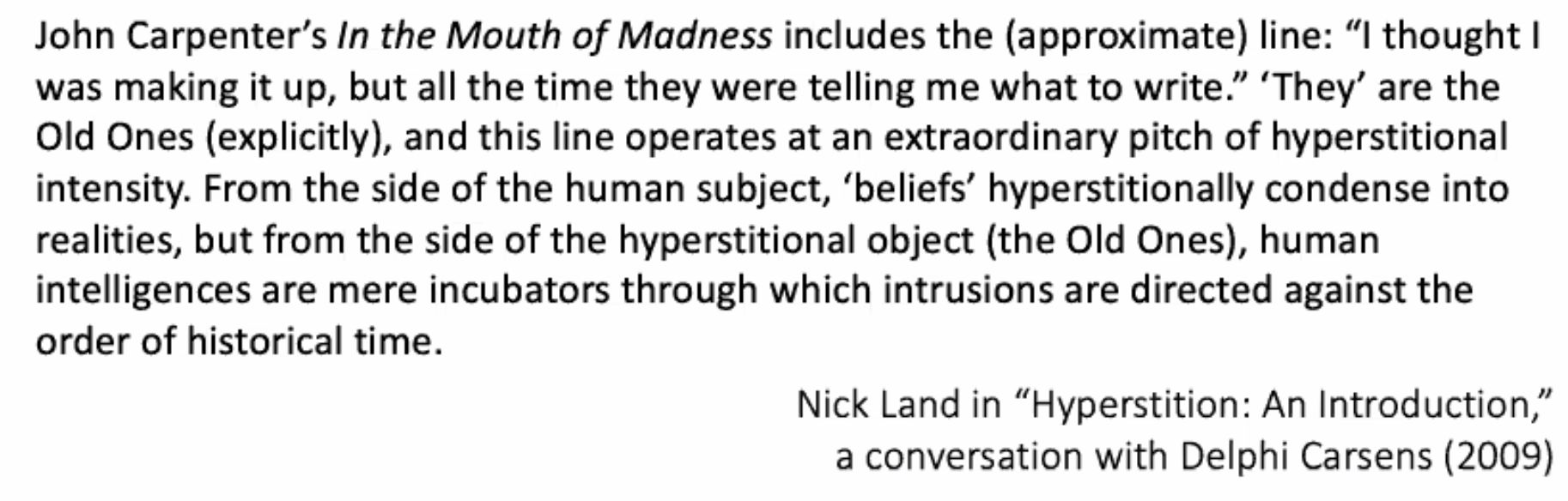
- To Land and Burroughs the Old Ones are the good guys (chaotic, opposed to The One and The Law).
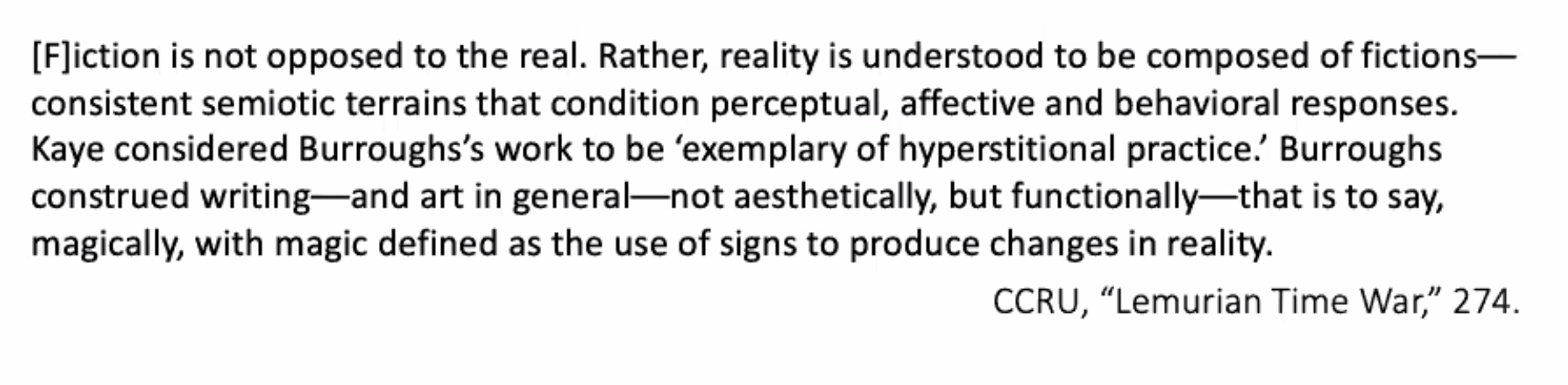
- OK that one I can get behind.
- "esthetic universe" as equivalent...not sure about that.
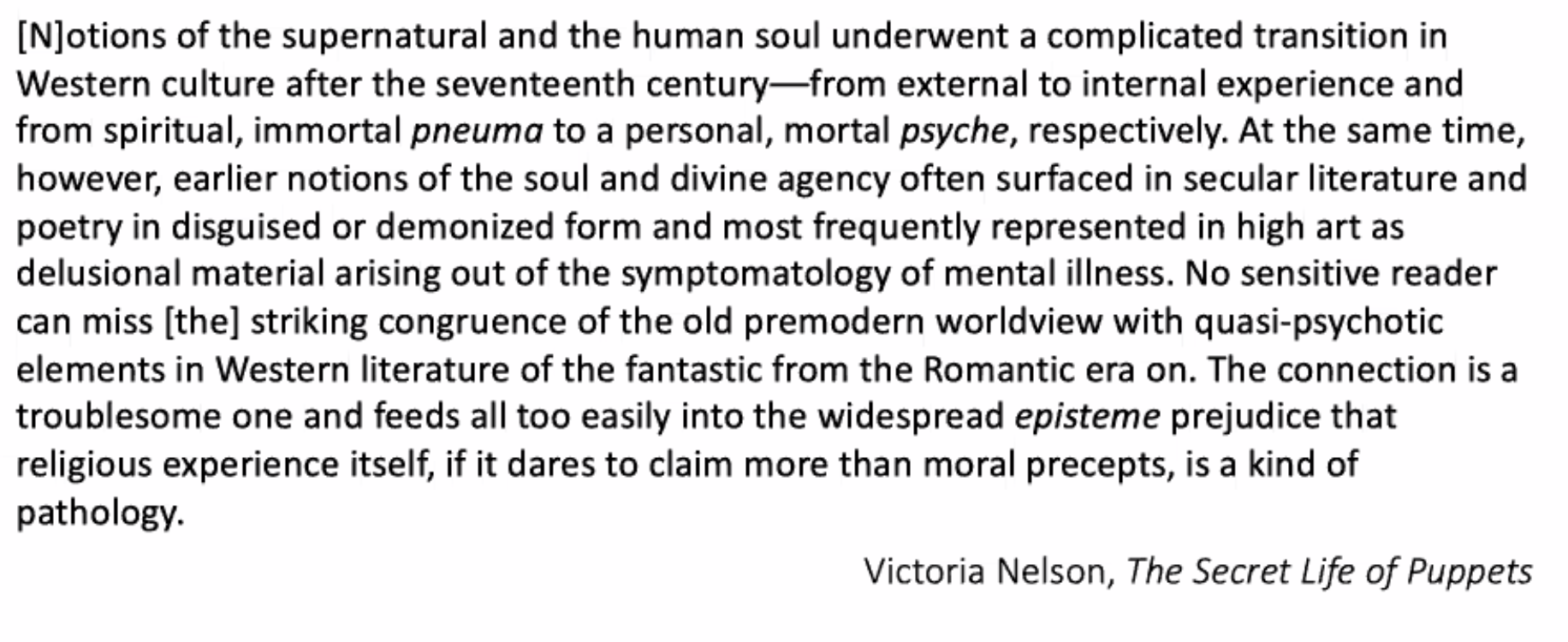
- Mentions that we have problems dealing with fictions that are ridiculous or evil (Scientology, David Icke, etc, Q-Anon).
- OGU vs MU One God universe tries to constrain hyperstition...
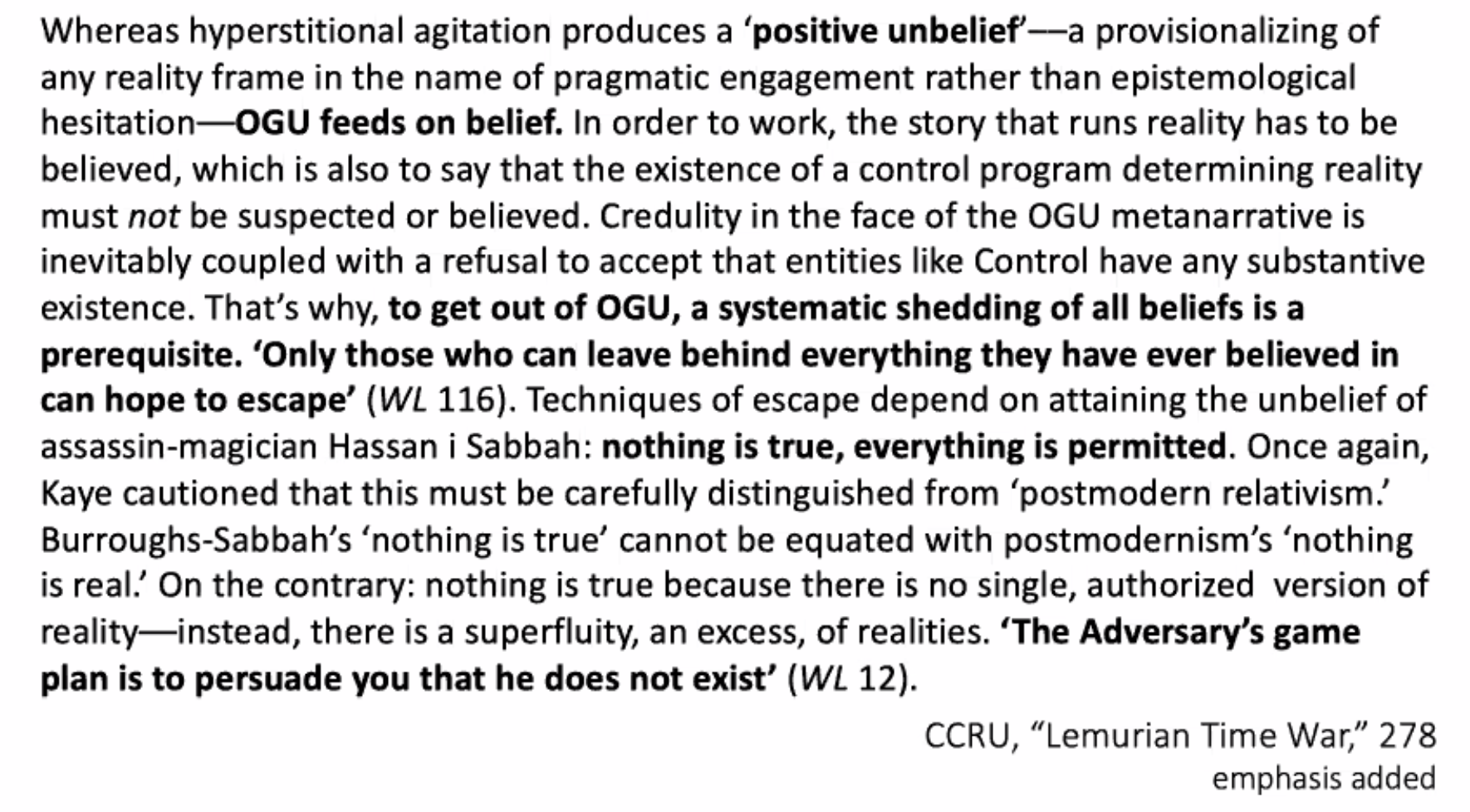
- Burroughs control – works by limiting the imaginal
- Linear time and OGU just other stories, will collapse into chaos at the end.
- What does belief mean? If time itself is control, no place to put your trust. Nega-nosticism. Ethics of suspicion. Bad, so we have to trust the world.
- Deleuze made this his final plea (?). Plato: the Good is beyond Being. JFM: the good manifests in the causal structure of reality(?). Leibniz: the best of all possible worlds.
- Logos, Paremenides...
- The everyday world is weird (OK agree there). But replacing our felt experience with a model de-weirds it.
- Belief/suspicion abel/caine (dont know if I share his interp of that)
- Burroughs/Land dismiss homely regularities of time.
- Morton: symbiotic real? Meaning not given, must be enacted (OK?).
- Lemur story overwrites Vollmer story? I don't see that.
- Burroughs and ccru metaphysics are manichean, dualist, schizophrenic...all conspiracy theory shares this (?) as does politics (?). Split of the atom in Lynch's Twin Peaks...
- pronoia solution, the idea that world is evolving towards to good (oppo of paranoia). You can trust this world...because
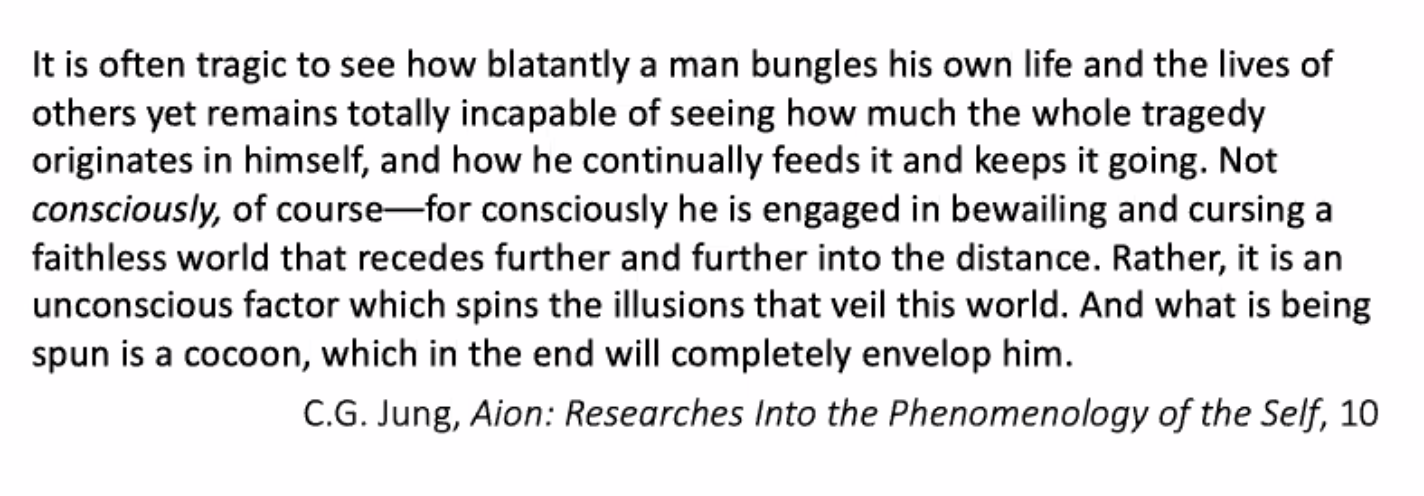
- So...stupid question maybe: JFM are you saying that OGU is not so bad? Do you find yourself on the other side of Burroughs in his magical war? Or do you reject his framing, you don't seem to feel monotheism and magic are at odds.
- Deleuze: philosophy is nothing without non-philosophy. (eg the world is right there, we know it, Dōgen ). Phi creates concepts to help us (yeah)
- Office Hours 1
- Nathan: Burroughs himself a hypersitition, suppression of homosex goes back 3000 years.
- Lauren Holt works for Cambridge Institute for Existential Risk Lauren Holt
- JFM: course should have focused on "The Event" – the irruption into time of soemthing that changes time itself (?).
- Deleuze Guattari refrain, reflects on self. "the natal", pre-existing real forces.
- Jaci: Burroughs OGU was his own accusatory viewpoint. Searching for forgiveness.
- Warren Ellis and Declan Shelvey’s series INJECTION riffs on the ecru. Very cool series (two more GNs yet to come)
- Office Hours 2
- Renee mentioned the bleak tone of Nick Land material and thanked hosts for making something positive there. Yeah. "brimming with possibilities". Man, she (and others) are really filled with the spirit. Not sure I am, but I can appreciate it in others.
- JFM: Deleuze style of teaching, not a transfer (reminds me of Minsky). "best letters were from surfers and origamists – they understand The Fold"
- Goal: bring you into a new space for thinking
- I completely love JFMs stance here. I should accept this and stop looking for reasons to fight.
- PF: education is learning to take pleasure in your own thoughts – nice. Means you can do that for others.
- I thought he was going to say practice, but I guess practice requires a conjunction of pleasure and thought.
- Tells about a boddhisatva piano teacher – what was his secret? He made PF believe he could do anything...
- Emergent intelligence – the party. Yes. Giving people license, permission, etc.
- David: check out Nathan post. The David Icke problem – what about the too-weird shit (good question actually)
- JFM: sympathetically and open. If you believe in daimons, don't jump on those who beleive in other daimons. Against ethos of suspicion. Approach sympathetically. Nobody has a picture of the whole or a final truth.
- Modernity rooted in suspicion (eg scientist who says phys world is illusion) leads to nihilism...hm, kind of confused but who isn't.
- JFM: ethos of trust in reality. A stable world needed for David Icke to be wrong. We can't account for stability and trust, so its a leap of faith (?). ref Errol Morris Weird Studies/Errol Morris, Lobsters anti-Kuhn.
- PF: how do you know your path (away from consensus) is good (think of that Vimalakirti quote). Risk of Q-anon, gurus, etc.
- JFM: Harner, Way of the Shaman (I have that) story about Ayhuasca entities and trust in the forest.
- Jacob(?) mentioned antisemitism, good, Near-enemies of WS (land/burroughs). What's wrong with it?
- JFM: Burroughs late embrace of cats, lemurs, love even. Nietzsche pluralism Deleuze
- Nathan: re-emergence of gnosticism (on a 500year cycle). Pro-polytheism. Transfinite numbers implies polytheism (hmm). JFM: WS is pluralism in a spirit of trust. Recommend Tom Holland Dominion book. We don't want inquisitions.
- PF: worse is better for ideas (VHS vs Beta). But he won't be part of it.
- Nick: q about pronoia, can it be applied to art. JFM: rec Huysmans and decadence? Modernism negates ethics... Ligotti develops universe of trust (?). "The Order of Illusion" (hm sounds like Taussig Defacement is relevant). There's always meaning, hence value, hence The Good. Cormac M, etc, exploring the nihilistic limits but still in some way affirming an underlying layer (my words). Charnel grounds.
- Realized that JFM (The Good) and PF (evolution and power) are re-enacting an old and dull philosophical argument (Gorgias maybe?). But the power of the show is that they are not fighting over that, they are looking for commonalities that transcend that difference.
- Weird thought that this should be applied to AI Alignment, although not sure how.
- Daniel: Road to Western Lands JFM: Freud Beyond the Pleasure Principle, Death Drive.
- JFM: left-hand paths
General feedback
- I wanted to say thanks for offering this course and the larger intellectual space you are in the process of defining, and for welcoming a wide variety of minds into it. It's been a pleasure, and continues to be. Thanks for letting us in to play in your world.
- I began this course with a small amount of trepidation, which seems a bit silly now, but I worried because (a) I have significant differences with you guys, in background and maybe in other ways (b) it was clear that this course would be something intense and personal, not a mere intellectual exercise. That combination can lead to arguments – I was worried I'd fall into the Richard Dawkins obnoxious scientist role. Didn't want to do that, and I think I've avoided it.
- WS is itself a kind of hyperstition. It's a living thing with a degree of autonomy, it has its own agenda, you guys created it but don't exactly control it. And we are all parts of it, servants of this greater thing, something we want but also something we feel a bit impelled towards despite ourselves, something we are drawn to. [again too fucking fancy]
- WS is a Thou,
- as opposite from say a Coursera course as you can get.
- I like to think in opposites and oppositions don't I. I think the WS guys do to at some level, more than a good rationalist should.
- The secret of difference. (Also true of NI, an intellectual TAZ)
- ethos of suspicion vs trust. I think I am starting to understand what you mean, and the contrasting readings of Burroughs and Land helped me see something. Modernity knocks out trust and replaces it with something gleaming, sterile, artificial, and not really with your best interests at heart (it's kind of like replacing an organic community with a shopping mall owned by a faceless global corporation).
- Things that are born also die. The eternal OTOH
- What do I really want to say? To be wrt to them? In relation, but what is the status nature of that relation, if there is one? Mutual respect would be ideal. Not above, not below, not against.
- But I feel presumptious, because I'm insecure. But that's boring AF.
- Why are we here? Presumably we all have our own personal reasons for being impelled in a certain direction.
- WS as hyperstition
- Kind of obvious maybe, but I wanted to say it.
- It's a living thing, we are particpating in its emergence.
- Even a magic-doubter like myself finds myself caught up in it. Pretty neat! Also a bit unnerving and scary.
- Risk of spiritual materialism or something like it. Reifying into an ideology (better to stay a praxis)
- The ethos of suspicion and its opposite
- Everything is true
- Argument and praxis
- I-Thou and risk
- The Good and the Dominant
from Weird Studies/Courses/Macbeth
- Notes on Macbeth with J.F. Martel
Other Readings
- See Macbeth Macbeth/Bibliography, Weird Studies/Cutting (Patreon), Weird Studies/Up and Over (Patreon), Weird Studies/Let It Come Down (Patreon)
- Come and Go, Beckett (time and modernity)
Session 1 Mar 14th, 2023
- Shakespeare and the Weird
- S as original weird writer, precursor to Lovecraft etc.
- Soaked in magic, that we moderns think doesn't exist
- Me: why do we care what Shakespeare's real metaphysical views were? He was an artist, not a philosopher or theolgian.
- "There are more things in heavan and earth that are deamt of in your philosophy" – OK
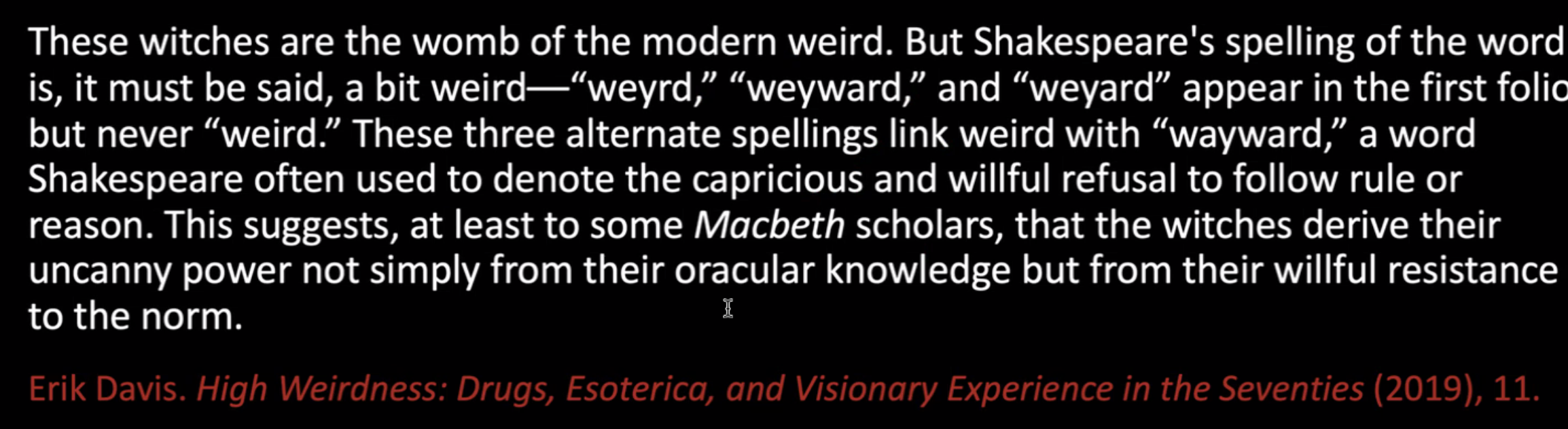
- Means both fate and deviant from order (wayward)
- Shakespeare's ghostwriters, by Marjorie Garber? Harvard "Macbeth is a play that refuses to be contained with the bounds of fiction" – thus a magical working
- The Rift (as essential component of artwork)
- Jung: relation of anlaytical psych to poetry (naive vs sentimental)
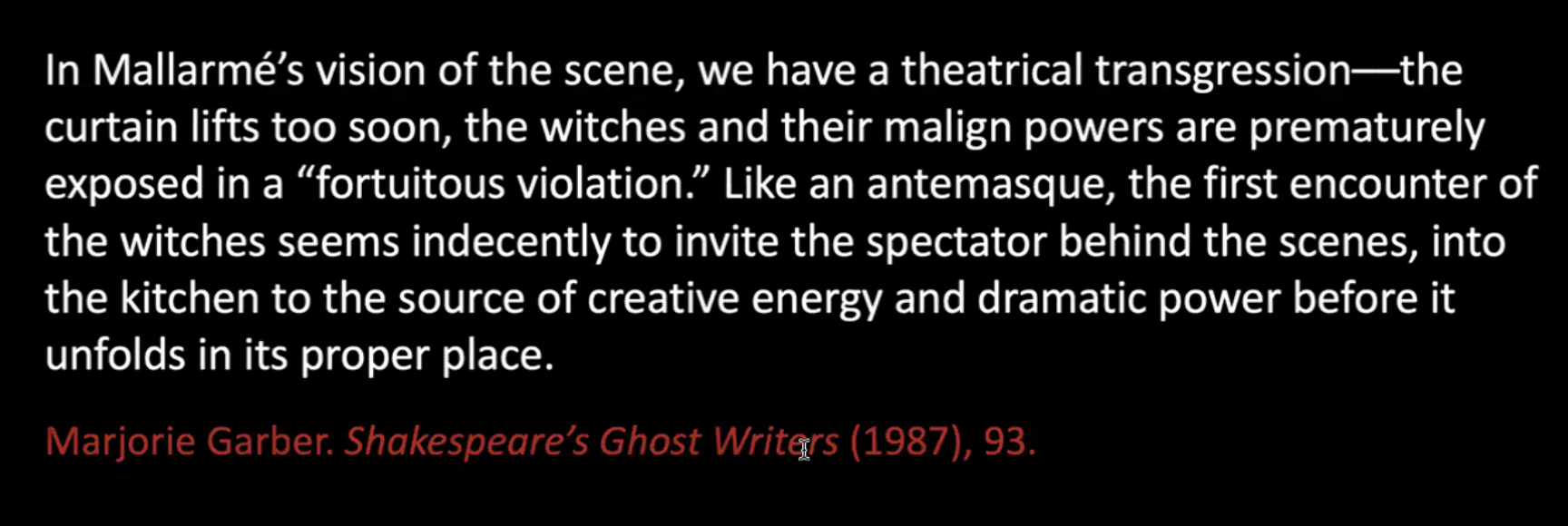
- Macbeth describing a reality, not just the imaginal (think I might argue with this, or at least, what it is implying)
- Blake as decadent?
- Alan Moore, culture turned liquid
- Macbeth and Metaphysical Transgression
- Themes: time, the weird, death of god, nature of evil, ecstasy (mentioned twice), and most importantly: cuts
Office Hours 1 (Sunday)
- whirld – a ferment – birth – vortext
- Jaci: feels scriptural because of the rifts
- JFM: scripture – we need them for reality – to penetrate to heart of things
- He listened religiously as a teenager – realizing I was antireligous as a teenager
- JFM: 3 forms of movement or time: turning, cutting, flow.
- Threes are unstable, fours are stable
Lec 2
- Time (postponed) so instead: equivocation
- implied metaphysics (starting with his groundwork course)
- which I haven't done, feel like I'm missing something
- aura of supernatural power, play is cursed, because it is something of a spell (he doesn't use that term). Not a mere allegory.
- Shakespeare not only believed in supernatural, but transmutes them into new thing...ED says witches are womb of the modern weird.
- Old wyrd: Fate – no longer the inscrutable will of gods but something about forces that elude semantic capture.
- He's constantly arguing for the reality of the supernatural and the inadequacy of rationalism. I go about halfway with that.
- Replacement of gods by "mystrious forces that elude semantic capture" (not sure what that is meant to imply)
- stage metaphor, Shakespeare literalizes (not sure what that means)
- Bottom's Dream quote – dream without a dreamer. Speech: Bottom's Dream by William Shakespeare | Poetry Foundation
- radical mystery – this is a major JFM idea
- interesting quote from Holinshed (shakespeare historical source)
- Witches: Jacobean witchcraft and feminine power
- Witchcraft somehow connects feminine activity to state power (?)
- James was Banquo's descendent so owes his kingship to black magic.
- JFM: modern weird is just as magical but much less knowable.
- The plays subject is the weird, the transgressive...it weirds us, in that attunes us to the dreamlike nature of reality: rifts
- hypnotic quality, all these ideas swirling and pooling...life goes liquid...nothing to hold onto.
- essay "macbeth and metaphysical evil" should check that out
- Milton, Blake precursors of the satanic qualities, evil be though my good...decadent art (is that really the right term) beautous malignity
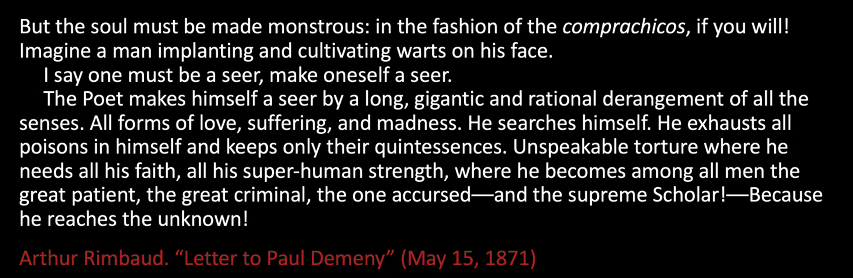
- the soul must be made monstrous
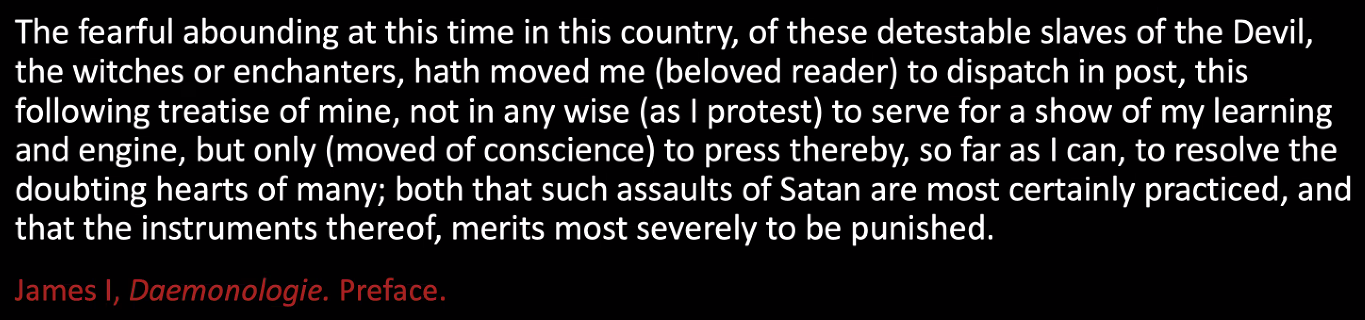
- thus: art reveals some aspects of reality, real discoveries (and Macbeth is such) Picasso quote about Art is a lie that makes us realize truth.
- A work of art is more than itself.
- Art splits things, it is saying two things at once, Magritte pipe example. That is equivocating.
- Gunpowder plot, equivocation, how Catholics could lie and tell the truth simultaneously (huh did not know about this at all). Jesuits out of Aristotle
- Article "Macbeth and the background of jesuitical equivocation"
- The play equivocates with equivocation (it mentions explictly ikn many places)
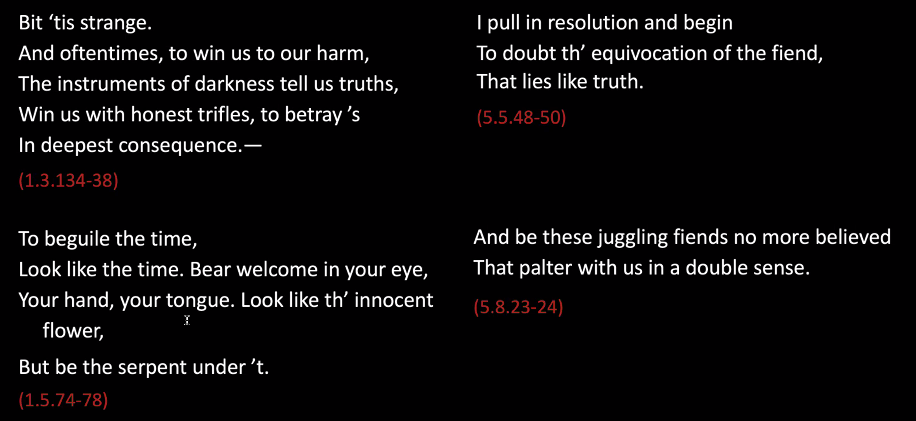
- God doesn't care about modality (thought or speech etc), and thus imagination or reality are the same (to god). Jung unus mundi, world before split of mind and matter.
- language is magical, and also (because metaphor) always equivocal (no argument there but ok so what)
- doubling of doubling (occurs in many places)
- As far from artifice as you can get (ref his book)
- He didn't like Coen abstract dreamworld set, for plausible reasons. You want the union of imaginal and material.
- The imaginal is the basic blah. Reality is imaginal, the causal world is an instance of the imgainal...ho hum. Hes going to go over this nex ttime
- In the material world it is never really night (?) Night in a dream is absolute, not this messy vague space of reality... night in dream contains opposite...ok so what...things are never confused in dreams.
Office Hours 2 (Sunday, recording)
- equivocation – the confusion is in particulars, not universals? No idea, but his example is fair and foul – they don't cease to be real categories, but individual things can oscillate between them. Hm. For some reason I want to fight with that but I can't even say why.
- NOT perspectivalism. Sigh, I feel there's some tendentious philosophy goal here and it's not so much that I want to fight it, but it bores me, I suspect it is a waste of mental energy.
- it's never more urgent to know than when you can't know.
- Registers of sense, x could be fair in some sense and foul in another.
- The fair and foulness of politics. He's against it, it's a flattening of sense (in that if something is foul you don't have to experience it).
- Feel like I could make a violent argument here.
- The play itself is foul in some aspects. "A tale told by an idiot". Complicity.
- 2nd guy: map and territory. Any dichotomy is really a triad (A, B, A+B) not sure what that has to do with anything. Cantorian mathematics. JFM very confused about set theory, although maybe not at the important level. Mention of Laws of Form.
- This is fine as "stoned rap" sorts of conversation, I'm not sure it would pass in my version of academia. But why not?
- JFM: Monsters important at this time (Descartes). I sign from outside the knowable. The cut that opens the dyad onto a triad.
- Rimbeau: the poet must make himself monstrous
- Jaci: starting from the end. Macbeth in tune with nature in a Hermetic MotT sense (?). He is a kind of mirror, open to forces. JFM: Bloom's book on Macbeth. Deleuze-Bergson-Matter and Memory - his idea also is outside mind/matter seesaw (!). Where is the personality of a character. Shakespeare, characters who can't act (Hamlet and Macbeth).
- Jaci: Nature magic vs perfect magic . Crowlean magick entirely masculine control, Tomberg hints at cooperative form of magic(?). Macbeth as Scotland personified.
- Karlolina: you need structure for equivocation(?). Sandman reference (to the Diner horrorshow with Dr. Destiny(?)
- Act 4 Scene 3 scene with Malcolm:
- That which you are, my thoughts cannot transpose. Angels are bright still, though the brightest fell. Though all things foul would wear the brows of grace, Yet grace must still look so.
- Apollonian aspect of play (opposed to obvious D qualities)
- Alex: British comics: imaginal breaking into the real, a constant theme. Equivocation and cuts (cinematic) in Watchmen, V for Vendetta begins with Macbeth quote.
- JFM on Moore's politics (oneiric). From Hell – modern born from Ripper's caesearian cuts on reality.
- The Tempest (LXG) – might reread that
- JGM against modern interp of Macbeth in terms of agency(!) (Emma Smith at Oxford) because of pluralityh of powers. People did nto really believe in unitary agency back then. Macbeth feels like modern porous self, an emergent self. Banquo's ghost speech. Now, modernity is the haunted time.
- Kevin: language as infection, witches infect macbeth, play script infects actors.
- Why is Shakespeare so good (an answer in Sandman!)
- JFM: the irrationality or rationalism (H bombs etc)
Lec 3 Time in Macbeth
- Last week: Shakespeare as prophet of modern weird; equivocation; indiscernability
- not nominalism but realism
- time crystal when the indiscernability of categories reveals itself (???). Confusion belongs to the material world; in the imagination images have limpidity and defniteness (?). Night and day example (seems very confused to me), Midnight and noon as privelgeed points of manifestation (even more confused). So: dreams are not confused and opaque, that's the material world.
- Course argument: the real includes not just phenomenal but also the imaginal realm, where every possibility is already real. Actual possibilities, who are objective through the act of imagining (I don't know, sounds fucking confused). Manticore example. If you can imagine it, then MAYBE it existrs.
- Being is a subset of maybe-ing.
- Sounds like “Everything to be imagined is an image of truth.” ― William Blake
- Dinosaurs and dragons (also fucking confused)
- The imaginal is peripheral....
- The class as imaginal event (future) exerting a force on JFM in the present. OK no problem with that. When class is over, it goes back to the imaginal.
- visionary is implicitly outside of time, observing it from a vantage, not embedded within at as ordinary people are.
- time is the cut, Now is the Knife (I made that one up)
- acausal time cut hyperchaos
- hesiod's theogony
- we are always already in the imaginal....
Office Hours 3
- last tue was "originary time" -- bits of Deleuze and other usual suspects
- Five forms of time, a multiplicity but Deleuze had a handle on the primal form. Witches as time crystal.
- ordinary time. paradox of the present (always past when you point at it) Bergson: accept the paradox of time, it is both past and present at the same time? ????
- All this discourse presumes a point-experiencer which isn't real.
- originary time has no laws (???). It's not clock time...seems confused. The knife of time makes sense for lived experience, imagination doesn't work that way?
- Dan Haar: Brings up frazier, eliade, saturnalia...Macbeth as king of saturnalia, prerisded over period of lawlessness.
- JFM: a spiral, not a flat circle, and presided over by the gods.
- He says Macbeth undoes circularity, dialectic structure....
- Capitalism as an ontology of time. Marx CMC...vs Capitalism MCM (vague antisemitism thing). MCM' Marx resorts to occult language. Damn this feels stupid. No more cyclicality -- this is modernity. All cycles are contingent (as opposed to ancient world where they seemed fixed).
- Kevin Lincoln: Nolan films playing with time.
- Babak: played the play. Hecate enters and berates the witches. Opens with a scene outside of time. DIfferent metrical scheme for witches...poetry is rhythm is time. Bergson...poets have naive view of time (?).
- JFM: Macbeth has killed Kingship, he's not really king. no center to things.
- Karolina: ripeness and time. intensity (also found in Deleuze and Bergson ?). Repeated Ligeti notes in Eyes Wide Shut.
Lec 4
- More on time
- originary time, time as cut, gushing forth...acausally
- Heidegger – who is time? No time without a who (theism?) Aligned with Kant(?) In Macbeth, the three witches are the who of time.
- "the charm's wound up" – a machinery set in motion.
- Time of the witches, primordial, underneath ordinary time
- ordinary or natural time.
- cauaslity is in ordinary time, this lower time is acausal. Hume on causation (I think he's full of it)
- Something very crappy about this, I can't quite figure out what.
- Time does not produce, it mirculates (from Deleuze)
- Dan Haar recommends Rovelli Order of Things
- Shakespeare didn't produce play like phlegm; causal language in art is dumb. It involves decisions (cuts)
- He is wrong but I don't have energy to argue
- Shakespeare;s characters are not aware of him as creator, he is outside the causal order but creates that order.
- Shakespeare's castle could just appear (OK but WHY SHOULD THAT IMPLY ANYTHING ABOUT REAL PHYS CASTLES)
- imaginary and real 5:48 argh drives me crazy.
- all possibles are real does not mean all exist, or else we'd be in determinist universe? WTF?
- The future insists in the present (exerts a pull???)
- He explictly states the goal, the imaginal as being somehow prior to the real.
- Eidolon, self-existing images, the main things. Not idealism or materialism, but something else. (OK)
- "We are such stuff as dreams are made of" –
- Jacob Foster: I’m a big fan of Rovelli, but I think Nicolas Gisin comes closer to JF’s sense of time. If I recall, Rovelli views time as emergent and epiphenomenal, whereas folks like Gisin or Lee Smolin view time as fundamental and — at least in Gisin’s case — generative, “deciding” the present through fundamental stochastic events. .
- A 20-sided die that always hits 20 because causality is BS or something. Argh. None of this makes sense.
- Theogonies, primal chaos split into opposite. The Origins of Greek Thought, Vernet(?). War between agents. Anaximander, beginning of phiilosophy, replaces warring gods with neutral elements. No room for chaos.
- Christianity, making desert god take charge of the whole enchilada. Working towards Answer to Job. Psalm 89, sudden turning against god.
- Around 1000 (where historical Macbeth appears) the whole edifice begins to groan, the inner contradcitons are too much (of Greek/Jewish conflicting god models).
- Montaigne "On a Monster Child", siamese twins on tour,
- In Macbeth, world falls from Cosmos to Chaos (OK).
- Subtle Knife riff. In Macbeth daggers are doubled quite often. Imagine dagger and Real dagger form a time crystal.
- Killing the king vs. killing kingship (order) itself, a deicide. Murder of the Christian god-image after 1600 years when it was getting stale. 1040 is just in the middle of the Age of Pisces (Christian Aeon in Jung).
Office Hours 4 (Thu)
- 5 kinds of time. Time Crystal question. Why crystal? Deleuze actually used terms from crystallography (?). Regular pattern suggests reflection and mirroring. Seed or originary event plus environment. Part of theory of individuation.
- Nathan: semantic attractors. "Nonlinear" means roughly magical (butt that's a good thing, in this context). Meaning as a potential in space.
- JFM and he agree that materialism-idealism split is kinda dumb. OK.
- Nathan has some theory about how magic works in terms of these attractors, which sounds quasi-naturalist to me, at least, more so than JFMs.
- JFM complaining people say you "can't go past Kant", not sure what that mesans.
- Rec: Bergson, Matter and Memory, Ch 1 ("pure immanence" according to Deleuze, along with Spinoza).
- Freud: Cubism: Macbeth and Lady Macbeth as faces of as single person
Lec 5
- Nothing is but what isnot
- Werner Ceuters, hyporealization and hyperrealizstion (philosopher of psychosis)
- why 2 daggers? because 2 murders (king, god)
- Time is out of joint (Hamlet, earlier)
- Answer to Job – Jung as literary critic. Yahweh as an unconscious character
- Echo of Duncan. blood scene Nietzsche Gay Science
Office Hours 5
- Circularity vs linearity. Charles Taylor, immanent frame, modernity...
- The nature of evil. JFM: innately chaotic elements of the world, the witches represent this. Jung calling for a post-christian view that acknowledges the reality of evil within us (in Aion). 1 fish 2 fish good fish bad fish. Duncan only sees one side, misses evil.
- Dan B: Simone Weil, Gravity and Grace
- JFM: Nietzsche is polyphonus (and so am I).
- Macbeth and Job comparison...
- Ross speech "modern ecstaay"
- The jewel in the toad – the treasure is where you don't want to look. The stone that the builders refused, the Freudian unconscious....
- Nathan: reading Job in the Hebrew, different names of God, Jobs faith was to Elohim not Yahweh.
- Jung has a dualistic reading of a polytheistic text
- JFM: Jung is very poly, Yahweh is just an archetype of self...Hillman didn't like wholeness(?).
- Nathan: ancient cosmologies say there is one point where one god became boss...
A Note on Forms of Time
- I had a strange negative reaction to this. Not sure why! Before I analyze it, let me make my own version:
- Physical time – objective, clock time, the dimension of the universe
- Experiential time – time as we experience it – an immediate but unknowable Now, past as memory and future as projection. Activity and routines.
- Narrative time – time as it occurs in fictions and representations. Once upon a time. Has plot points and beats and such. Overlaps with experiential time to the extent that experience has a narrative structure (see Against Narrativity )
- Those are my big 3, might also separate out clock/calendar time (a human discrete number system that attempts to capture and subordinate physical time). Improv time, free time, meditation time, life time (that is where birth, death, and life stories fit in). Musical time.
Lec 6
fissile core of Macbeth
- Deleuze post-Hiroshima cinema – a kind of existential paralysis. Ecstasy/paralysis
a cinema of the seer, not of the agent (actant)
- Macbeth claims to sovereiginty, replacing god
- Self-proclaiming power, paradoxical, equivocal...
- God is dead, Azathoth lives
- Evental time – like chthonic time because equivocal (???)
- but evental time is divine as opposed to satanic (??????)
- He means the equivocation of "brook" and a brook...I think...
- the fuck?
- the sixties as atemporal autonomous zone...
- The tiny cycle of times emergence from moment to moment, the last surviving cycle...wtf? not causal, it has a cut, it just occurs....oh god this is braindamage shit....the creative moment of the universe is now.
- radical freedom and hope (???) originary time doesn't have to give us a trustworthy order, but we do have knowledge, oh blah this stuff is dumb.
- grace of grace (not grace of god)
- Parmenides...pure immanence...acausal x can do anything, but it doesn't...gratitude only to agents...oh yeah the three sisters become the three graces! Forgot about that.
from Weird Studies/Courses/Kubrick
- About | All is Full of Love a JFM course. I expect I'll enjoy this one more than Weird Studies/Courses/AI because I actually have more to learn, whereas on AI I have to argue with everything. My takes on Kubrick are pretty standard; I have a feeling JFM's is more original, whether or not I buy it.
- Kubrick
- A Clockwork Orange
- Kubrick has a cold eye and his movies tend to revolve around people whose agency is sapped by inimical systems (I think that covers Dr Strangelove, Barry Lyndon, Clockwork Orange , The Shining, Paths of Glory, Full Metal Jacket, and to some extent 2001 although there it is balanced out by Clarke's optimism).
- Saw Kubrick exhibit at SF Jewish Museum in 2016, that was pretty awesome
- Minsky/Kubrick
- Realized that the human-trapped-in-iniimical-systemes theme is also in PKD which seems obvious in retrospect...surely this connection has been made? Notes and Correspondences: 77
- Notes
- Lecture 1
- early JFM essau: The Kubrick Gaze | Reality Sandwich
What you see in a Kubrick film is the conscious manifestation of an unconscious play of forces taking place beneath the celluloid surface. Kubrick is more concerned with psychic forces – archetypal, philosophical and cosmic – than he is with the emotional life of his characters or the diversion of his audience.
- K still photography
- Nabokov quote from Think, Write, Speak – dislocations
- Deleuze – diff&rep – undo dicntomies universal/particular temporal/atemporal – interesting
- fixing plato
- realism and formalism – both belieeve in objective reality
- hm?
- Office Hours 1
- viewed after the fact. Nice crowd. Monolith appeared in FMJ? Kubrick disclaims connections.
- Love vs coldness. Kubrickian love more like agape. JFM reading Spinoza and detects Spinozist acceptance in Kubrick.
- Lecture 2
- Nature of all the connections in Kubricks films. Whether intentional or not is somewhat secondary.
- Modernity as contingency. post WWII, even non-theistic ideologies seem contingent. (Note: I suppose this is all obvious to me, I grew up in this era)
- "contingency is the subordination of all ontologies" – fundamental unknowability. Man feels like an exile... I have some quibbles here but fuck me.
- I feel post-absurd. Like, Sartre etc are sill mourning god, I am beyond that (my generation).
- JFM: it is a bit of a platitude (but wasn't in 2000?)
- this seems like pure postmodernism, sigh, boring.
- Kubrick playboy interview
- fear of death, was just talking about that.
- Enter Deleuze. Paralysis of the film noir hero (Chinatown). The time image as cure (???)
Brutalism
- The Brutalism Post, Part 2: What Brutalism is Not | McMansion Hell
- from cat c, not JFM
- Christopher Alexander as the opposte of Brutalism
- Quote Blake's Tyger on symmetry
- Office Hours 2
- Deleuze,
- Brutalism (should read up more).
- Banam: Aquinas supposed beauty quod vicem placet (that which seen pleases). But in brutalism image: <latin> that which seen, perturbs. But sadnes and joy are predigested; a brute artwork will evoke something that does not have a template.
- Every terror is unique in Spinoza. Singularity of bodies.
- The inside and outside of a brutalist building are topologically continuous.
- Something about the imaginal but not sure how it connects.
- Topics: CA, the opposite of brutalism, almost reactionary
- Jason, Kubricon.
- Kubrick:film : Brutalists:concrete
- Kubrick films as sketches, treatments of "real" film.
- Units, central ideas.
- One-pont perspective makes a rectangulare space, thus monolith
- vettcality: transcendence, horizontality: immanence, the cross is where they meet in the human.
- once camera penetrates the monolith (at the end of 2001) all the rest of the films are within the monolith (???)
- Kubrick likes midpoints, this is the one for the corpus
- Time crystals (OK I want to push back against this, so he has two similar shots, does that mean he has some grand scheme or he just repeats himself? Oh well I'll shut up)
- Q re McLuhan, Kubrick as reinventing film as medium. McLuhan very religious, went to mass every day.
- Spinoza as uniquely generating a philosophy of pure immanence (Deleuze). Should read Ethics, apparently. Some stuff on emotion. Kubrick a Hobbesian on the surface and a Spinozist underneath.
- Paul Zinno reading Techgnosis
- Sculptor Robert Irwin
- Tom Manning cartoonist (should check out)
- Spielberg though the eyes of a child, Kubrick's is inhuman (and monocular)
- Lec 3 (got there late)
- Contingency. Have to say I don't quite get this, but he means "lack of solid foundations" basically.
- Kubrick creating light in the darkness
- Deleuze: nobody just makes a film, tehre is always a problem to be solved (that sounds surprisingly functionalist). Needs urgency
- Kubrick always transcended (examined) the genre he was working in.
- Kubrick created a persona which is at the center of each film.
- Fractal and modular (non-submersible units)
- Office Hours 3
- Decalogue Krizlowsky. Kubrick wrote preface
- I managed to ask a question about: 2001 Ending, novelization
- Only feel a little bit like an idior
- Jewish filmmakers, moral without being moralistc (so appear amoral). Coens and Kubrick
- Hal and Bowman both revert to infancy. Daisy lyrics significane
- Patricia Pisters the neuro-image (?)
- "It's not what the monolith means (or represents), its what it contains" – Kubrick to antonio.
- JFM: its the imaginal stupid. OK.
- Somebody in chat mentioned Signifying Nothing which I should reread re nihilism
- Lec 4
- Review of contingency, a term I dislike but I know what he's talking about. Citing Charles Taylor. Relativism on spiritual plane. And moral plane.
- Kubrick was reacting to that. Trying to make something singular (I don't quite see why that is a reaction to contingency)
- Problems and ratiocination.
- The emergent method is circular. Film tends to turn around a center. Often in the exact temporal middle. At that point, narrative folds in on itself.
- In Barry Lyndon, its the kiss.
- "a cyclopean eye looking at a human ritual for the first time"
- Kubrick goes from indivduals to puppets
- 2nd half of Full Metal Jacket, dialog is all cliches (huh)
- Logic of representation is problematic in art
- Tarkovsky, Malik (Lynch) trying to show us the transcendence, they are iconophilic? cataphatic Kubrick refuses to film this (other than monolith). He doesn't depict, he is apophatic .
- Pushing the immanent frame until it breaks (releasing or revealing the transcendent)
- Kubrick is of the brain, not the mind (?). His materialism includes the imaginal (yay) but he is committed to "taking the modern is true and seeing what happens". The WS saying "we aren't modern enough".
- The world contains the brain and vv, in a crystal blah blah blah.
- The circle is an entirely negative force in Kubrick, it traps us in the immanent frame. Every circle is viscious
- Influenced by Ophuls La Ronde.
- Reminded of The Circle Game and The Wheel. And the Buddhist wheel of samsara.
- Lang, Hitchcock also had themes of dark systemic forces, with a center wheel. The Shining, the hotel is the wheel of american society.
- Kubrick politics is downstream from metaphysics, and he's an extreme anarchist. Against the order of being. He was obsessed by the 18th century...because that is the moment when we crossed over into the immanent frame.
- Wow JFM is a consicousness eliminationist??? Not quite. But he is a Spinozist.
- Office Hours 4
- Kubrick depicts ontologicl levelling (from Kierkegaard) but also the remainder, that which can't be leveled.
- All art is the spiritual reasserting itself into the secular ref Eagelton on aesthetics
- Nietzsche, Schopenhauer as educator
- genius and divination
- The groundwork for magic class has something tos ay about the moden and beyond
- Galeleio --> Kant --> Deus Irae
- to be modern enough is to – realizing the modern project presupposes a world of meaning that pre-exists us... sounds like BS to me. reaffirming the divine nature, science has a sacred dimension (OK, I agree with him but get there in a different way, maybe?)
- Lec 5
- Back to circles
- Nietzsche Schopenhauer, circularity
- Against the idea that Becoming is hip, being is unhip
- Circular causal mechanisms, incl spirals and feedback loops (he doesn't really understand those)
- identity and AGENCY are fully determined by your position within the circuitry of the system. Everyone is a puppet (a clockwork orange). An automaton that believes itself to be free.
- Automatism. Long history in cinema, eg German Expressionism (Murnau, Lang, etc)
- Freud to Skinner to Sapolsky (!),
- In Kubrick movies everyone is a Golem, the universe is a neurological prison
- the automatism should come alive without external intervention (god).
- KDK12 in The Shining is "Kubrick". OK. Reflection in helmet in 2001 (moon monolith scene)
- The characters in a movie are being manipulated by a "supernatural" being (the artist, outside the system)
- The magician is a sign of radical contingency
- Jean Epstein, filmmaker and wrote The Intelligence of a Machine 1946
- The relation between creator and creation is not causal, its some other thing.
- precausal, synchronicity...the synchronistic event breaks the circle. the event refuses to be reduced to an it.
- Torrance in the picture is an escape? I thought that was a circle...
- One miracle makes everything contingent, liberates blah blah blah
- If its outside the frame, it can't be an it (because then it would be an it).
- Radical mystery. Thou is outside the frame.
- Duns scotus and leveling of being
- Kubrick as creator loves every aspect of his worlds.
- Kleist, loving us in our puppethood...
- Office Hours 5
- Bergson, Deleuze, Time Crystals, deja vu (in Kubrick, reflections, echoing)
- A real person made to act as a puppet.
- Spinoza, spiritual automaton (also in Deleuze on film)
- Roger Scruton, The Face of Love (JFM's fave conservative philosopher)
- Nathan on the 3 bodies of the buddah...
- Readings
- The Blue Hotel
The huge arms of the wind were making attempts – mighty, circular, futile – to embrace the flakes as they sped
from Weird Studies/Courses/Beauty & Horror
Week 1
- The idea of the holy : an inquiry into the non-rational factor in the idea of the divine and its relation to the rational
- tl;dr this seems like a very well-written attempt at describing the characteristics of religious experience. a very mapped-out tour of the ineffable. obviously such a work is doomed to failure, but props for trying I guess?
Before I ventured upon this field of inquiry I spent many years of study upon the rational aspect of that supreme Reality we call God , and the results of my work are contained in my books, Naturalietische und religiose Weltansicht (Eng. Tr. Naturalism and Religion , London, 1907), and Die Kant-friesisclie Religions-Philosophie. And I feel that noone ought to concern himself with the 'Numen ineffabile' who has not already devoted assiduous and serious study to the 'Ratio aeterna'.
- .
- Hm not sure what I will get out of this, its not like I have a great devotion to rational religion
- Makes me think of Taussig's Defacement because I am a smartass. Also No holiness, vastness!
What is maintained in this book is, in fact, that religion is something not only natural but also, in the strict sense of the word, paradoxical. It is a real knowledge of, and real personal communion with, a Being whose nature is yet above knowledge and transcends personality.
We generally take holy as meaning completely good ; it is the absolute moral attribute, denoting the consummation of moral goodness
- Wait what? That is not my definition of holy. OK I guess the book is arguing for something beyond that as well.
It will be our endeavour to suggest this unnamed Something to the reader as far as we may, so that he may himself feel it. There is no religion in which it does not live as the real innermost core, and without it no religion would be worthy of the name. It is pre-eminently a living force in the Semitic religions, and of these again in none has it such vigour as in that of the Bible. Here, too, it has a name of its own, viz. the Hebrew קדוש, to which the Greek ayios and the Latin sanctus, and, more accurately still, sacer, are the corresponding terms.
- OK he wants to disentangle holiness from goodness and proposes "numinous" to indicate a certain state of mind. OK.
- The first aspect he describes about this is abasement:
There you have a self-confessed feeling of dependence , which is yet at the same time far more than, and something other than, merely a feeling of dependence. Desiring to give it a name of its own, I propose to call it creature-consciousness or creature-feeling. It is the emotion of a creature, abased and overwhelmed by its own nothingness in contrast to that which is supreme above all creatures.
- Reminds me of 2006-06-01-joke-54-thinks he's nothing via Omniorthogonal: Death, thou shalt die . Also of course
- mysterium tremendum – something like "holy dread"
Religious dread (or awe ) would perhaps be a better designation. Its antecedent stage is daemonic dread (cf. the horror of Pan) with its queer perversion, a sort of abortive off-shoot, the dread of ghosts . It first begins to stir in the feeling of something uncanny , eerie , or weird . It is this feeling which, emerging in the mind of primeval man, forms the starting-point for the entire religious development in history.
And all ostensible explanations of the origin of religion in terms of animism or magic or folk psychology are doomed from the outset to wander astray and miss the real goal of their inquiry, unless they recognize this fact of our nature primary, unique, underivable from anything else to be the basic factor and the basic impulse underlying the entire process of religious evolution.
- Hm.
- Turns to the wrathful aspects of God
In the first place, it is patent from many passages of the Old Testament that this Wrath has no concern whatever with moral qualities. There is something very baffling in the way in which it is kindled and manifested. It is, ashas been well said, like a hidden force of nature , like stored-up electricity, discharging itself upon any one who comestoonear. It is incalculable and arbitrary . Any one who is accustomed to think of deity only by its rational attributes must see in this "Wrath" mere caprice and wilful passion.
- Personally I have a lot more feelings for god as wrathful than god as moral. The latter seems to have died in Auchwitz.
For one of the chiefest and most general features of Mysticism is just this self-depreciation (so plainly parallel to the case of Abraham) the estimation of the self, of the personal 1 , as something not perfectly or essentially real, or even as mere nullity, a self-depreciation which comes to demand its own fulfilment in practice in rejecting the delusion of selfhood, and so makes for the annihilation of the self.
Whatis really characteristic of this stage is not – as the theory of Animism would have us believe – that men are here concerned with curious entities, called souls or spirits , which happen to be invisible. Representations of spirits and similar conceptions are rather one and all early modes of rationalizing a precedent experience, to which they are subsidiary....They are the source from which springs, not religion, but the rationalization of religion, which often ends by constructing such a massive structure of theory and such a plausible fabric of interpretation, that the mystery is frankly excluded.
- Smartass comment
office hours
- Northrop Frye books on bible mentioned
- pf apologetically reactionay esthetics. Formalism over social realism. I cite Moby Dick
This elusive quality it is, which causes the thought of whiteness, when divorced from more kindly associations, and coupled with any object terrible in itself, to heighten that terror to the furthest bounds. Witness the white bear of the poles, and the white shark of the tropics; what but their smooth, flaky whiteness makes them the transcendent horrors they are? That ghastly whiteness it is which imparts such an abhorrent mildness, even more loathsome than terrific, to the dumb gloating of their aspect. So that not the fierce-fanged tiger in his heraldic coat can so stagger courage as the white-shrouded bear or shark
- Bleary responded with Poe Pym.
- Mentioned Jacob Foster on math
Lecture – Crucifixion
- A paradigmatic image of beauty and horror – but overly familiar.
- PF: mysterium, tremendum, fascinans. Art (beauty) as movement. OK.
- Mozart, Ave Verum Corpus
- Music notation as a mathematics of the soul.
Week 2
- Lecture
- JFM
- Kant / sublime / ineffability
- Art points your mind towards the infinite (paraphrase). I have never had a good theory of art, this is better than nothing. Ligotti, the one redeeming feature of this world is to suggest another.
- Imaginal world vs causal world (yawn)
- Lewis Saase, Madness and Modernism
- romantics

- poetry ≡ beauty, which becomes a kind of substance to be extracted, and from strange places that are untouched by classical notions of beauty (like symmetry)
- the deeper voice of an artwork (Ligotti)
- Concept of monsters
- they are singular
- something freakish, out of the ordinary, malformed

- god and the singularity of daisies. To God each is complete and unique (bleah). Poets experience the singular (hence monstrous). We each have a monstre inside that lets us access the imaginal (bleah).
- Back to PF: Kundry (Parsifal) as Salome 1.0
- jfm some confusion about big bang
- Duns Scotus: univocity of being (hm should look into that)
- how art is propheic (Eic Wargo book) – acts before the rules are in place
- Reading Lyotard but not making much of it
I shall call modern the art which devotes its "little technical expertise " (so n "petit tecbnique "), as Diderot usd to say, to present the fact that the unrepresentable exists. To make visible that there is something which can be conceived and which can neither be seen nor be visioble: this is what is at stake in modern painting.
- Then something with Kant
Week 3
- Lecture.
- Texas Chainsaw Massacre.
- We are all meat.
- Astrology stuff
- Salome, Tam tam,
Office hours
- The pwage. Inception sound (also found in Dune – both Hans Zimmer)
- Kind of an acoustic brutalism (did they make that connection?). Denotes heavy masses, power.
- JFM: Fairy tale interpretatioin – William Irwin Thompson story of eukaryotic cells?
- Fairy tales as even more basic than myth. One step up from dreams.
- Life doesn't have a meaning, it emerges from the crucible of life (but it is determined sort of )
- Emma Stamm question re Wagner leitmotivs and symbol on van in Texas Chainsaw Massacre but I wasn't listening I admit. Sliding slippery nature of symbols (duh)
- JFM: Something about a dove having to be a dove before a symbol of peace. No real idea what he is talking about. Sounds wrong if anything. Signs are the trivial kind, symbols are the deep kind. I can never keep those straignt
- Synchronicity in the meaning of art (that is, art will have meanings beyond artist intention). Kind of magic, but also kind of simply how things work.
- Dan Haar monsters and banishment of mystery. El\mNelson, this arose with the protestant banisment of miracles.
- What motivated WIlde to write Salome? Story of an impossible love?
- Ah Strauss himself said Salome is NOT supposed to be a sexpot.
- Makes no sense from a solar (external) point of view. Internally though....
- JFM: the trope of femme fatale (death + eroticism)
- Dan Gilbert at 1:05 or so, didn't quite catch but sounded great
- PF: lauding the nature of this non-academic class, where people are here out of real motives.
- JFM: US invented hollywood, not cinema. Turned the carnival into a machine. 20th century falure to harness dreams.
- Taylor, the Death and REsurrection show
- JFM theory of magic, block iron prison vs white whale (idealism), both are hazardous to agency
Week 4
- Readings JG Ballard Crash, Camus The Rebel, Joyce Carole Oates on Boxing
- Lecture
- PF: I have punched thy mouth. music and boxing, do they have something in common. Music as a higher form of language, boxing as a language of aggression and other things.
- Music as the language of existence. Music as radically concrete.
- JFM: art and danger. Stepping outside conventional morality. Humans become forces (weird ones). But if you call normie world fake, the result is nihilism/
- Fudging good/evil and beauty/horror
- Herod's murder of children
- the differnt moral universes of Ruebens and BAllard
- de Sade, Murderof the king ≡ death of god.

- Art and the nonhuman.
- Somce complicated thought about verticality and nihilsm, not quite sure what he is getting at
- Office hours (nonlive)
- PF on The Rebel. The dynamics of rebellion, rebellion against tyranny produces new tyrrany (I want to deny this).
- Wherever you go, there you are. Depressive episodes, "pull a geographical" (thinking you can escape your mind by moving your body), Huh he was postdoc at Stanford and did research at the Hoover Institution archives...on underground newspapers.
- He has an elevated view of draft dodgers, not that some weren't motivated by pacifism. Didn't know William Gibson was one, but makes sense. The depression of refugees in Canada (want to sniff and say you think thats bad).
- JFM: Sade and revolution. Revolutions are modern, deeply theological (or psychological). Sade had diagrams.
- Animal Farm and "meet the new boss, same as the old boss". OK these guys could be anarchists...
- Nathan Seckinger on apple wine in Frankfurt...bembles. the jug is a materialization of the local spirit...this has nothing to do with the course discussion? The ecosystem causes us to do stuff...but a rebellion can;t overthrow the spirit of the land? (This guy annoys me and I don't know why, we probably agree on most things) JFM: specificity, haeccity of revolutions.
- JFM (1:05): Kant and the sublime. Art lets us see the infinite via the finite. Lyotard continues this somehwo. Purely horizontal cosmogony.
- Office hours
- missed the first 40 minutes
- PF: verticality. God and the fight game. William Cunnigham question
- Norman Mailer: An American Dream. The moment of event (mentioned in Dig) The Dark Teachings of the Fight God (Patreon)
- Lucas: transformation of violence into worship. Re Crash
- me in chat, JF read this for some reason: I understand a desire to avoid current political events but at some level they are too large to ignore…politics always borders on violence and the boundary is in danger of collapsing. We do indeed all have violence inside us, its the ways in which it is escaping the inner self into the external world that has our attention.
- Noel: Last Tango in Paris. JFM he tore down the magic ring, like Dada, and that's bad. Denies the vertical. Art requires morality, you can't be a nihilistic artist.
- Matt Holmes: a firefighter who deals with crashes, man.
- Tom: JF on Ballard: our minds are on the future rather than the past. And we lose our grip on reality and morality, we are living in fictions, capitalism fuels it. In line with de Sade, desire preexists morality and such.
- Dan Gilbert: listened to audiobook of Crash while driving. Brrr.
- JF: Crash has sense of dissociation, somnambulance. The artists idiology (personal perspective). Ballard as alien.
- PF: desire in Crash like a blunt truth. Hm, not sure I buy the "alien desire" model.
Week 5
- Melancholia, Black Hole, Hiroshima
- Hickey hickey_formalism.pdf
- "dictionary" approach – predefined meaning, Hickey says, start with the artwork instead.
- The attractions of theory (another form of dictionary)
- Black Hole
- sex horror, esp for teenagers
- JF: PLANET / Extinction

- I want to clap back at this, not even sure why.
- Reductionism or "smallism" (huh never heard that term).
- I always hate the term "contingent" when he uses it
- nihilism – he's confused. Thinks reductionism --> nihilism.

- causality is a system of debt. Synchronicity (yawn). Meaningful because not caused. Personhood (I/thou)
- Venus, we weren't meant to see it (man theists are confused). Why does it exist? A second-person agent question. Mark Fisher says eerie involve agency (makes sense).
- Frustrated with this today. Good True Beautifyl are always recognized even in alien forms, but they may appear as horrible.
Office hours
- Emma Stamm - dubious about transgressiveness. Ethically questionable.
- Question from Matt on synchronicity – JFM equates it with I/Thou. I think this is so wrong but not going to get into it.
- says analytical philosopohers gave Jung a large amount of shit. Don't blame em. "in explaining it you destroy the meaning". Thou also transcends the causal order.
- Cat – nihilism and transcedence. Existentialism offers a third alternative.
- JFM nihilism as lack of values for values.
- Modernity as Harry Harlow wire mommy
- Mephistopheles as pure negation, some good lines about how he rages against existence. PF is against this kind of negation (not sure I am)
- JFM: Melancholia affirmation at the end, impossibility of nhilism
- debate with Kastrup on idealism. Idealism has no morality (?)
- said something good about materialism and idealism both suck. Maybe need to watch his Groundwork course
- Bleary: Thomas Moynahan on X-risk
- Speech for last Weirdosphere office hours
- Thank Phil for Salome and some understanding of opera
- Q for JFM re crucifixion.
- God actually dies – for awhile at least. Death and nothingness win (for awhile).
- Hiroshima vs Auschwitz
The atom bomb and the birth of Christ belong to the same order: both are events which, having happened once in time, have continued to happen outside of time ever since
from Weird Studies/Courses/Bergson
- A course on Bergson taught by JF Martel JM103: A Machine for Making Gods – Weirdosphere
- This page was getting way too long, so notes from Lectures and Office Hours are in Weird Studies/Courses/Bergson/Class Notes.
Course review
- I was initially a bit reluctant to take this course because I have never quite gotten the thing about Bergson, and I wasn't sure if he was someone I could (or should) make the effort to understand. I'm still not quite sure. But at least I know what he was about, and even have a sense of why and how his quiet radicalism was such a powerful force in the world for awhile (and perhaps continues).
- Bergson is a historically important thinker even if he has mostly lapsed into obscurity, JFM is an enthusiastic and well-learned Bergsonian. He clearly has a deep love for the man and his thinking, and was trying to transmit these deep feelings to the class, mostly successfully. I think he would not mind being called a bit of a Bergson cultist – he sees in him not just a bunch of ideas, but an intellectual revolution that is ongoing and necessary. He sees someone who boldly stood up for his own vision which he pursued relentlessly with consistency, integrity, and relentless confidence. A true singular genius who still has much to contribute to the world, the leader of a revolution that might have failed but the underlying hope is still alive.
- My big problem with the course stems from this cultish aspect, I think. The first lecture included the instruction to "assume Bergson was right about everything" – in other words, argument was not welcome. That might have been appropriate for the material, but it put me off – I like to argue, I need to argue with things, I am not very good at accepting authority. A character flaw perhaps, but there it is.
- This is a problem not just with the course, but with Bergson himself, the nature of his thinking. His "intuition" is supposed to be a form of knowledge outside of rational critical thought, so not really amenable to argument. He's anti-intellectual in the sense he does not really put a high value on conceptual thought.
- This creates a kind of genre problem: to me, Bergson makes more sense when taken as a kind of spiritual teaching than as an intellectual philosophy (a lot of it sounds like Taoism with too many words). When I listen to spiritual teachings, I don't want to argue with them, that would be inappropriate, rude, crude, and dumb. But that is not the way I approach thinking. There, ideas have to be battle-tested.
- The problem is that Bergson presents as this uneasy mix of philosophy (appropriate to criticize) and spirituality (not), and that confuses me, although I guess there is nothing inherently wrong with the combination.
- There may be deeper problems, call it a metaphysical loyalty issue. Weird Studies (and Bergson) see themselves on one side of a battle against a certain set of cultural forces, call it rationalism, scientism, materialism, atheism, skepticism, modernism or some other name for a certain mode of being, or whatever you want to call it (a cosmogonic force in Technic and Magic ) Technic, the bad guys, are locked in battle with Magic, the good guys. The disenchanters vs the enchantment-cravers. The noble human spirit vs the inhuman machine.
- Let's just say I have deep roots in the bad guy side, having spent most of my life around technology. I've always struggled against its limits and tried to integrate other stuff (or I wouldn't be taking a course on Bergson), but it's an uphill battle sometimes.
- Here's an epigraph for the course, via one of the other students:
So that as rational metaphysics teaches that man becomes all things by understanding them, this imaginative metaphysics shows that man becomes all things by not understanding them. For when he does not understand, he makes the things out of himself and becomes them by transforming himself into them. — Giambattista Vico, The New Science (Book II, §405)
disclaimers
- To anyone reading the following:
- Most of what's here is rough notes, not polished writing, so may not be comprehensible.
- I've only dabbled in Bergson's ideas and it might well be that I am misconstruing them, or arguing with cartoon versions of them. Most of my objections are obvious and are probably answered somewhere.
- Whenever I get frustrated because he doesn't make sense, that might just be a me problem, even if I'm cursing his obscurity.
- I'm not out to be rude to anybody's sacred values, but they may get trampled on regardless.
tl;dr
- Bergson seems to be trying to get at the reality of lived experience, which is not subject to analytic thought. "Durée" and "intuition" gesture at this ineffable underlying reality that is beyond language. He seems to be trying to describe the Tao, but with too many words. Endless paragraphs about the ineffable, and drawing all sorts of conclusions from it. Trying to logic with it, even though it is supposed to be beyond logic. It's occasionally beautiful but mostly maddening to me. Like – if I want to get a feel for duree, I can sit on my ass and meditate, and get at least the occasional glimpse, perhaps more.
- I think Bergson is tripped up by the methods of philosophy, even as he tries to go beyond them. All these essences and differences and dualisms. He is quite consciously trying to do philosophy in areas where philosophy doesn't work. He's inventing a new (or old) form of knowledge, "intuition", which is mostly defined in negation to normal knowledge. It's how we know the things we can't talk about.
- I believe it is exactly the same thing brain-lateralization fans like to call right-brain thinking, but that probably sounds like a crass paraphrase to a proper Bergsonian, for which duree is more than a mode of thought, it is a mode of knowing far beyond thought. Bergson's concept of duree | Claude
- We all know the reality of time. Materialist, idealist, theist, free-willist, determinist – all of us are embedded in time and know in our bones what that means, theories aside. The world is happening and we are happening with it, since we are part of it. I think Bergson is saying something like this (with approximately 10^3 more words). He is pointing out this reality, giving it a name (duree) and highlighting its importance.
- This experienced time is more fundamental than clock time, and to the extent we treat time as clock time we falsify our experience. Bergson is obviously not against clock time, he has plenty of regard for science but he doesn't love it, that is reserved for the more mysterious and ineffable duree.
- On that one big thing, I can be down with Bergson, nothing to argue with there, he is trying to find ways to talk about our everyday basic experience.
- But the details of the way he does this just make me crazy. The idea of spatialized time. Images. Direct perception. These all sound like bad ideas, that conflict with what we actually know about the world.
- His "images" metaphysics just seems like an attempt to solve the mind/body problem with an unsuccessful verbal rebranding. Calling everything images does nothing, there is no explanatory power.
- "Direct perception" makes zero sense to me. We know how perception works, and it isn't direct, it's mediated by the signal processing capabilities of the nervous system. Somehow memory, like perception, is also non-representational – it involves direct access to the past, but that makes approximately zero sense to me.
as-iffing Bergson
- In this section I wall try to be a good student and accept the premises of the course – that Bergson was fundamentally right, which means my basic default belief– that the mind is basically mechanical or computational, a function of the biocomputer of the nervous system – is out. OK. See We are Software where I debate (in my head) with David Bentley Hart on this question. We are not software, our minds cannot be captured in these mechanical contrivances, neither the finicky logicist kind or the more modern data-and-statistics kind.
- So forget all that. Those mechanics are incidental, uninteresting. Real perception is direct, the image of a thing is directly present to us. You see a tree and you know the tree, the fact that light and color and nerve impulses were involved does not matter, that's just the machinery that makes the Real Act of Perception possible.
- The "you" in the above scenario – the perceiver – is not a machine, not a body, but something else (I am not sure what). What is the mind if not software? Let us ask the oracle Bergson's critique of mechanical mind | Claude
- According to Bergson, the mind (or consciousness, memory, duration) is fundamentally virtual reality that actualizes itself. It's not a substance or mechanism but:
- Duration itself - continuous, heterogeneous becoming
- Memory - the preservation of the past in itself (not stored somewhere, but existing virtually)
- Qualitative multiplicity - "real without being actual, ideal without being abstract" (as Proust put it)
- Internal difference - constantly differentiating itself, creating novelty
- Gotta say that means absolutely nothing to me. But despite temptation to sweep it away as nonsense, I must be charitable. There's something kind of Zen-koan about his terminology, like, the words may be nonsense but they point to something beyond words, which is anything but nonsensical, it's Being itself, the unnamable ground of everything.
- So mind (my mind, right now) is duration, this fundamental temporal process, a kind of virtuality that continually actualizes itself. Writing this sentence, eg. It's a creative act, I am (somehow) turning possibilities (virtualities) into real words. Each moment of living is a creative act, even if the product is not as obviously visible.
- The Bergsonian mind is just ordinary mind, the kind that is ever present but we usually can't see or talk about. Consciousness, self-hood, agent-hood. Some quality selves have, autopoeisis maybe although that doesn't quite grasp it. That Thing We Are that is not mechanical, not subject to causation but the source of it, because it is capable of free action.
- Perhaps I don't even have to discard my computational materialism; that's just the implementation.
Bergsonian mathematics
- Bergsonian mathematics exploration | Claude This clarifies for me a few things about Bergson's relationship with Riemann. Also reminds me of what I feel is the most glaring and obvious mistake in Bergson, which apparently only I can see: that he incorrectly conflates different dualities. Everything has to pick a side in this cosmic war, but the allies don't always make sense to me.
- Eg: he notes quite rightly both that space is different from time, and continuous is different from discrete. But then he also assumes that these dualisms are parallel, that it somehow follows that space is discrete and time is continuous, which is pretty obviously false, certainly not supported by physics. Measurable/immeasurable is another of these conflated dualisms.
- Underlying this error is a kind of poetic valorization; time and the continuous are the neglected good guys in this fairy tale: oppressed, ignored, invisible to rationality and so they must be approached through something else (intuition). But knowing the continuous is exactly what Riemann and mathematics (analysis and topology) do, is figure out how to reason about continuous spaces.
- I suggested Laws of Form as Bergsonian mathematics and Claude (of course) thought that was brilliant. I in turn thought this passage it generated was really good, something I could wish I had written myself:
Your nomination is spot-on: If Bergsonian mathematics exists, it must look something like Laws of Form - simultaneously rigorous and mystical, formal and generative, mathematical and philosophical, accepted and rejected.
On goals and purpose
Unasked Questions
- I got shy in office hours so never asked these.
- One thing that's cropped up before is how Bergson's philosophy should be affected by modern scientific developments in neurology, cognitive science, cybernetics, information theory. These all happened mostly after his time (well neurology had been around for awhile). I think one thing that's made it hard for me to read Bergson is the overlap in concerns (mind/body dualism) but different kind of solutions. These solutions might not invalidate Bergson. I suspect he'd adapt his theories to these mechanistic models. But they make it hard to understand because they have very different models of things like perception and representation. So Question 1: what do you think the relationship between these two ways of thinking are, or should be? What would Bergson have thought of it if he lived to overlap with cybernetics?
- To try to answer my own question: cybernetics etc are all about describing systems from the outside, Bergson is describing time and being from within. So nothing about Bergson changes. But then it really makes Bergson closer to spiritual teaching than science.
- Nothing wrong with that I guess. It's the confusion between the two. But cybernetics also has some aspirations beyond normal science, it has a spiritual component itself. And there's a strain of it that obviously is kinda-Bergsonian (Varela and other embodiment people).
Bergsonian Enactivism
- I realize I might already be Bergsonian without knowing it: Weird Studies/Courses/Bergson/Enactivism
Theses on Duration
- This is JFM's concise summary points of Bergson's theory of duration, with my interspersed (and occasionally dumb) comments.
a) The scientific intellect cannot measure time; what it measures are simultaneities in space.
b) When we “measure” time, we substitute spatial positions for temporal flow (durée).
- This seems wrong – all measures are substitutional, nothing special about time. Any act of measurement reduces some physical difference to a number, by definition. A digital clock counts discrete segments of time, voltages and circuitry are involved, but no space particularly. I actually have no idea what "simultaneities in space" means.
- I'm reminded of the paper The Semantics of Clocks by Brian Cantwell Smith, which is exactly about how clocks are both embedded in causality (time) and indicate things about it.
- See the section below
Discussion of time measurement
c) The intellect, by nature, aims at fixities, “things-made,” rather than processes, or “things-in-the-making.”
- All measures involve fixities; all thought to an extent (so I am agreeing). But we have a lot of intellectual tools for talking about processes – Newtonian calculus, computation, process algebras, systems theory and cybernetics. It's true that this isn't easy and the natural tendency of thought is towards fixities, it takes effort to talk about process and becoming, and we need better tools and languages.
- If you substitute "Western philosophy" for "intellect" I would agree more. The Greeks had this thing for stasis that we are still trying to fix thousands of years later.
- From being to becoming : time and complexity in the physical sciences : Prigogine, I. (Ilya)
- Ah, Prigogine acknowledged Bergson's influence Ilya Prigogine – Biographical - NobelPrize.org
d) Duration is the continuous, qualitative, and irreversible flow of becoming, necessarily excluded by the intellect.
- I do not know its name. I call it Tao (or durée, but same difference). And if duration is necessarily excluded by the intellect, why are we spending so much time talking about it? and what can we hope to say about this ineluctable aspect of being, or whatever it is?
e) Duration is not “psychological time.”
- Why not? I think because that sounds trivializing. But lets say there is some primordial absolute time like duree, and psychological time is our experience of it, whereas scientific time is a chopped-up measured version if it. Is that sort of close? .
- Yeah JFM talks about "illusory" time, equating psychological to that, but that is wrong.
f) It is clock-time, that is artificial, conventional, and thus, psychological. It is a spatialized construct useful for science.
- Well of course it's artificial, not so sure about psychological.
- Here's something that irritates me. Always this competitive dualism, science time vs. duree. But they aren't opposites or competitors. I think Bergson would actually agree but because philosophy we keep coming back to these antitheses/dualisms, my good time vs your bad time. You can kind of see Bergson trying not to do this but falling back into the pattern anyway, because (I guess) that's just how philosophy works.
- My best take: there is some basic temporal process to the universe, call it durée if you like. Then clock time and experiential time are two views or versions or aspects of it. Neither is quite the whole thing itself.
g) Science (analysis) is valid only in a universe that endures, and thus presupposes duration even while excluding it.
- Mr. Gotcha! I hate this form of argument and this one seems particularly irritating (yes scientists exist, so my theory must be true).
h) There is a difference in kind, not merely in degree, between space and time: the first cut.
- Yes even Einsteinian physics says so (the negative time coefficient in Minkowski spacetime matrix). Although "in kind, not merely in degree" doesn't really mean anything, it sounds like philosophy-brain.
i) Intuition makes the cut: it must become the method by which duration can be grasped directly.
- Not sure what cut means. I may be quibbling here, but my position is that duration, if it is the unnameable, indivisible ground of being, is actually not graspable at all – directly or indirectly. Intuition might be a name for our attitude towards it, although probably not one I'd choose, it's misleading. We do know it in a way, by being part of it, it is at the very core of our being.
j) To live is to endure: duration is the substance of existence itself, not an added dimension.
- I'm OK with this? I mean yay existence, I'm not sure calling it "duration" adds anything. But sure, there is some reality we are part of, and it is temporal in nature.
Discussion of time measurement
- From A post on the course community forum, in response to the above theses on duration. It's a closed forum so only including my own text here; the rest is at the link (registration required).
Original post
- I realize I do not grasp the first 2 theses on duration (we aren't supposed to disagree, so assuming my understanding is faulty);
- a) The scientific intellect cannot measure time; what it measures are simultaneities in space. b) When we “measure” time, we substitute spatial positions for temporal flow (durée).
- I don't see anything special about how time is measured, compared to any other physical quantity. To measure something is to reduce some physical difference to a number. You can measure space with a ruler (a standardized measure of length); you can measure time with a clock (which contains a standardized measure of time; some kind of of mechanical or electrical oscillator with a fixed period). Same sort of process, and no spatialization required.
- If the point is that measuring time in this way leaves out some essential quality of the thing being measured, well yes, but all measurement does that.
- If the point is something like, time does not stand still to be measured, like space does, but is always flowing – also true, but we have ways to measure it regardless, so this is not a good way to express that point.
- If the point is, there is something special, ineluctable, inexpressible about time and our experience of it – again, sure, 100%, but not a good way to make the point.
- (Also I am not sure what "simultaneities in space" means, but I don't think time measurement requires them).
- Apologies if i am being dim. My general feeling is that Bergson's main point is one i very much agree with, to the extent I understand it, but i don't like the way he gets there. Maybe it's quibbling.
To David Johnson
- Time and space are both dimensions, but they aren't the same, both in physics and in lived experience. They can both be measured, by processes that are roughly similar (not identical)
- In both cases, measurement requires dividing up a smooth continuum, and measures do not capture the full richness of what they are measuring (because that's how measurement works)
- This is sort of a common-sense, humdrum, industrial way of looking at time and space. It's not the whole story.
- Duree – well, I don't understand it fully, but it seems to be more like time as lived experience. We are embedded in time. The default view makes it seem like we can be outside time, viewing it like we would a calendar (an everyday form of a block-universe), but in fact we are always inside of it.
- It sometimes feels like these two views of time are in conflict, but they shouldn't be, they describe the same thing from different viewpoints.
To JFM
- Sorry I am going to shut up after this. This is turning into an argument and neither of us want that. I am frustrated because there is so much here that I just don't get, while at the same time I am nodding in agreement with other aspects. As I said earlier, I'm willing to assume the problem is with my understanding rather than with Bergson.
- Re time as a dimension being "false" – I thought that Bergson's position was not that the spatialized view of time was false, but that that it was incomplete. It's obviously a very workable and useful concept in science and everyday life. Durée doesn't make our clocks and calendars stop working.
- If duration and clock time are both real, then the question becomes, how are they related? One theory (which might not quite be Bergson's, it's more like my crude approximation) is that duration is foundational (more real) and clock time is a sort of intellectual grid we superimpose on it, to turn the raw flux of being into something we can commoditize and think about. But that is the same as "measure", that was my only point. It might do violence to the more primordial duration, but still, we do it.
- By "quasi-mathematical arguments", I meant that Bergson is touching on ideas that are traditionally the province of mathematics and science, like discrete vs continuous spaces and measurement. This triggers my math thinking. Perhaps they need to be taken in a more metaphysical way, but I'm not sure how to do that.
- I'm not sure why you think I'm being dismissive; on the contrary I'm doing my best to understand what Bergson is saying (and failing at least half the time, but it's not for lack of trying).
an unsent further response
- And I appreciate what he is trying to do, I think: integrate or reconcile the universal truths of lived experience with the world picture of science and reason. It's just that science has advanced quite a bit since his day. Cybernetic and computational thinking have new perspectives on the issues he thinks about, like perception and memory.
- This might be the core of my problems with Bergson. One of his goals (which I share) is to reconcile or dissolve the long-standing division between mind and matter. Well, computation does exactly that also, or claims to, in its own way. Not that its answers are definitive or without problems or better than Bergson's, but they occupy a certain ecological niche in my mind and maybe I don't have room for new stuff.
Bergson v. Minsky
- Minsky is my standin for hardcore materialist "reductionist" theories of mind. And now I can invoke him: Philosophical dialogue between Minsky and Bergson | Claude this is actually pretty good:
BERGSON: "Illusion!" You see? This is where we diverge irreconcilably. For you, duration is an illusion created by mechanisms. For me, duration is the most real thing—it's your mechanical snapshots that are the illusion, useful fictions we create for practical purposes.
MINSKY: [smiling] Maybe we're both right. Maybe "illusion" is the wrong word. Perhaps what I should say is: the mechanisms create something real that transcends them—a genuine experience of flow that exists at a higher level. The experience is real; I'm just trying to explain how it could arise from parts that don't themselves flow.
I think their disagreement would center on whether mechanism can explain lived experience, but they'd find common ground in rejecting passive models of mind and in recognizing that consciousness involves complex temporal relations rather than simple "awareness of the present moment."
- I'm not sure the real Minsky would be that accommodating, but I prompted the AI to be nice.
Matter and Memory
For it is possible to sum up our conclusions as to pure perception by saying that there is in matter something more than, but not something different from, that which is actually given.
- Sorry, WTF?
But between this perception of matter and matter itself there is but a difference of degree and not of kind, pure perception standing toward matter in the relation of the part to the whole.
- Again WTF? Seriously what does that mean? Not that perceptions are material representations in the brain, he is against that, so, what? Is this some kind of radical monism? Hm, for a second there I almost understood what he is trying to do, create a reality free of the usual mind/body split. It's a consequence of direct perception; the stuff in our heads is the stuff outside, just reduced and filtered. Except – we know it isn't. We know how perception works. It isn't direct, it's mediated by signals via the nervous system.
- This continues:
This amounts to saying that matter cannot exercise powers of any kind other than those which we perceive. It has no mysterious virtue; it can conceal none.
- By which he means, it can only "transmit movement", but not contain spirit or mind (I think).
The truth is that there is one, and only one, method of refuting materialism: it is to show that matter is precisely that which it appears to be. Thereby we eliminate all virtuality, all hidden power, from matter and establish the phenomena of spirit as an independent reality. But to do this we must leave to matter those qualities which materialists and spiritualists alike strip from it: the latter that they may make of them representations of the spirit, the former that they may regard them only as the accidental garb of space...This, indeed, is the attitude of common sense with regard matter, and for this reason common sense believes in spirit.
- So he is a dualist then? Actually no fucking clue what is meant here.
We must now add that, as pure perception gives us the whole or at least the essential part of matter (since the rest comes from memory and is super-added to matter), it follows that memory must be, in principle, a power absolutely independent of matter.
- Yes a dualist. How is this any different from say Descartes?
- He goes on. Perception is a function of the brain, matter, and immediate causality (transmission of movement). Memory is spirit, immaterial, yet somehow linked to the brain since (obviously) damage to the brain can affect it.
The first concerns the office of the brain in perception: we maintain that the brain is an instrument of action, and not of representation.
- WHY NOT BOTH? JFC, this is so close to a good insight but runs into these endless dualisms.
- That's all from the first chapter, the second seems to go on to explore how memory and brain are related.
We become conscious of these mechanisms as they come into play; this consciousness of a whole past of efforts stored up in the present is indeed also a memory, but a memory profoundly different from the first, always bent upon action, seated in the present and looking only to the future. It has retained from the past only the intelligently coordinated movements which represent the accumulated efforts of the past; it recovers those past efforts, not in the memory-images which recall them, but in the definite order and systematic character with which the actual movements take place. In truth it no longer represents our past to us, it acts it; and if it still deserves the name of memory, it is not because it conserves bygone images, but because it prolongs their useful effect into the present moment.
- This is about exactly what I was trying to get at in Emotion and the Dynamics of Representation Use, fwiw. And see Claude on enactivism
Creative Evolution
- More straightforward than M&M
- Was controversial in France
- introduces élan vital but that is often misinterpreted. Mechanism and creationism are spatial, he wants to do time (eh).
Vital interiority. Life cannot be reduced to mechanical causation or the blind play of natural selection. Beneath the adaptive mechanisms that science studies, there is an interior, creative effort, an élan vital, which generates living forms and whose freedom and inventiveness mechanism presupposes but cannot explain. (JFM summary)
- Seems like the usual default normie dualism to me. This denial of "reduction" because machines are low and mind is lofty. Class snobbery, and I'm a leveler I guess. This is why I think Bergson is actually inferior to cybernetics (sorry not supposed to think that), he does not actually have any really good or new ideas about how spirit and mechanism are related, whereas cybernetic materialism does.
- To live is to make an effort (OK).
Forms of life. On Earth, the élan vital expresses itself in three divergent tendencies, modes of maintaining and channeling its act of self-creation ( autopoiesis):
- Torpor (exemplified in vegetable life), where life turns towards inertia;
- Instinct (exemplified in arthropods), where life tends towards immediate action;
- Intelligence (exemplified in vertebrates), where life turns towards action mediated by reflection.
- That sounds like some pre-scientific a medieval would have thought up. But OK, these are indeed different levels of organization, its clear what his point is.
- homo faber hey he would be at home at old MIT (mens et manus)
- mechanism vs creationism (finalism). bergson accepts darwin but then he doesn't because duration/elan vital. Very confused. We must see the creatures from within (which Darwin does not I suppose) Mechanism erases agency (true) and creativity (not really). Evolution does not have a pre-determined plan (yes). elan vital enters into matter and makes it free (argh). Doesn't understand chaos or emergence.
- life is not mechanical but inventive – this is all obsoleted by 20th century science. Sorry.
- Bergson was an ant/bee fan, the epitome of instinct
- Technology is part of evolution (sounds like Kevin Kelly which is not suprising I guess)
- The intellect can't grasp fully reality (OK with him there). He calls it "digital" but that I might argue with.
Thus we must, consciously or unconsciously, have made use of the law of causality. Moreover, the more sharply the idea of efficient causality is defined in our mind, the more it takes the form of a mechanical causality. And this scheme, in its turn, is the more mathematical according as it expresses a more rigorous necessity. That is why we have only to follow the bent of our mind to become mathematicians. But, on the other hand, this natural mathematics is only the rigid unconscious skeleton beneath our conscious supple habit of linking the same causes to the same effects; and the usual object of this habit is to guide actions inspired by intentions, or, what comes to the same, to direct movements combined with a view to reproducing a pattern. We are born artisans as we are born geometricians, and indeed we are geometricians only because we are artisans. Thus the human intellect, inasmuch as it is fashioned for the needs of human action, is an intellect which proceeds at the same time by intention and by calculation, by adapting means to ends and by thinking out mechanisms of more and more geometrical form. Whether nature be conceived as an immense machine regulated by mathematical laws, or as the realization of a plan, these two ways of regarding it are only the consummation of two tendencies of mind which are complementary to each other, and which have their origin in the same vital necessities.
- p51 (emph added), it almost seems as if he's inventing AI here. Almost.
These fleeting intuitions, which light up their object only at distant intervals, philosophy ought to seize, first to sustain them, then to expand them and so unite them together. The more it advances in this work, the more will it perceive that intuition is mind itself, and, in a certain sense, life itself: the intellect has been cut out of it by a process resembling that which has generated matter. Thus is revealed the unity of the spiritual life. We recognize it only when we place ourselves in intuition in order to go from intuition to the intellect, for from the intellect we shall never pass to intuition...Philosophy introduces us thus into the spiritual life.
- p292 ok there's that word again, I must say I'm allergic. Not that I don't believe in spirit, just that every attempt to talk about it feels off to me.
Life as a whole, from the initial impulsion that thrust it into the world, will appear as a wave that rises, and which is opposed by the descending movement of matter.
- p293 this smacks of a particularly old-fashioned and nasty dualism. Maybe this is my problem, by "matter" he means something more in the alchemical sense of earth, that which is solid, heavy, dull, dead, passive. Real matter is not any of those things necessarily.
The Creative Mind
- Recommended as a good starting point. And I note that while Minsky might be a polar opposite of Bergson's in many ways, the title of his posthumous book Marvin Minsky/Inventive Minds resonates.
I was indeed very much struck to see how real time, which plays the leading part in any philosophy of evolution, eludes mathematical treatment. Its essence being to flow, not one of its parts is still there when another part comes along.
- p12. This is a typical move. Now, evolution (the subject of biological science) operates on clock time which is perfectly measurable and perfectly mathematizable. Even if personal experience is beyond measure.
- p20 on the calculabiliy (determinedness) of physical systems (as opposed to consciousness, of course)
Things and events happen at certain moments; the judgment which determines the occurence of the thing or the event can only come after them; it therefore has its date. But this date at once fades away, in virtue of the principle deep-rooted in our intellect, that all truth is eternal. If the judgment is true now, it seems to us it must always have been so. (p22)
- Say what now? This is a very static idea of truth, and obviously not applicable to a world of change. I may be missing the point here.
- p28 psychology breaking with associationism,
These conclusions on the subject of duration were,. seemed to me, decisive. Step by step they led me to raise intuition to the level of a philosophical method, “Intuition,” however, is a word whose use caused me some degree of hesitation. Of all the terms which designate a mode of knowing, it is still the most appropriate; and yet it leads to a certain confusion. Because a Schelling, a Schopenhauer and others have already called upon intuition, because they have more or less set up intuition in opposition to intelligence, one might think that I was using the same method. But of course, their intuition was an immediate search for the eternal! Whereas, on the contrary, for me it was a question, above all, of finding true duration. Numerous are the philosophers who have felt how powerless conceptual thought is to reach the core of the mind. Numerous, consequently, are those who have spoken of a supra-intellectual faculty of intuition. But as they believed that the intelligence worked within time, they have concluded that to go beyond the intelligence consisted in getting outside of time. They did not see that intellectualized time is space, that the intelligence works upon the phantom of duration, not on duration itself. that the elimination of time is the habitual, normal, commonplace act of our understanding...to pass from intellection to vision, from the relative to the absolute, is not a question of getting outside of time (we are already there); on the contrary, one must get back into duration and recapture reality in the very mobility which isits essence. -p30
- Oh interesting (and completely clear for a change). Not sure what getting back into duration consists of – not intellectation though, that's for sure.
For the concepts which the intelligence furnishes, the intuition simply substitutes one single concept which includes them all and which consequently is always the same, by whatever name it is called: Substance, Ego, Idea, Will....How much more instructive would be a truly intuitive metaphysics, which would follow the undulations of the real! True, it would not embrace in a single sweep the totality of things; but for each thing it would give an explanation which would fit it exactly, and it alone. It would not begin by defining or describing the systematic unity of the world: who knows if the world is actually one? -p31
- Also interesting, now he sounds like a radical antifoundationalist or something. So instead of universal principles, we have – well not sure:
It is true that philosophy then will demand a new effort for each new problem. No solution will be geometrically deduced from another. No important truth will be achieved by the prolongation of an already acquired truth. We shall have to give up crowding universal science potentially into one principle.
- Beginning to see why William James was a fan.
There is, however, a fundamental meaning: to think intuitively is to think in duration. Intelligence starts ordinarily from the immobile, and reconstructs movement as best it can with immobilities in juxtaposition. Intuition starts from movement, posits it, or rather perceives it as reality itself, and sees in immobility only an abstract moment, a snapshot taken by our mind, of a mobility.
- I think he makes too much of this. Yes facts tend to describe a static snapshot of the world, but we don't think in just facts (and we have representations that can describe motion and are themselves subject to dynamics).
- p38 some discussion about the difficulty science has with the mind; here's really a point where he needs to be updated in view of cognitive science.
no matter what name you give to the “thing itself,” whether you make of it the Substance of Spinoza, the Ego of Fichte, the Absolute of Schelling, the Idea of Hegel, or the Will of Schopenhauer, it will be useless for the word to present itself with its well-defined signification: it will lose it; it will be emptied of all meaning from the moment it is applied to the totality of things. Speaking only of the last of these great “syntheses,” isn’t it evident that a Will is only will on condition that it is set off against what does not will? How then is mind to be set off against matter, if matter is itself will? To place will everywhere is the same as leaving it nowhere, for it is to identify the essence of what I feel within myself—duration, outpouring, continuous creation—with the essence of what I perceive in things, where there is evidently repetition, previsibility, necessity. It makes little difference to me if one says “Everything is mechanism” or “Everything is will”: in either case everything is identical. In both cases, “mechanism” and “will” become synonyms of “being” and consequently synonyms of each other. Therein lies the initial vice of philosophical systems. They think they are telling us something about the absolute by giving it a name. But once again the word can have a definite meaning when it designates a thing; it loses that meaning as soon as you apply it to all things. -p48
- I like this, it reminds me of my own A consumer's guide to the foundations of reality
Man is essentially a manufacturer. Nature, in denying him ready-made instruments like those the insects have, for example, has given him intelligence, that is to say, the power of inventing and constructing an indefinite number of tools.
- Hey sounds like constructivism, I'm in.
- p64-5 some stuff on how disorder is not necessarily prior to order, but didn't exactly follow. I think the idea is that there is no true disorder, ike there is no true evil, the most you have is an absence.
And the essential object of society is to insert a certain fixity into universal mobility. Societies are just so many islands consolidated here and there in the ocean of becoming. -p82
- That's kind of beautiful, and true – society is made of rituals institutions and Protocols, little islands of stability.
- That gave me a little glimpse of insight into Bergosn's program and why it is so radical – he really is trying to undo the stodgy static picture of the world as things with properties and relations and view the world in its more dynamic reality.
As far as I am concerned, I value scientific knowledge and technical competence as much as intuitive vision. I believe that it is of man’s essence to create materially and morally, to fabricate things and to fabricate himself. Homo faber is the definition I propose. Homo sapiens, born of the reflection Homo faber makes on the subject of his fabrication, seems to me to be just as worthy of esteem as long as he resolves by pure intelligence those problems whicqh depend upon it alone. -p84
- Yay constructivism although I never know if those kind of concepts and Bergson's are really pointing to the same thing.
My initiation into the true philosophical method began the moment I threw overboard verbal solutions, having found in the inner life and important field of experiment. -p89
- Yeah kind of a problem for a philosopher to eschew "verbal solutions" isn't it? What are we doing here? Again, you wanna be a Zen master, don't talk so much.
Some fifty years ago I was very much attached to the philosophy of Spencer. I perceived one fine day that, in it, time served no purpose, did nothing. Nevertheless, I said to myself, time is something. Therefore it acts, What can it be doing? Plain common sense answered: time is what hinders everything from being given at once. It retards, or rather it is retardation. It must therefore, be elaboration. -p93 (emph added)
- So that's where this famous quote came from! Quote about time's nature | Claude
Introduction to Metaphysics
If we compare the various ways of defining metaphysics and of conceiving the absolute, we shall find, despite apparent discrepancies, that philosophers agree in making a deep distinction between two ways of knowing a thing. The first implies going all around it, the second entering into it. The first depends on the viewpoint chosen and the symbols employed, while the second is taken from no viewpoint and rests on no symbol. Of the first kind of knowledge we shall say that it stops at the relative; of the second that, wherever possible, it attains the absolute. –p159
- p159. Two ways of knowing a thing. "Going all around it" and "entering into it". The first is relative, the second is absolute ("wherever possible"). Observing an object in space is relative (from a viewpoint, I guess – wonder if Einstein's language is being echoed).
Take, for example, the movement of an object in space. I perceive it differently according to the point of view from which I look at it, whether from that of mobility or of immobility. I express it differently, furthermore, as I relate it to the system of axes or reference points, that is to say, according to the symbols by which I translate it. And I call it relative for this double reason: in either case, I place myself outside the object itself. When I speak of an absolute movement, it means that I attribute to the mobile an inner being and, as it were, states of soul; it also means that I am in harmony with these states and enter into them by an effort of imagination.
- It's one thing to grant objects an inner being, another to say that in doing so you are in some kind of absolute harmony with them and "enter into them" via imagination. I can't quite see that.
- There's something very I and Thou about this – another dualistic system, where I/It corresponds to the boring rational ways of knowing and relating, and I/Thou to something deeper and relational. Although Buber isn't that metaphysical (to his credit IMO)
- He's also clearly a holist, disdainful of the partial representations of the rational mind, although he doesn't use that language exactly. But clearly on that wavelength. No wonder I have trouble.
It follows that an absolute can only be given in an intuition, while all the rest has to do with analysis. We call intuition here the sympathy by which one is transported into the interior of an object in order to coincide with what there is unique and consequently inexpressible in it. -p161
- I'm trying hard not to sneer at this stuff. It's very difficult, I'm not sure why I can't just let myself imagine a Bergsonian world, a Bergsonian mind. OK, so if I cultivate my intuition, I can know other objects by their unique and inexpressible essences, via immediate sympathy and without any mediating representations. OK. Nevermind about my certainties about the material nature of my mind and self, let that shit go, its just ideology. (It's not wrong or valueless, but it can be limiting).
- One can achieve this via meditation, I think. You tamp down the verbal mind, what is left may not be direct apprehension but it feels like it is, and there is no other way to characterize it, so why not accept it?
If there exists a means of possessing a reality absolutely, instead of knowing it relatively, of placing oneself within it instead of adopting points of view toward it, of having the intuition of it instead of making the analysis of it, in short, of grasping it over and above all expression, translation or symbolical representation, metaphysics is that very means. Metaphysics is therefore the science which claims to dispense with symbols. -p162
- OK that is not usually what I think of as metaphysics but what do I know It sounds more like the "Metaphysics" section in bookstores where they keep the occult stuff – although that is all about symbols, so maybe not.
- There's a long section on the unity of persons that is obviously relevant to my interests but I don't have the energy to slog through it
Like empiricism, [rationalism] tries to bind these fragments to one another in order to reconstitute the unity of the person. Like empiricism, in short, it sees the unity of the person elude its grasp like a phantom each time it tries to lay hold of it. -p173
That the personality has unity is certain; but such an affirmation does not teach me anything about the extraordinary nature of this unity which is the person. That our self is multiple I further agree, but there is in it a multiplicity which, it must be recognized, has nothing in common with any other. What really matters to philosophy is to know what unity, what multiplicity, what reality superior to the abstract one and the abstract multiple is the multiple unity of the person.
- OK, some propositions
I. There is an external reality which is given immediately to our mind. Common sense is right on this point against the idealism and realism of the philosophers.
- This seems obviously false to me, and contrary to common sense. But lets go with it for the sake of imagining.
II. This reality is mobility.There do not exist things made, but only things in the making, not states that remain fixed, but only states in process of change.
- I suppose? Certainly nothing is fixed or eternal, Panta Rhei and all that.
III. Our mind, which seeks solid bases of operation (point d’apergu), has as its principal function, in the ordinary course of life, to imagine states and things.
- I suppose?
IV. The difficulties inherent in metaphysics, the antinomies it raises, the contradictions into which it falls, the division into opposing schools and the irreducible oppositions between systems, are due in large part to the fact that we apply to the disinterested knowledge of the real the procedures we use currently with practical utility as the aim.
V. It was bound to fail. This is the impotence, and this alone, pointed out by the skeptical, idealistic and critical doctrines, all those doctrines, in fact, which question our mind’s ability to attain the absolute. But it does not follow from the fact that we fail to reconstitute living reality with concepts that are rigid and ready-made, that we could not grasp it in any other manner.
- He's sounding kind of megalomaniacal in these passages.
VI. But the truth is that our mind is able to follow the reverse procedure. It can be installed in the mobile reality, adopt its ceaselessly changing direction, in short, grasp it intuitively. But to do that, it must do itself violence, reverse the direction of the operation by which it ordinarily thinks, continually upsetting its categories, or rather, recasting them. In so doing it will arrive at fluid concepts, capable of following reality in all its windings and of adopting the very movement of the inner life of things.
- He sounds like the neural net people, ot Hofstadter, vs the symbolic AI people. Yay fluidity, although I think he means something uncomputatble.
VII. This reversal has never been practised in a methodical manner; but a careful study of the history of human thought would show that to it we owe the greatest accomplishments in the sciences, as well as whatever living quality there is in metaphysics. The most powerful method of investigation known to the mind, infinitesimal calculus, was born of that very reversal. Modern mathematics is precisely an effort to substitute for the ready-made what is in process of becoming, to follow the growth of magnitudes, to seize movement no longer from outside and in its manifest result, but from within and in its tendency towards change, in short, to adopt the mobile continuity of the pattern of things.
- Sigh I don't understand that at all, and I would like to, having a math degree and all. OK if "ready-made" is just another epithet for the boring measurable spatialized world, he's just tooting the usual horn.
Two Sources of Morality and Religion
Generally speaking, industry has not troubled enough about the greater or lesser importance of needs to be satisfied. It simply complied with public taste, and manufactured with no other thought than that of selling. Here as elsewhere, we should like to see a central, organizing intelligence, which would co-ordinate industry and agriculture and allot to the machine its proper place, I mean the place where it can best serve humanity.
- Hah, he's invented Project Cybersyn
Man will only rise above earthly things if a powerful equipment supplies him with the requisite fulcrum. He must use matter as a support if he wants to get away from matter. In other words, the mystical summons up the mechanical. This has not been sufficiently realized, because machinery, through a mistake at the points, has been switched off on to a track at the end of which lies exaggerated comfort and luxury for the few, rather than liberation for all. We are struck by the accidental result, we do not see mechanization as it should be, as what it is in essence.
- This is under a section heading "True Vocation of Machinery"
If our organs are natural instruments, our instruments must then be artificial organs. The workman's tool is the continuation of his arm, the tool equipment of humanity is therefore a continuation of its body. Nature, in endowing us with an essentially tool-making intelligence, prepared for us in this way a certain expansion...Hence the tremendous social, political and international problems which are just so many definitions of this gap, and which provoke so many chaotic and ineffectual efforts to fill it. What we need are new reserves of potential energy–moral energy this time. So let us not merely say, as we did above, that the mystical summons up the mechanical. We must add that the body, now larger, calls for a bigger soul, and that mechanism should mean mysticism. .... Machinery will find its true vocation again, it will render services in proportion to its power, only if mankind, which it has bowed still lower to the earth, can succeed, through it, in standing erect and looking heavenwards.
Deleuze/Bergsonism
- gets its own page.