ungrasp
21 Sep 2026 - 07 Nov 2026
- Seems to be The One Real Secret of all teaching. See grasping
- Hypothesized goal of meditation although it isn't supposed to have one. A non-goal, a goal of not having strong goals. Perhaps an eigenvirtue since i've labeled grasping as an eigensin .
- Two distinct things?:
- not grasping in the first place
- recognizing that you are grasping and letting go
Full enlightenment instructions:
— Michael Taft (@OortCloudAtlas) August 27, 2026
1. Release the grabby thing
2. GOTO 1 pic.twitter.com/VeeNBA0Aiy- See ungrabby machine
- Asked Claude about Deuteronomy 15:1 (from Jubilee work )
- shemittah (שְׁמִטָּה), It comes from the root sh-m-t, a physical verb meaning to let drop, let fall, or loosen your grip on something.
What Does It Mean to Unclench? blyg
- A Zoom session with Michael Taft Peter McEwen Jonny Miller
- How to Unclench | Jonny Miller
- Used the a-word agency what does it mean to be agentic but unclenched
- Clenching is identified with a sort of single, unchosen mechanical reaction to situation; unclenching permits choice (agency). OK. I see agency as more clenchy (because you are focused on goals).
The working definition I have for clenching is: unconsciously holding tension in a way that narrows your capacity to feel and respond.
- Michael Johnson sense of self within smooth-muscle ??? he is the vasocomputation guy Principles of Vasocomputation: A Unification of Buddhist Phenomenology, Active Inference, and Physical Reflex (Part I) · opentheory.net
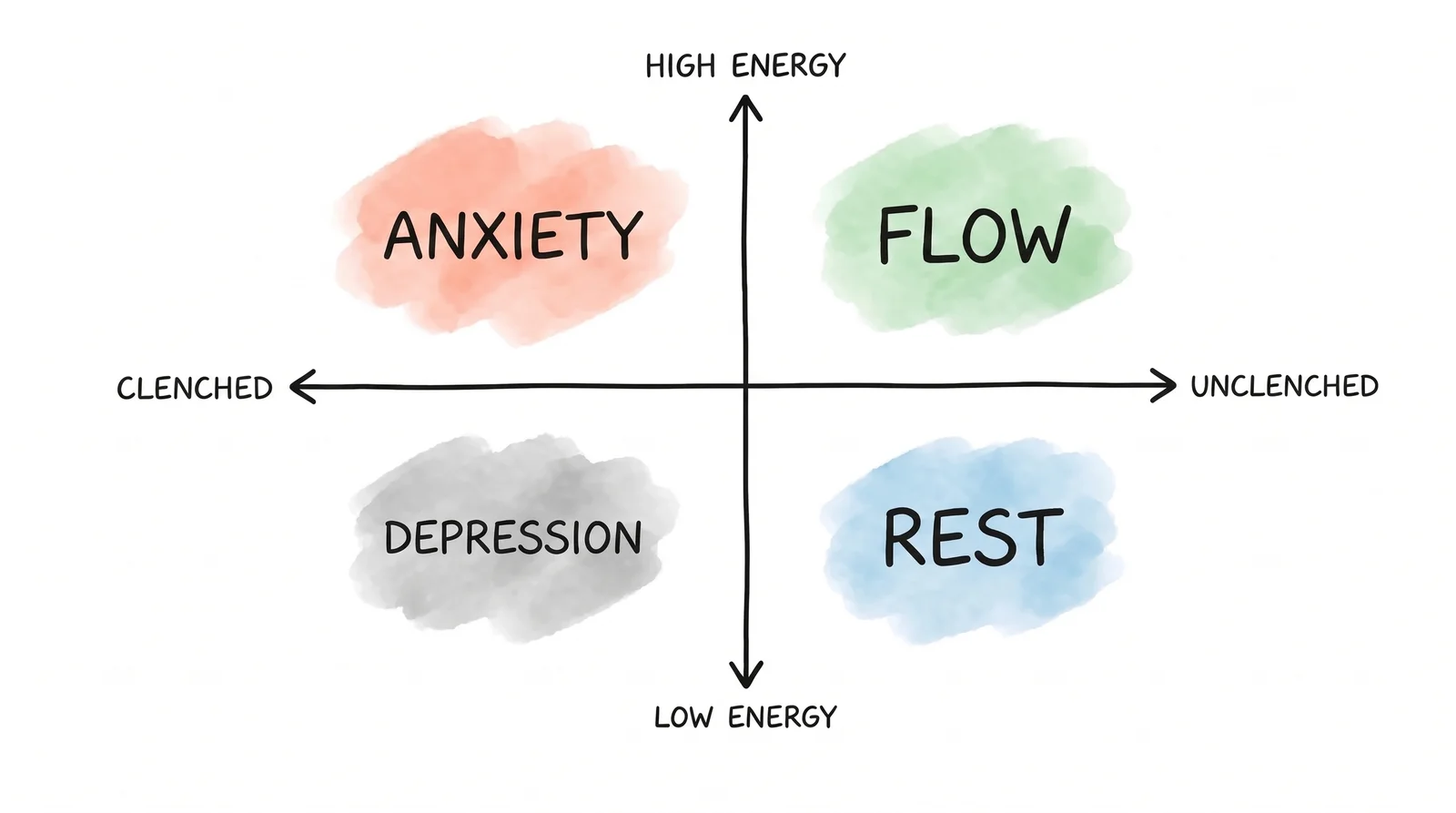
If you only take away one thing from this essay, let it be this: unclenching is a trainable skill. But perhaps not in the way that you think.
Unclenching is like falling asleep—you cannot force yourself to do it, but you can create the conditions for it to arise.
How do you create these conditions? By sending signals of safety to your nervous system
**In fact, the urge to unclench everything at once itself comes from a tightly clenched place (yes, it’s clenches all the way down).** (like!)
- Peter: different from recognition of open awareness.
- I asked a couple of questions:
- Q: what's the relationship between clenching and the Buddhist idea of grasping? Seem very close but not precisely the same.
- Answer was, they are about the same. OK.
- Q: is clenching always bad? Presumably it has some valid cognitive function. There is some energy behind it.
- I think this is answered in the essay.
- "knots in the energy body" – ? Some sanskrit name
- Taft: imaginal, sambotakaya (?), crosses mind-body boundary
- find the real sanskrit term and eli5
- Ask Claude
- There are actually two separate terms from your notes to unpack here — "knots in the energy body" and Taft's "sambotakaya." Here they are:
"Knots in the Energy Body" → Granthis (ग्रन्थि)
- Granthi is a Sanskrit word that translates as "knot."
- More specifically,
- it denotes "a difficult knot to untie" and refers to knotted areas of energy which can block the flow of prana in the body.
- ELI5: Imagine your life-force energy (prana) is water trying to flow up a hose. Granthis are kinks in the hose — spots where the hose is twisted by fear, attachment, or conditioning, and the water can't get through.
- The three granthis — Brahma Granthi, Vishnu Granthi, and Rudra Granthi — are three psychic knots situated in the astral body.
- They are located along the sushumna nadi, the central energy channel running from the base of the spine to the crown of the head — specifically the places where energy gets stuck or tied up so tightly that prana cannot ascend.
- In yoga, the three granthis are a silo of our complexes, unconscious fears, and mental/emotional/physical conditioning.
- These map very naturally onto what Jonny Miller is calling "clenching" — they are functionally the same idea: places where contraction and holding create a blockage.
Taft's "sambotakaya" → Saṃbhogakāya (संभोगकाय)
- Sambhogakāya is a Buddhist term that translates as "body of divine enjoyment" or "bliss body." It comes from sambhoga ("complete enjoyment") and kāya ("body").
- Sambhogakāya is one of the three bodies (trikāya), the other two being the non-physical dharmakāya (the truth body) and the physical nirmāṇakāya (the transformation body).
- ELI5: Buddhist philosophy says a fully enlightened Buddha has three "bodies" or modes of existence simultaneously:
- Dharmakāya — pure formless awareness, beyond space and time
- Saṃbhogakāya — a subtle, luminous "enjoyment body" that exists in a realm beyond ordinary human perception but isn't fully formless either
- Nirmāṇakāya — the ordinary physical body that walks around in the world (e.g., the historical Buddha)
- The Sambhogakāya is described as a "subtle body of limitless form."
- In the words of Chogyal Namkhai Norbu, it means the "body or dimension of wealth, the wealth being the infinite potentiality of manifestations of wisdom."
- Why Taft invoked it: He's pointing to the sambhogakāya as the ontological "layer" where phenomena like karmic knots and imaginal/subtle-body experience live — it's neither purely physical nor purely formless mind, which is why he said it "crosses the mind-body boundary." It's the middle tier of existence where things like energy-body architecture, archetypal imagery, and inner visions operate.
- Michael Levin mentioned. Donald Hoffman too.
- Peter: making friends with well-being (?)
I’m curious if the subtle-body architecture lives in the kamadhatu/desire realm or is it more the rupadhatu/form realm.
- annhilatory experiences as good. Making friends with the void mind-destroying ideae
- Peter: Bruce Tifts formalist panic (oh it was "formless panic", that is less interesting)
- ok need to know more about that
- Ask Claude
- Note: Peter said "formless panic" (not "formalist panic" — likely a transcription error in your notes).
- Here's the concept:
- Bruce Tift is a Western psychologist and longtime practitioner of Vajrayana Buddhism, based in Boulder, Colorado, who studied with Chögyam Trungpa Rinpoche.
- His central work integrates Buddhism with psychotherapy, laid out in his book Already Free.
- "Formless panic" is a key term in his framework.
- Intimacy with vulnerability opens into formless panic, and beyond that, into open experience without reference. It is specifically the raw, pre-conceptual dread that underlies our emotional strategies — and working with it means choosing to stay in contact with those sensations instead of fleeing into distraction or compulsive strategies.
- The core insight: the sensations we flee from — that raw panic beneath our emotional strategies — might actually be the texture of openness itself, filtered through a nervous system that reads groundlessness as threat.
- From a spiritual path point of view, anxiety can be seen as a very intelligent response to an accurate perception that there's no basis for claiming we are an actually existent, significant, continuing, objectively important self. And who isn't going to feel panic about that?
- His therapeutic method is "embodied immediacy": inviting people to stay embodied with the very real, legitimate panic that goes into our survival-level response, and see for themselves — does feeling like I'm going to be annihilated mean that I'm actually being harmed?
- The practice is counter-instinctual: we have to keep voluntarily doing the counter-instinctual work of taking ourselves into exactly what we've organized our life trying not to feel — over and over, maybe thousands of times. It's a long-term practice, but the goal isn't to get rid of those feelings; you just stop being so captured by them.
- The endpoint: relaxing our fundamental panic to the point where we can more and more frequently take the risk of just being present without knowing who we are, not knowing what we're doing.
- This connects tightly to what Peter was saying in the session — formless panic sits right at the intersection of clenching/unclenching and those "annihilatory experiences as good" notes you flagged.ic
- IFS is good for heady people